



|
Getting your Trinity Audio player ready...
|
By: Fern Sidman
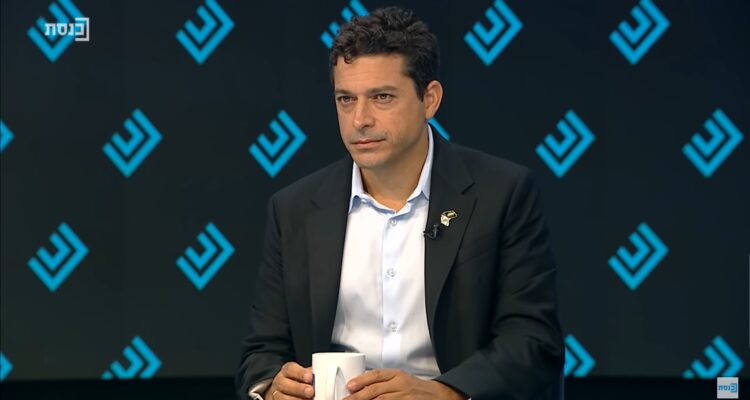
The fragile resumption of negotiations between Israel and Hamas, now anchored in President Donald Trump’s sweeping peace initiative, has drawn both cautious optimism and clear-eyed skepticism from Israeli officials. Diaspora Minister Amichai Chikli, speaking in an interview with Kan Reshet Bet on Sunday, emphasized that the very fact of renewed dialogue was a direct outcome of Israel’s persistence in Gaza City and its refusal to buckle under international pressure. As Israel National News (INN) reported on Sunday, Trump’s plan has introduced both hope for a possible ceasefire and new challenges over the geography of Israeli withdrawals and the scope of security guarantees.
“There are good foundations,” Chikli said. “First the hostages and then a withdrawal. We need to let the Prime Minister and the delegation do the work. If it weren’t for the stubbornness and the campaign in Gaza City, we wouldn’t have reached talks on the current outline.” His remarks reflect a broader consensus inside Israel that military leverage created the conditions for Hamas to even entertain Trump’s framework.
On Saturday night, Trump announced via Truth Social that Israel had confirmed an initial withdrawal line in the Gaza Strip, attaching a map that he said had already been shared with Hamas. “After negotiations, Israel has agreed to the initial withdrawal line, which we have shown to, and shared with, Hamas,” the president wrote. “When Hamas confirms, the Ceasefire will be IMMEDIATELY effective, the Hostages and Prisoner Exchange will begin, and we will create the conditions for the next phase of withdrawal, which will bring us close to the end of this 3,000 YEAR CATASTROPHE. Thank you for your attention to this matter and, STAY TUNED!”
The map, which quickly circulated in both Israeli and Arab media, delineates zones of Israeli withdrawal but leaves intact two critical positions: the Philadelphi Corridor—a narrow strip along the Egypt-Gaza border long regarded by Israel as indispensable for preventing weapons smuggling—and “Hill 70,” a strategic high ground overlooking Israeli territory. As INN emphasized in its analysis, these elements suggest that even as Israel negotiates withdrawals, it intends to preserve core strategic assets.
Why the Philadelphi Corridor Remains Israel’s Non-Negotiable Red Line
According to the information contained in the Israel National News report, the Philadelphi Corridor – which runs along Gaza’s southern border with Egypt—was singled out in the withdrawal map shared by Trump on Saturday as territory Israel insists on retaining control over, even as it contemplates broader concessions. Its inclusion reflects decades of bitter experience and underscores why Israeli officials consider it a non-negotiable element of any deal.
The Philadelphi Corridor traces back to the 1979 Egypt-Israel peace treaty, which created a narrow buffer zone between Gaza and Egypt under joint oversight. For Israel, the purpose was always clear: preventing cross-border weapons smuggling.
When Israel unilaterally disengaged from Gaza in 2005, control of the corridor passed to Egypt and the Palestinian Authority. Within months, smuggling tunnels multiplied. Hamas, which seized Gaza in 2007, transformed the zone into its lifeline—importing weapons, explosives, and funds through elaborate subterranean routes.
INN has frequently highlighted how these tunnels allowed Hamas to accumulate a rocket arsenal that reached Tel Aviv and Jerusalem, fueling cycles of conflict from Operation Cast Lead in 2008–09 to Protective Edge in 2014 and beyond.
Today, Israeli officials view the corridor as indispensable for preventing Hamas’s resurgence. As Trump’s plan envisions phased withdrawals and a hostage release, Israel is adamant that surrendering this border zone would undo any gains.
The military logic is straightforward: without physical control over the Gaza–Egypt border, Israel cannot guarantee that Hamas—or any successor force—will be denied the means to rearm. Even advanced surveillance, Egypt’s patrols, and international monitors have proven insufficient in the past.
A senior security official told INN that “the corridor is the oxygen pipe of Hamas. Without control of it, every agreement collapses within months.”
For Hamas, the corridor is equally critical—but for the opposite reason. As Kan Reshet Bet reported and the INN report indicated, Hamas negotiators balked when Trump’s map confirmed Israeli control. In their view, the corridor is essential not only for smuggling but also for asserting sovereignty. Ceding it would amount to accepting permanent Israeli encirclement of Gaza.
Thus, the corridor is not merely a tactical disagreement. It is a symbolic battleground that encapsulates the gulf between Israel’s demand for verifiable security and Hamas’s demand for unfettered autonomy.
Israel’s insistence is rooted in hard lessons. During Operation Protective Edge, the IDF uncovered over 30 cross-border tunnels, many linked to the Philadelphi Corridor. These tunnels enabled Hamas squads to attempt kidnappings and attacks deep inside Israeli territory. The operation revealed how smuggling infrastructure, once entrenched, could not be neutralized without enormous cost.
As the INN report pointed out in a retrospective analysis, even after the war, Hamas continued rebuilding its network. Only sustained pressure—including close surveillance of the corridor—reduced the flow of weaponry.
The corridor also connects directly to “Hill 70,” another zone Israel insists on retaining. From that vantage point, Israeli forces can observe and defend the border communities that were decimated in Hamas’s October 7 massacre. Taken together, the corridor and the hilltop form what military planners call a “defensive anchor.”
In peace talks, cartographic lines often blur. But for Israel, the Philadelphi Corridor is not a line on a map—it is the difference between security and vulnerability.
As the Israel National News report stressed, Israel may show flexibility on withdrawal zones deeper inside Gaza, but not on the southern border. Hamas’s refusal to accept this reality could stall negotiations in Sharm el-Sheikh before they even begin.
Trump’s initiative may yet yield progress on hostages and ceasefires. But without agreement on the Philadelphi Corridor, the pathway to lasting peace remains perilously narrow.
According to a report on Kan Reshet Bet, sources close to the talks revealed that Hamas has expressed serious reservations about the withdrawal map. While the terror organization has not formally rejected Trump’s plan, its negotiators reportedly balked at the idea of leaving the Philadelphi Corridor under Israeli control. Hamas has historically relied on this border zone to maintain smuggling routes from Egypt, which serve as lifelines for weapons, cash, and supplies.
The issue is expected to dominate the next round of discussions, scheduled to take place in Sharm el-Sheikh tomorrow. Egyptian officials, who have long played a dual role as both mediators and stakeholders in Gaza’s border arrangements, will host the negotiations.
As the Israel National News report noted, the friction over the map calls attention to the broader difficulty of achieving what Trump has called an “immediate ceasefire.” For Hamas, ceding control of key border points threatens its operational viability. For Israel, relinquishing them would mean exposing its citizens to renewed cross-border attacks.
As the INN report highlighted, the insistence on retaining these positions demonstrates that Israeli officials do not view Trump’s plan as a retreat but rather as a calibrated adjustment that secures strategic priorities while advancing the release of hostages.
For the families of the remaining 48 Israeli hostages, Trump’s plan represents perhaps the best opportunity in months for their loved ones’ release. Of those held, 20 are believed to be alive. The plan envisions their release as the opening step in the ceasefire process, tied to an exchange formula that Hamas has tentatively accepted “provided the field conditions for the exchange are met.”
Chikli’s emphasis on “first the hostages and then a withdrawal” captures the hierarchy of Israeli priorities. Any pause in combat, Israeli officials insist, must translate directly into the safe return of captives. As INN reported, negotiators are bracing for Hamas to seek more time regarding deceased hostages whose remains are in undisclosed locations, possibly demanding further IDF withdrawals before they are returned.
Trump’s framing of the negotiations—casting them as a pathway to ending a “3,000-year catastrophe”—reflects both his penchant for grand language and his attempt to appeal to historic narratives of Jewish suffering and Middle Eastern strife. His statements have been applauded by some Israelis as evidence of his alignment with their cause, though others caution that hyperbolic rhetoric risks inflating expectations.
Nevertheless, as the Israel National News report observed, Trump’s willingness to post detailed maps and ultimatums on social media is a marked departure from traditional diplomacy. It places both Israel and Hamas under immediate international scrutiny, raising the stakes for each side to be seen as constructive—or obstructionist.
The upcoming meeting in Sharm el-Sheikh could determine whether Trump’s framework gains momentum or falters under the weight of entrenched positions. Egyptian mediation will be critical. Cairo has long feared instability on its Gaza border and is wary of any arrangement that might embolden Hamas or undermine its own influence.
Israeli officials told INN that the talks will not only revisit the withdrawal map but also address broader questions: Who will govern Gaza once hostilities end? What guarantees exist that Hamas will not regroup? And how can humanitarian aid flow without strengthening terrorist infrastructure?
For Minister Chikli, the key message is one of patience. “We need to let the Prime Minister and the delegation do the work,” he said, stressing that Israel’s battlefield resilience had already reshaped the negotiating table. His remarks resonate with a public still divided between urgency for hostages’ release and determination not to sacrifice hard-won security gains.
The Israel National News report emphasized that the situation is deeply fluid. While Hamas’s conditional acceptance of Trump’s plan suggests progress, its resistance to ceding critical territory signals that negotiations could quickly stall. Meanwhile, Israel’s insistence on security control over border zones remains firm.
As the latest phase of negotiations unfolds, the Trump peace plan faces the same paradox that has defined decades of diplomacy in the Middle East: the tension between immediate humanitarian needs and long-term security imperatives. The hostages’ plight demands urgent action, yet the structural realities of Gaza’s borders, tunnels, and militant governance complicate every map line and every proposed withdrawal.
Chikli’s measured words remind Israelis that progress comes not only from diplomacy but from strength. “If it weren’t for the stubbornness and the campaign in Gaza City, we wouldn’t have reached talks on the current outline,” he insisted. His view, widely echoed in the Israel National News report, is that negotiations are not a substitute for military pressure but a product of it.
Whether Hamas will accept Trump’s map, or continue to hedge with conditions, remains uncertain. What is clear is that the coming days in Sharm el-Sheikh will test the viability of Trump’s bold gambit and the resolve of both Israel and its adversaries.
