



|
Getting your Trinity Audio player ready...
|
By: Tzirel Rosenblatt
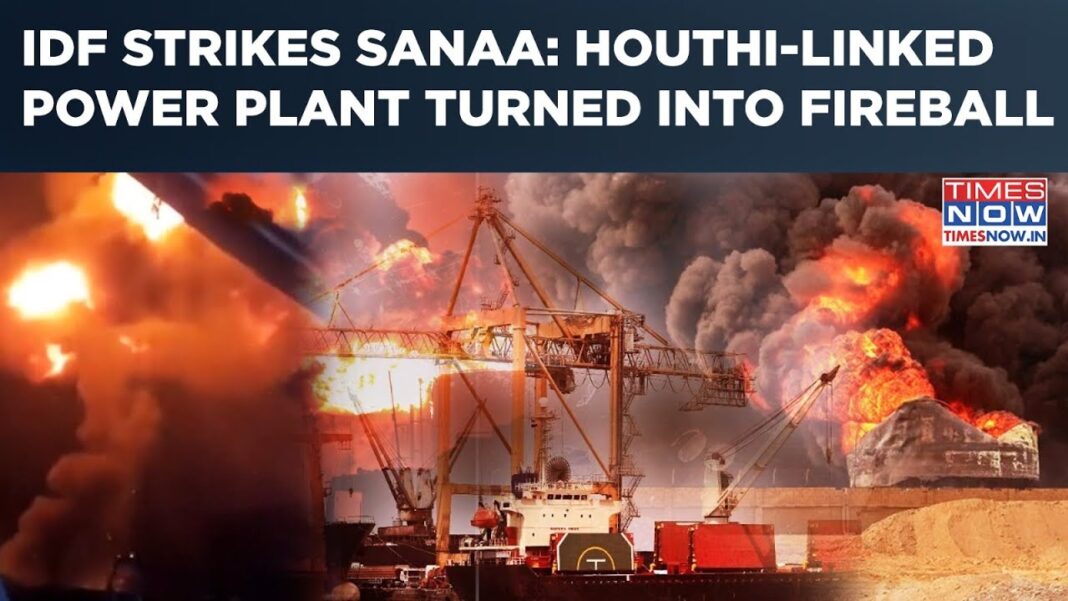
In the early hours of Sunday morning, the Israel Defense Forces (IDF) announced that it had carried out a far-reaching strike against what it termed a “terror infrastructure site” in the Saana region of Houthi-controlled Yemen. The operation, conducted from a distance of more than 2,000 kilometers from Israeli territory, underscored both the breadth of Israel’s military reach and its determination to neutralize threats originating far beyond its borders.
According to the official statement, the target was an energy infrastructure facility utilized by the Houthi regime—an Iranian-backed terrorist organization that has intensified its missile and drone campaign against Israel since the Hamas-orchestrated atrocities of October 7, 2023. The IDF said the strike was a direct response to repeated attacks on Israeli soil and maritime interests, including an unprecedented missile hit near Ben-Gurion International Airport on May 4, which sent shockwaves across the nation and highlighted the growing reach of the Yemeni group.
The Jewish News Syndicate (JNS), which has followed the escalation of hostilities closely, reported on Sunday that explosions were heard near a power plant in the Yemeni capital, indicating a successful Israeli strike against a target deep inside enemy territory.
Significantly, the strike appears to have been executed by the Israeli Navy, marking only the second time that naval forces have been employed against Houthi targets instead of the more commonly used air force. As the JNS report noted, the last such naval deployment occurred on June 10, when Israeli missile ships targeted what the IDF described as “terror targets” at the Houthi-controlled port of Hudaydah.
By utilizing naval capabilities, Israel demonstrated not only operational versatility but also the capacity to conduct long-range precision strikes across vast distances, a feat that further cements its reputation as one of the world’s most technologically advanced militaries. Naval missile ships, operating in coordination with intelligence assets, can provide Israel with a stealthier, harder-to-detect method of projecting force compared to traditional air sorties.
The reliance on naval platforms also suggests Israel’s intent to expand its strike envelope and complicate the strategic calculus for its adversaries, including both the Houthis and their Iranian sponsors.
The Houthis, formally known as Ansar Allah, have long functioned as a proxy of the Islamic Republic of Iran. Since October 7, when Hamas terrorists stormed southern Israel in a massacre that left more than 1,200 dead and saw hundreds taken hostage, the Houthis have dramatically stepped up their own campaign of aggression against the Jewish state.
As JNS has reported, these attacks have included ballistic missiles, cruise missiles, and drones launched at Israeli territory. In addition to the direct strike near Israel’s main international airport in May, the Houthis have attempted to strike southern Israel on numerous occasions, with many projectiles intercepted by Israeli and allied air defense systems.
The Houthis’ offensive is not confined solely to Israel. The group has also targeted international shipping lanes, particularly in the Red Sea and Gulf of Aden, seeking to disrupt global trade flows. As the IDF pointed out in its statement, the “terrorist regime exploits the maritime domain to project force and carry out terror activity against global shipping and trade routes.”
By positioning themselves as the vanguard of the so-called “axis of resistance,” the Houthis are extending Iran’s capacity to project power beyond the Levant and into the broader Middle East maritime theater.
In explaining its strike, the IDF emphasized that the Houthis’ “ongoing and repeated attacks” against Israel left it with no choice but to take action. “The Houthi terrorist regime operates under the direction and funding of the Iranian regime, in order to harm the State of Israel and its allies,” the IDF said. “The IDF will operate against the ongoing and repeated attacks by the Houthi terrorist regime, and remains determined to continue removing any threat to the State of Israel, wherever required.”
The JNS report shed light on the significance of this statement, noting that it reflects a broader Israeli doctrine of preemption: Israel will not wait for threats to materialize fully before neutralizing them. Instead, it is willing to strike thousands of kilometers away to ensure the safety of its citizens and its global interests.
For analysts, the IDF’s operation cannot be viewed in isolation. Rather, it is part of a larger strategic contest with Iran, which has carefully cultivated and armed the Houthis as a regional proxy. By providing advanced missile and drone technology, Tehran has enabled the Yemeni group to extend its influence well beyond the Arabian Peninsula.
As JNS has reported, Iran’s strategy involves multi-front pressure on Israel: Hamas in Gaza, Hezbollah in Lebanon, Shi’a militias in Iraq and Syria, and the Houthis in Yemen. Each of these actors is intended to pin down Israeli resources and create a sense of encirclement.
The strike in Saana is therefore not only an attack on Houthi assets but also a signal to Tehran that Israel is prepared to disrupt the Iranian proxy network wherever it operates. It is a reminder that geographic distance offers no immunity from Israeli retaliation.
The decision to employ the navy in this operation reflects broader transformations within the IDF. Traditionally seen as the smallest branch of Israel’s armed forces, the Navy has increasingly emerged as a strategic asset capable of projecting power beyond Israel’s immediate borders.
The June 10 attack on Hudaydah marked a turning point, illustrating the navy’s role in Israel’s expanding campaign against Iran and its proxies. The latest strike in Saana reinforces this trajectory, showing that the navy is no longer confined to coastal defense or anti-smuggling operations but can serve as a long-range strike force in its own right.
This evolution also calls attention to the growing importance of maritime domains in modern conflict. With the Houthis threatening shipping lanes vital to international trade, naval assets provide Israel with a tool to counter aggression at sea and onshore.
The IDF’s strike reverberates far beyond the immediate theater of conflict. By targeting an energy infrastructure site, Israel has sent a message to both the Houthis and their Iranian patrons: aggression will come at a cost not only in military terms but also in economic disruption.
As the JNS report observed, attacks on infrastructure resonate with global stakeholders, from oil markets to shipping companies, who are directly affected by instability in Yemen. With the Red Sea serving as a critical artery for global commerce, ensuring its security has become a matter of international concern. Israel’s strike, while aimed at deterring attacks against itself, also indirectly aligns with broader Western interests in maintaining secure trade routes.
Nevertheless, the strike carries risks. Targeting deep inside Yemen could escalate the conflict, provoking further retaliation by the Houthis and possibly triggering a broader confrontation with Iran. For Israel, however, the calculation appears to be that deterrence requires assertive action. Failure to respond robustly might embolden the Houthis and their backers, creating an even greater long-term threat.
Israel’s message is clear: distance will not shield aggressors from retribution, and proxies acting under Iranian sponsorship will be treated as extensions of Tehran’s military apparatus.
The IDF has not provided further details on the scale of the damage inflicted in Saana, but the symbolic and strategic implications are already evident. For the Houthis, the strike represents a significant blow, demonstrating Israel’s ability to penetrate their defenses and target critical infrastructure at will. For Iran, it is a warning shot that its proxy strategy remains vulnerable to Israeli disruption.
As Israel continues to grapple with challenges on multiple fronts—from Gaza to Lebanon, Syria, and beyond—the operation in Yemen underscores the breadth of the conflict and the determination of the Jewish state to safeguard its citizens.
The IDF’s long-range strike on a Houthi infrastructure site in Yemen represents a bold projection of Israeli power, both militarily and symbolically. Conducted from 2,000 kilometers away, it signals Israel’s refusal to be constrained by geography or by the growing network of Iranian-backed proxies arrayed against it.
For Israel the conflict with the Houthis is not an isolated skirmish but part of a larger regional confrontation with Iran’s destabilizing ambitions. The strike in Saana sends a clear message: Israel will act decisively against threats wherever they originate, and the IDF’s reach extends as far as necessary to protect the state and its people.
