



|
Getting your Trinity Audio player ready...
|
By: Fern Sidman
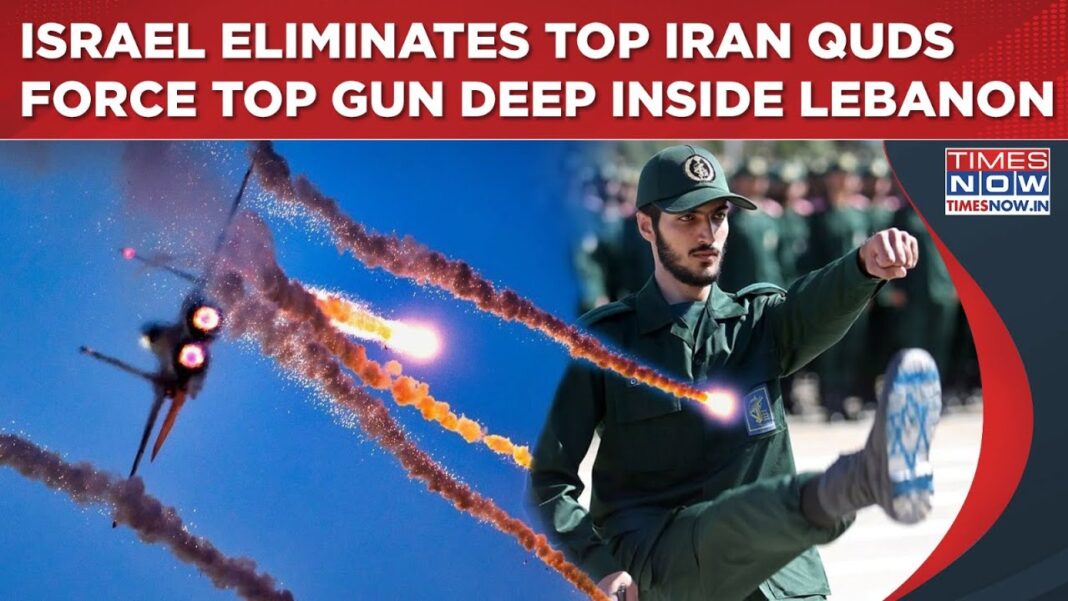
In the opaque and often deadly contest unfolding just beyond Israel’s northern frontier, a decisive strike this week underscored both the intensity and the precision of Israel’s long-running campaign against Iranian-backed terrorism. As reported on Thursday at VIN News, the Israel Defense Forces (IDF), acting in close coordination with Israel’s domestic security agency, the Shin Bet, announced on Thursday that they had eliminated a senior operative of Iran’s Islamic Revolutionary Guard Corps (IRGC) Quds Force in southern Lebanon.
The target, Hussein Mahmoud Marshad al-Jawhari, was described by Israeli security officials as a key terrorist figure within Unit 840—the clandestine operational arm of the Quds Force tasked specifically with orchestrating attacks against Israel beyond Iran’s borders. According to the joint IDF–Shin Bet statement cited by VIN News, al-Jawhari was killed earlier in the day in the Ansariyah area of southern Lebanon, a region long exploited by Iranian proxies as a staging ground for hostile activity against the Jewish state.
This latest operation, while tactical in execution, carries strategic resonance. It reflects Israel’s continued determination to confront Iranian terror networks not only at its borders but wherever they take root, whether in Syria, Lebanon, or beyond. As VIN News reported, Unit 840 has emerged in recent years as one of Tehran’s most dangerous instruments—designed to operate in the shadows, recruit local assets, and execute deniable attacks that advance Iran’s regional ambitions while maintaining a veneer of plausible deniability.
Israeli officials made clear that al-Jawhari was not a peripheral figure. According to the information provided in the VIN News report, he had been actively involved over the past several years in planning and advancing terrorist attacks against Israeli targets, operating from both Syrian and Lebanese territory. His activities were conducted under direct IRGC auspices and aligned with Iran’s broader strategic objective of encircling Israel with hostile forces capable of striking at short notice.
Unit 840, to which al-Jawhari belonged, is reportedly headed by Asghar Baqeri, with Mohammad Reza Ansari serving as his deputy. The unit functions as the Quds Force’s external operations branch, responsible for recruiting operatives, facilitating logistics, and directing terror plots against Israeli civilians and security forces alike. Unit 840 has been linked to attempted kidnappings, bombings, and assassination plots targeting Israelis both inside and outside the Middle East.
The elimination of a senior Unit 840 operative on Lebanese soil therefore represents more than a single tactical success. It signals a disruption of Iran’s operational continuity and a clear warning to those embedded within its terror infrastructure that geographic distance offers no immunity.
The choice of location is also significant. Southern Lebanon has long functioned as a forward operating base for Iranian-backed militias, most notably Hezbollah, but also for IRGC personnel operating under various guises. As VIN News has consistently reported, Israel views Iranian entrenchment in Lebanon as an intolerable strategic threat—one that could open an additional front in any future regional conflict.
While the IDF did not release operational details regarding the method used to eliminate al-Jawhari, Israeli security doctrine has emphasized precision and intelligence superiority. Joint operations between the IDF and Shin Bet rely heavily on real-time intelligence, surveillance capabilities, and an intricate understanding of enemy networks. Israeli officials have repeatedly stressed that such operations are conducted only after exhaustive verification, with the explicit goal of neutralizing imminent threats.
In their joint statement, the IDF and Shin Bet said they “view with great severity any attempt by the Iranian regime and its proxies to advance terror plans,” adding that Israel will “continue to act to remove threats against the State of Israel.” The language reflects a long-standing Israeli policy of deterrence through action—responding not with rhetoric alone, but with decisive measures that impose tangible costs on hostile actors.
This approach has been a defining feature of Israel’s security posture in recent years, particularly as Iran has sought to expand its influence across the Levant. Tehran’s strategy of operating through proxies and covert units such as Unit 840 is intended to stretch Israel’s defenses and complicate attribution. Yet, as the VIN News report observed, Israel has repeatedly demonstrated its ability to pierce that veil, holding Iranian operatives directly accountable.
The killing of al-Jawhari occurs against a backdrop of heightened regional tension. Iran’s Quds Force, long the spearhead of its extraterritorial operations, has faced sustained pressure from Israeli actions aimed at curbing weapons transfers, dismantling command networks, and deterring escalation. Each such strike, while localized, reverberates across the broader Middle Eastern chessboard.
Analysts cited by VIN News note that Israel’s actions are calibrated to avoid unnecessary escalation while firmly asserting red lines. By targeting a senior operational figure rather than lower-level proxies, Israel sends a message not only to Hezbollah and allied militias, but directly to Tehran: efforts to plan and execute attacks on Israel will be met with precise and uncompromising force.
Despite the success of Thursday’s operation, Israeli officials are under no illusion that the threat has been eliminated entirely. The IRGC’s Quds Force remains deeply embedded across multiple theaters, and Unit 840 continues to operate under new commanders and evolving tactics. As VIN News has emphasized in its coverage, Israel’s campaign against Iranian terror networks is not a single battle but a sustained and adaptive effort.
Still, the removal of Hussein Mahmoud Marshad al-Jawhari represents a meaningful disruption—one that may delay or prevent planned attacks and force Iran’s operatives to reconsider their assumptions about safety and anonymity.
In the shadow war that defines much of the modern Middle East, moments like these rarely unfold in isolation. They are chapters in a larger narrative of deterrence, intelligence dominance, and national defense. Israel has made clear that when it comes to confronting Iran’s terror apparatus, vigilance is permanent, and resolve is non-negotiable.
There should be a world-wide effort. Israel alone cannot do this.
Israel can do it alone. Israel just needs the determination of the Irgun and the Maccabees and give ‘world opinion’ the finger.