



|
Getting your Trinity Audio player ready...
|
By: Fern Sidman
In a stark escalation of military activity along the volatile Israeli-Lebanese border, the Israel Defense Forces (IDF) confirmed on Wednesday its first ground incursions in months into southern Lebanon, signaling renewed efforts to dismantle Hezbollah’s entrenched presence amid mounting international pressure to enforce a fragile cease-fire and disarm the Iran-backed militant group.
As reported by The New York Times on Wednesday, Israeli military officials stated that “targeted operations” had uncovered and destroyed Hezbollah infrastructure inside Lebanese territory. While the precise timing of the raids was not disclosed, footage released by the IDF depicted soldiers conducting nighttime operations, further underscoring the sensitive nature of this strategic campaign.
These incursions follow months of intensified Israeli airstrikes against Hezbollah positions across southern Lebanon — part of an effort to degrade the group’s capabilities without reigniting a full-scale war. But the latest operations mark a departure from that policy of containment, with Israeli ground forces now moving across the border to confront Hezbollah’s entrenched infrastructure directly.
According to the information provided in The New York Times report, fears are rapidly growing in diplomatic circles that the truce negotiated in November — following the region’s deadliest conflict in decades — may be unraveling.
The cease-fire came after a 2023 war sparked by Hezbollah’s entry into the broader conflict between Israel and Hamas in Gaza. The group launched attacks on Israel in solidarity with Hamas, whose Iranian-backed operatives had carried out the October 7 massacre that killed more than 1,200 Israelis. In retaliation, Israel opened a second northern front, unleashing a campaign that claimed approximately 4,000 lives in Lebanon and left vast swaths of the country in ruins.
While Hezbollah has not responded militarily to the recent Israeli escalations, the silence is not being interpreted as submission. Rather, it reflects the group’s weakened posture following its heavy losses and the growing pressure from both internal and external actors.
As The New York Times reported, the United States and Israel are leveraging this moment of vulnerability to push harder for Hezbollah’s total disarmament — a longstanding point of contention in Lebanese politics and one of the central conditions of the cease-fire agreement.
Leading the diplomatic push is Thomas J. Barrack Jr., President Trump’s trusted Middle East envoy, who arrived in Beirut on Monday with a clear mandate: accelerate Hezbollah’s demilitarization. Mr. Barrack’s visit came on the heels of an Israeli aerial offensive targeting suspected Hezbollah caches in southern and eastern Lebanon — strikes that Lebanese officials viewed as an overt message to both Hezbollah and Beirut.
In meetings with Lebanese President Joseph Aoun, Mr. Barrack delivered a formal U.S. proposal — authored by Secretary of State Marco Rubio — outlining a “road map” for Hezbollah’s disarmament. While the seven-page document remains confidential, Barrack told reporters he was “unbelievably satisfied” with the Lebanese government’s initial response.
“Both countries are trying to give the same thing: the notion of a stand-down agreement, of the cessation of hostilities, and a road to peace,” Barrack said, according to The New York Times report.
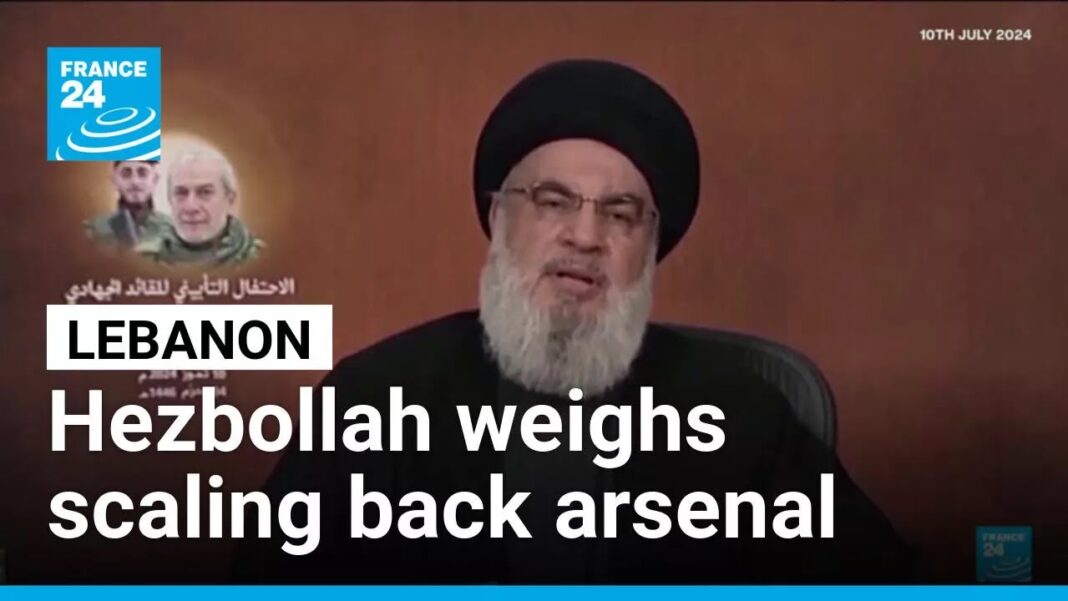
But the path ahead is riddled with complications. Hezbollah’s disarmament is a red line for the group, which has long claimed its arsenal is essential to resisting Israeli aggression. In a speech on Sunday, Hezbollah’s deputy leader Naim Qassem declared, “How can anyone expect us not to stand firm?” — a clear rejection of the notion that the group would lay down its weapons while Israeli strikes continue.
That stance sheds light on a central paradox of the current moment. While Lebanon’s new government has made modest progress in asserting state authority — dismantling hundreds of non-state military sites since the cease-fire began — there remains no timeline for full Hezbollah demilitarization. As The New York Times report pointed out, Hezbollah remains the country’s most formidable armed group, more powerful than the Lebanese Armed Forces and deeply embedded in Lebanon’s political and social fabric.
Its grip, however, is slipping.
The past year has seen Hezbollah lose top commanders and key weapons systems in Israeli strikes. Its ability to rearm has also been diminished by the collapse of Syria’s Assad regime, once a crucial land corridor for Iranian-supplied weaponry. Iran itself, Hezbollah’s primary patron, is facing domestic and international turmoil following unprecedented joint Israeli-U.S. attacks on its nuclear infrastructure, further isolating Hezbollah from external support.
Yet, despite this vulnerability, the threat of renewed violence looms large. According to Lebanon’s health ministry — cited by The New York Times — more than 250 people have died in Israeli strikes since the cease-fire began. That figure includes civilians and terrorists, though the government has not published a breakdown.
The fragile nature of the current truce is perhaps most clearly illustrated by Israel’s decision to retain five military positions along the Lebanese border — a direct violation of the agreement’s terms. Israel argues that Hezbollah has itself violated the deal by maintaining an armed presence in the area, a claim the group denies. Hezbollah says it has fully withdrawn from southern Lebanon.
Thomas Barrack, echoing frustrations in both Washington and Jerusalem, called the truce “a total failure,” highlighting the urgent need for a more robust and enforceable framework. His statement comes amid a wave of diplomatic urgency: if the cease-fire collapses, regional leaders fear Lebanon could spiral into yet another prolonged war.
For Israel, the strategy is clear. By combining targeted ground operations with intense diplomatic pressure, it seeks to tilt the balance of power in Lebanon — isolating Hezbollah politically while diminishing its military capabilities on the ground.
For Hezbollah, the stakes are existential. Its historical justification as Lebanon’s “resistance” force is losing credibility amid growing internal opposition and fatigue from perpetual conflict. Meanwhile, its traditional patrons are either embattled or withdrawing, leaving the group increasingly isolated.
As The New York Times noted in its analysis, the current inflection point presents both danger and opportunity. Should the U.S.-brokered disarmament proposal gain traction, it could mark the beginning of a new phase in Lebanese statehood — one in which all weapons are finally brought under the control of Beirut.
Yet if Hezbollah chooses confrontation over compromise, it risks drawing Lebanon into another catastrophic war, one from which neither the group — nor the country it claims to defend — may recover.
In this moment of uncertainty, Israel’s ground incursions are not merely tactical maneuvers. They are signals — to Hezbollah, to Lebanon, and to the world — that the status quo is no longer acceptable. Whether this leads to resolution or renewed bloodshed remains to be seen.
