




|
Getting your Trinity Audio player ready...
|
By: Fern Sidman
On the eve of his first official visit to Washington since assuming office in November, Israeli Foreign Minister Gideon Sa’ar made a profoundly symbolic stop in Queens, New York. On Tuesday, Sa’ar visited the Ohel, the resting place of Rabbi Menachem Mendel Schneerson, the Lubavitcher Rebbe of righteous memory, whose teachings and vision have inspired generations of Jews worldwide.
The Ohel, regarded as the most visited Jewish sacred site in North America, annually draws close to a million visitors who seek solace, guidance, and spiritual renewal. Sa’ar’s decision to begin his American itinerary at this revered site carried with it both personal and national resonance, highlighting the enduring bond between Israel’s state leadership and the spiritual foundations of Jewish continuity.
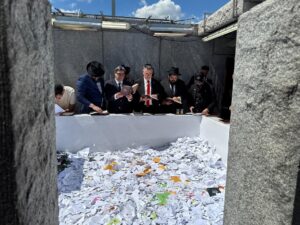
At the Ohel, the Foreign Minister was warmly received by Rabbi Mendy Kotlarsky, a senior figure at Chabad World Headquarters and director of the International Conference of Chabad Emissaries (Kinus HaShluchim).
Rabbi Kotlarsky welcomed Sa’ar not merely as a statesman but as a representative of the Jewish people whose responsibilities extend beyond politics into the preservation of identity, faith, and community. As part of the visit, Kotlarsky also sounded the shofar, the traditional ram’s horn associated with the Jewish month of Elul. Its piercing call imbued the moment with a sense of urgency and reflection, as Jews worldwide prepare spiritually for the High Holidays.
Standing in quiet reverence, Sa’ar recited Psalms at the Rebbe’s resting place. His prayers were wide-ranging yet deeply connected to the pressing realities Israel faces today.
He prayed for the success of his mission in Washington, where he is expected to engage in high-level talks with American officials on issues ranging from security coordination to diplomatic initiatives in the Middle East.
He remembered the hostages still held by Hamas, calling for their safe return.
He prayed for the well-being of Israel’s soldiers, many of whom remain deployed in ongoing operations.
He also offered prayers in memory of the fallen, whose sacrifices continue to shape Israel’s resilience and resolve.
By weaving these intentions together, Sa’ar anchored his diplomatic mission within a framework of faith and collective memory, reflecting the interdependence of Israel’s political struggles and spiritual fortitude.
Sa’ar used the occasion to reflect on the Rebbe’s enduring vision, which he described as both universal and profoundly personal. The Lubavitcher Rebbe, who passed away in 1994, is remembered for his boundless care for every Jew and for establishing a network of Chabad emissaries (Shluchim) now present in 111 countries.
“The most important thing is to strengthen Jewish education. It is the most critical key to protecting the Jewish people,” Sa’ar said, echoing one of the Rebbe’s central teachings: that continuity is secured not only through defense and diplomacy but through education and identity.
The Foreign Minister also inquired after the well-being of Chabad’s emissaries around the world. He mentioned his recent visit to Zambia, where he personally met with the local Chabad representative, noting how vital such figures are in sustaining Jewish life in remote and challenging environments.
Chabad today represents the largest Jewish communal infrastructure in the world, serving Jews across continents and contexts, from major metropolitan centers to isolated outposts.
This global network of emissaries functions not merely as religious leaders but as lifelines of Jewish continuity, often stepping in to support communities in moments of crisis, whether during natural disasters, political upheaval, or acts of terror.
By acknowledging this network during his visit, Sa’ar underscored the partnership between the State of Israel and Chabad in ensuring that Jewish life not only survives but flourishes across the globe. The Foreign Ministry, he noted, collaborates closely with Chabad to provide logistical, diplomatic, and occasionally security support for Jewish communities facing difficulties abroad.
Sa’ar was accompanied at the Ohel by Ofir Akunis, Israel’s Consul in New York, and Igor Tulschinsky, a noted visionary partner of Chabad whose philanthropic and strategic support has helped expand the movement’s global reach. Their presence highlighted the synergy between diplomacy, communal leadership, and philanthropy in safeguarding Jewish continuity.
That the visit took place during Elul, the month of introspection leading up to Rosh Hashanah and Yom Kippur, added further weight to the moment. Rabbi Kotlarsky’s sounding of the shofar served as a reminder of the Jewish imperative to return, reflect, and renew. For Sa’ar, about to engage in a high-stakes mission in Washington, the act symbolized both a personal and collective summons to courage, clarity, and commitment.
Gideon Sa’ar’s visit to the Ohel, ahead of his critical diplomatic engagements in Washington, illuminates the deep interplay between Israel’s political leadership and the spiritual heritage of its people. By seeking inspiration at the resting place of the Rebbe, Sa’ar signaled that Israel’s foreign policy is not detached from Jewish continuity but grounded in it.
The Foreign Minister’s prayers encompassed not only his own diplomatic mission but the broader struggles of the Jewish people—hostages in captivity, soldiers in harm’s way, and communities striving for strength worldwide.
For Chabad, and for the millions of Jews who look to the Ohel as a source of inspiration, the visit reaffirmed the enduring relevance of the Rebbe’s teachings. For Israel, it demonstrated that its leaders recognize education, identity, and spiritual resilience as critical components of national survival, alongside defense and diplomacy.
