



|
Getting your Trinity Audio player ready...
|
By: Fern Sidman
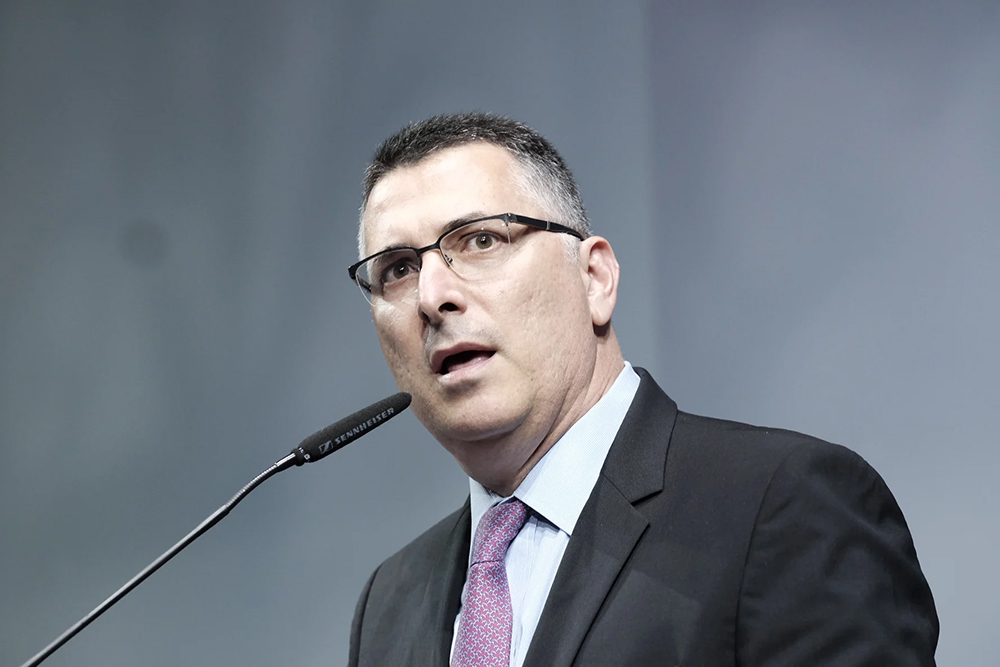
In a firmly worded statement delivered alongside a visiting Newsmax delegation in Jerusalem on Wednesday, Israeli Foreign Minister Gideon Sa’ar declared that Israel “will not allow” the establishment of a Palestinian state on its territory. The remarks, reported extensively by Newsmax, underscore Israel’s rejection of renewed international efforts to promote a two-state solution based on the 1967 borders.
Israel “will not allow” its land to be used for the creation of a Palestinian state, Foreign Minister Gideon Sa’ar said Wednesday. https://t.co/FCdXkOSRbE
— NEWSMAX (@NEWSMAX) August 13, 2025
Speaking while seated next to Newsmax CEO Christopher Ruddy, who led the delegation of journalists to Israel, Sa’ar said that countries advocating for a Palestinian state should consider creating one within their own borders.
“A Palestinian state in the heart of the land of Israel would indeed be a solution — a solution for those seeking to destroy us,” Sa’ar said, according to coverage cited by Newsmax. “We will not allow that to happen.”
The foreign minister pointed to large nations such as France and Canada, suggesting that if they truly wished to see a Palestinian state, they could allocate territory from their own land. “They have plenty of space,” Sa’ar remarked. “But here, in the land of Israel, it will not happen.”
As reported by Newsmax, Sa’ar stressed that the creation of a Palestinian state on land currently controlled by Israel would jeopardize the country’s security. He warned that such a move would “endanger Israel’s major population centers” and force the country back to “indefensible boundaries.”
“The establishment of a Palestinian state within the 1967 lines, with its capital in East Jerusalem — a short distance from here — would place Israel’s population centers in grave danger and push Israel back to indefensible borders,” Sa’ar said. “Such a move would be suicidal.”
The 1967 lines, often referred to as the Green Line, trace back to the armistice agreements of 1949 between Israel and its neighbors following the War of Independence. In the Six-Day War of 1967, Israel captured the Sinai Peninsula, the Gaza Strip, Judea and Samaria, East Jerusalem, and most of the Syrian Golan Heights, dramatically shifting the regional map.
During the meeting, Sa’ar gave the Newsmax delegation a strategic overview of Israel’s security landscape, outlining the threats that he argues would be exacerbated by the establishment of a Palestinian state under current conditions. According to Newsmax’s reporting, the foreign minister detailed the close proximity of the proposed state’s potential capital to central Israeli cities, the vulnerability of transport routes, and the exposure of densely populated regions to hostile fire.
He reiterated that Israel’s stance is shaped not only by historical precedent but also by the present-day realities of missile ranges, regional instability, and the operational presence of armed groups in adjacent territories.
Before his meeting with Ruddy and the delegation, Sa’ar also appeared on Carl Higbie FRONTLINE, a Newsmax program, in an interview scheduled to air at 5 p.m. ET Wednesday. In that discussion, he addressed the same core themes, emphasizing that no diplomatic process can override the existential risks posed by hostile entities operating near Israel’s borders.
Sa’ar’s comments to Higbie, as highlighted by Newsmax, reinforced his message that “territorial concessions without full guarantees of demilitarization and security control” would be untenable.
Sa’ar’s statements come amid renewed calls from various world capitals for a two-state solution as part of a broader resolution to the Israeli-Palestinian conflict. Leaders from France, Canada, and other nations have recently reiterated support for the creation of a Palestinian state within the parameters of the 1967 borders, with East Jerusalem as its capital.
The report at Newsmax noted that Sa’ar dismissed these appeals as unrealistic and dangerously naive, particularly given the current geopolitical climate and the history of failed negotiations. He also emphasized that Israel will not accept arrangements that undermine its defensive capabilities, regardless of the diplomatic pressure applied.
The debate over a Palestinian state within the 1967 lines has been a central feature of the peace process discourse for decades. While the framework is supported by much of the international community, successive Israeli governments have expressed concerns over security, the status of Jerusalem, and the right of return for Palestinian refugees.
As Newsmax has frequently reported, Israeli officials argue that territorial withdrawals in the past — such as the 2005 disengagement from Gaza — have not produced peace but instead led to increased instability and attacks against Israeli civilians. Sa’ar’s comments fit squarely within this longstanding policy approach.
The foreign minister’s unequivocal rejection of a Palestinian state on Israeli land signals that any renewed international push for a two-state solution will face entrenched opposition from Jerusalem. As reported by Newsmax, Sa’ar’s position reflects not only the stance of the current government but also a broad consensus among many Israelis who view territorial concessions as a direct threat to national survival.
By delivering his message in the presence of a high-profile American media delegation, Sa’ar ensured that his words would resonate beyond Israel’s borders. The involvement of Newsmax CEO Christopher Ruddy and the planned broadcast of his interview on Carl Higbie FRONTLINE underscores the foreign minister’s intention to communicate Israel’s position directly to U.S. audiences, particularly those engaged in the ongoing debate over Middle East policy.
