



|
Getting your Trinity Audio player ready...
|
By: Fern Sidman
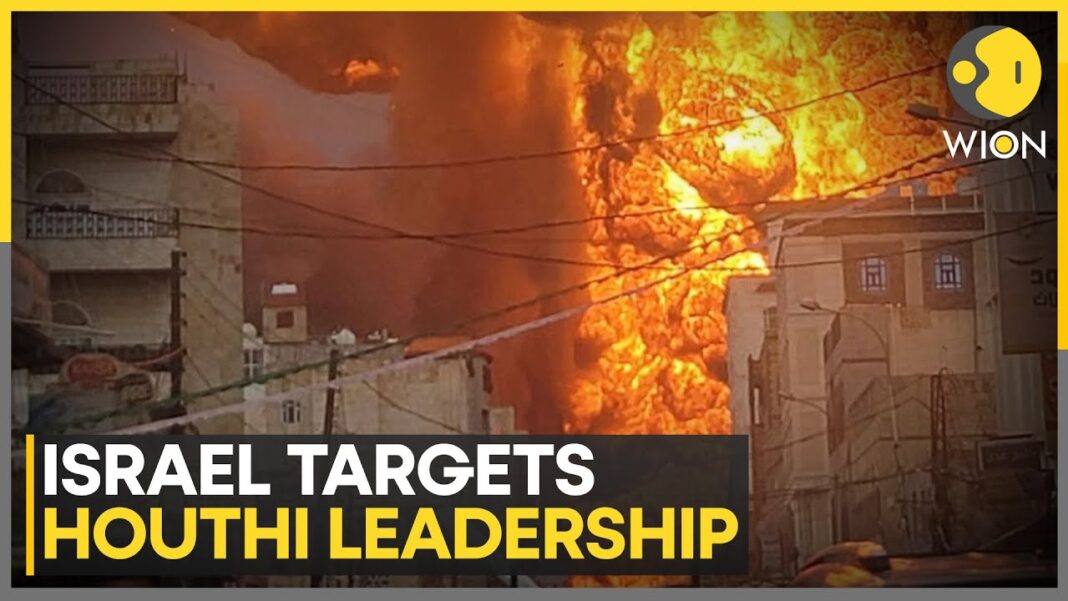
The Israeli Air Force (IAF) carried out a dramatic wave of strikes in Sanaa, the capital of Yemen, on Thursday evening, targeting what defense officials described as a high-level meeting of the Iranian-backed Houthi movement’s political and military leadership. The strikes, which coincided with a televised address by the group’s leader Abdul-Malik al-Houthi, represent one of Israel’s boldest operations in Yemen since the outbreak of the current war and underline the country’s expanding battlefront against Iran’s regional proxies.
According to a report on Thursday on the Israel National News (INN) website, the Israeli Defense Forces (IDF) confirmed that it struck “a Houthi terrorist regime military target in the area of Sanaa.” Military sources described the target as a secure site where senior figures were convening, a meeting likened to a cabinet session blending military commanders and ministers. One defense official told reporters, “We estimate that we succeeded,” suggesting that among the casualties were the Houthi Defense Minister and the group’s Chief of Staff.
Though unconfirmed, reports indicate that the Chief of Staff had been recovering from injuries sustained in an earlier Israeli strike. The group’s leader, Abdul-Malik al-Houthi, was apparently not present, sparing him from the attack.
In a formal statement carried by Israel National News, the IDF emphasized that the Houthis have acted as an extension of Iranian policy since the beginning of the Gaza war in October 2023, engaging in operations designed to destabilize Israel and threaten international shipping lanes.
“The Houthi terrorist organization has been operating under the Iranian direction and funding in order to harm the State [of Israel] and its allies since the beginning of the war, undermining regional stability and disrupting global freedom of navigation,” the IDF said.
It added pointedly: “The IDF is operating decisively against the Houthi terrorist regime, while simultaneously intensifying strikes against the Hamas terrorist organization in Gaza, and will continue to act to remove any threat to the citizens of the State of Israel.”
The strike was approved at the highest echelons of the Israeli government. Defense Minister Israel Katz, IDF Chief of Staff Lt.-Gen. Eyal Zamir, and the senior IDF command conferred directly with Prime Minister Benjamin Netanyahu before authorizing the operation. Katz, known for his blunt rhetoric, later declared:
“As we warned the Houthis in Yemen, after the Plague of Darkness comes the Plague of the Firstborn. Whoever raises a hand against Israel — his hand will be cut off.”
The biblical imagery underscored Israel’s intent to demonstrate both resolve and deterrence, signaling to adversaries across the region that attacks on Israeli territory will carry a steep price.
Thursday’s attack marked the second Israeli strike in Yemen this week, part of what appears to be a sustained campaign against the Houthis’ military infrastructure and leadership.
On Sunday, 14 Israeli fighter jets carried out coordinated strikes on Houthi military assets in the Sanaa area, dropping an estimated 40 munitions. Targets included a military complex housing the presidential palace, as well as the Asar and Hizaz power plants—facilities that the IDF said provided crucial electricity for Houthi military operations. A fuel storage site used by Houthi forces was also destroyed.
As INN reported, the IDF justified Sunday’s strikes as a direct response to repeated Houthi missile and drone launches against Israeli territory. In recent weeks, the Houthis have claimed responsibility for firing surface-to-surface missiles and armed UAVs toward Israel, most of which were intercepted but some of which landed in southern Israeli communities.
“The presidential palace in the Sanaa area is located within a military site from which the military forces of the Houthi terrorist regime operate,” the IDF stated at the time. “In addition, the Hizaz and Asar power plants, which served as a significant electricity supply facility for military activities, were struck.”
Thursday’s operation appears to have gone further than degrading infrastructure by directly targeting the Houthis’ command structure. According to defense officials cited by INN, the meeting that was struck included some of the group’s most senior figures, including ministers and military leaders responsible for directing operations against Israel.
Foreign reports suggested that the IAF struck a “safe house” in which these officials had been sheltering. The Hezbollah-affiliated channel al-Mayadeen claimed that over ten Israeli strikes hit multiple sites in the capital, underscoring the scale of the operation.
If confirmed, the elimination of the Houthi Defense Minister and Chief of Staff would represent a significant blow to the group’s operational capacity. However, as the INN report noted, the absence of Abdul-Malik al-Houthi himself means the group retains its symbolic leadership, ensuring that the Houthis’ ideological direction remains unchanged.
The Houthis, who seized control of Yemen’s capital in 2014, have long been backed by Iran, which supplies them with weapons, funding, and training. Since Israel’s war against Hamas began in Gaza, the Houthis have positioned themselves as part of the so-called “axis of resistance,” alongside Hezbollah in Lebanon and Shi’a militias in Iraq and Syria.
INN has repeatedly emphasized that the Houthis’ actions are not merely local but part of Tehran’s broader strategy to encircle Israel and disrupt Western interests. Their targeting of Israeli territory with missiles and drones has dovetailed with their campaign against international shipping in the Red Sea, where Houthi attacks have disrupted critical global trade routes.
By striking directly at the group’s leadership in Yemen, Israel is sending a message not only to the Houthis but also to Iran: that proxy warfare will not shield Tehran’s partners from consequences.
The intensification of Israeli strikes in Yemen underscores the expanding geographic scope of the conflict. While the war’s epicenter remains Gaza, where Israel continues operations against Hamas, the threat matrix now spans Lebanon, Syria, Iraq, and Yemen. Each of these fronts reflects Iran’s influence and each poses unique challenges for Israeli defense planners.
As INN reported, Israeli officials see the Houthis as particularly dangerous because of their willingness to target shipping lanes in the Red Sea and Gulf of Aden, directly affecting global commerce. The threat to the Bab el-Mandeb strait—a narrow maritime chokepoint—has drawn concern from the United States and European nations, which have also deployed naval forces to counter Houthi attacks.
Inside Israel, the strikes have been framed as necessary defensive measures. Government officials argue that no country can tolerate repeated missile and drone launches on its civilian population, and that decisive action against the Houthis is justified.
Internationally, reactions are more complicated. While Western allies share concerns about Houthi aggression in the Red Sea, they also fear that expanded Israeli operations in Yemen could further destabilize the region, already engulfed in multiple overlapping conflicts.
Nonetheless, the symbolism of striking the Houthis during Abdul-Malik al-Houthi’s speech is unmistakable. For Israel, it signals confidence in its intelligence and a willingness to act even when adversaries believe themselves secure.
The Israeli Air Force’s strike on senior Houthi officials in Sanaa represents a new phase in the country’s confrontation with Iran’s regional network of proxies. By targeting leadership figures in Yemen just days after bombing key infrastructure in the capital, Israel has demonstrated both capability and intent: to degrade the Houthis’ operational capacity and deter further attacks on Israeli soil and shipping routes.
The strikes highlight the IDF’s determination to act on multiple fronts simultaneously, balancing a grinding campaign in Gaza with precision strikes in distant theaters like Yemen.
Whether the elimination of senior Houthi figures will reduce the group’s ability—or willingness—to strike Israel remains uncertain. What is clear is that the battle lines of this conflict continue to expand, with Yemen now firmly enmeshed in a regional war that pits Israel and its allies against an entrenched axis of Iranian-backed terrorist movements.

Excellent. Elsewhere, it has been reported that the Houthi’s entire senior command was destroyed in one attack. The same needs to be accomplished against Hamas and the PA. On the “news” propaganda front, virtually the ENTIRE legacy corporate media is committed to vicious Nazi lies and propaganda. Even the “friendly” majority of Israeli, not to mention most “Jewish” media and religious and civic “Jewish” organizations, have become unremitting enemies. (With friends like them, who needs enemies.) Virtually EVERY news is repeating the same vicious lies about Israel killing “journalists” (in fact Hamas terrorists), “civilians” (committed Hamas supporters), “ “starving“ and creating a “famine” (despite the incongruous photographs of fat Gazan mothers with “starving” children). Since there is SO much information and readily available evidence of Israel’s extraordinary morality, the inescapable reality is that everyone in that business is an EVIL nazi liar.