



|
Getting your Trinity Audio player ready...
|
By: Fern Rosenblatt
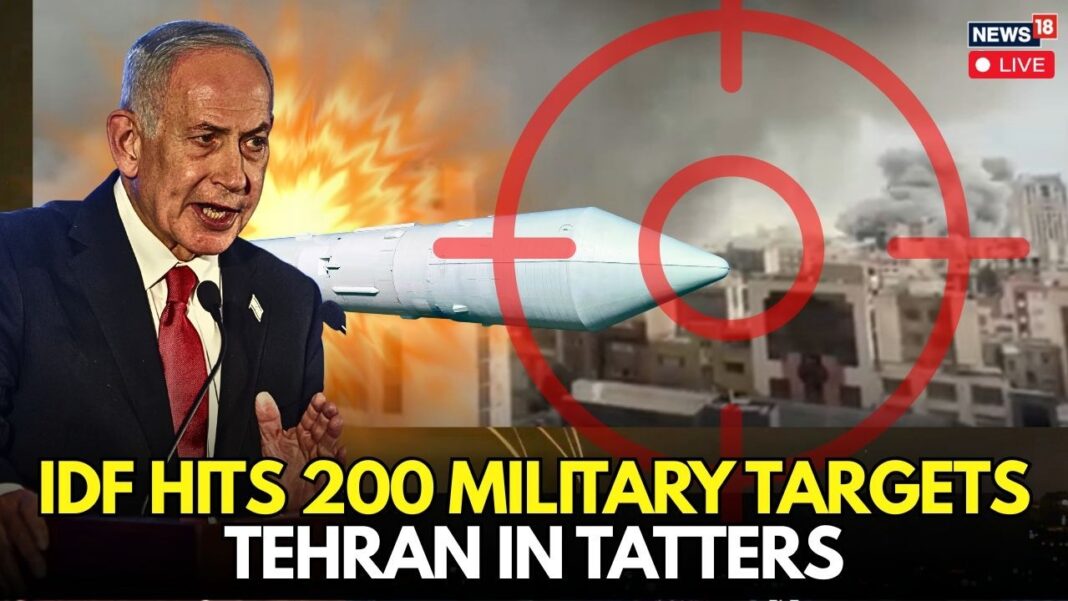
In one of the most expansive aerial campaigns in recent memory, the Israeli Air Force has dramatically escalated its offensive against the military infrastructure of the Iranian regime, carrying out a series of coordinated strikes that officials say have crippled key components of Tehran’s missile and defense networks. Over the past 24 hours alone, dozens of Israeli fighter jets launched deep-penetration missions into Iranian territory, destroying more than 200 strategic targets across western and central regions of the country.
According to a detailed report on Friday by Israel National News, the operations were directed by the Intelligence Directorate of the Israel Defense Forces (IDF) and were designed to dismantle Iran’s capacity to launch ballistic missiles and unmanned aerial vehicles toward Israeli territory. The strikes represent one of the most concentrated waves of Israeli military action against Iranian assets since the current conflict erupted.
Israeli officials describe the mission as a decisive step in degrading the military capabilities of what they repeatedly characterize as the Iranian regime’s “terror infrastructure.” Military planners say the goal of the campaign is to neutralize the systems that allow Tehran to threaten Israel’s civilian population while simultaneously undermining the operational structure of the Islamic Revolutionary Guard Corps (IRGC).
According to the information provided in the Israel National News report, the latest wave of attacks involved dozens of advanced Israeli fighter aircraft conducting carefully coordinated sorties guided by real-time intelligence. The missions targeted critical facilities associated with missile production, launch infrastructure, and air-defense systems across multiple Iranian provinces.
Among the assets destroyed were dozens of missile launchers that had already been prepared for imminent use, as well as several weapons manufacturing plants responsible for producing ballistic missile components. Israeli military officials said these facilities were integral to Iran’s capacity to assemble and deploy missiles capable of striking Israeli cities.
“These operations are aimed at dismantling the regime’s offensive capabilities and preventing future attacks on Israel’s civilian population,” an IDF statement said, according to Israel National News.
The strikes also targeted air-defense installations that attempted to intercept Israeli aircraft. According to Israeli officials, these defensive systems were swiftly neutralized, allowing Israeli jets to continue their operations with minimal interference.
The current offensive forms part of a broader Israeli military initiative that has unfolded over several weeks. Since the beginning of the operation—known as Operation Roaring Lion—the Israeli Air Force has conducted hundreds of strike sorties across Iranian territory.
As Israel National News has reported, these operations are specifically designed to dismantle the infrastructure used by Iran to coordinate missile launches and drone attacks against Israel’s home front.
Military analysts note that the strategy reflects a shift toward targeting the entire ecosystem that supports Iran’s offensive capabilities. Rather than focusing exclusively on launch sites, Israeli planners are systematically striking factories, command centers, and logistical networks.
The aim, according to Israeli defense officials, is to ensure that Iran cannot rapidly rebuild the systems necessary to threaten Israeli territory.
The latest airstrikes focused on three critical locations within Iran: Tehran, Shiraz, and Ahvaz. Each city plays a significant role in Iran’s military command structure and weapons development programs.
One of the most dramatic operations occurred in the southern city of Shiraz, where Israeli jets destroyed a heavily fortified underground facility used by the Iranian regime for the production and storage of ballistic missiles.
According to the Israel National News report, intelligence assessments indicated that the missiles housed at the site were intended for imminent deployment against Israeli targets.
The complex was constructed deep underground and designed to withstand conventional bombing. However, Israeli aircraft reportedly employed specialized munitions capable of penetrating reinforced structures before detonating. The destruction of the facility represents a major setback for Iran’s missile production capacity.
Simultaneously, Israeli aircraft carried out precision strikes in Tehran, Iran’s capital and the heart of the country’s political and military leadership. According to reports cited by Israel National News, Israeli forces targeted several installations linked to Iran’s air-defense network. These sites were responsible for detecting and intercepting hostile aircraft approaching sensitive Iranian facilities.
By disabling these systems, Israeli planners hope to leave key strategic locations exposed to future strikes. The operation also included attacks on factories producing critical missile components and advanced defense systems, further degrading Iran’s ability to replenish its arsenal.
Military officials say the destruction of these facilities will significantly slow Iran’s efforts to rebuild its missile forces.
In the western city of Ahvaz, Israeli fighter jets targeted the operational nerve centers of Iran’s Revolutionary Guards and internal security apparatus. These command centers played a central role in coordinating Iranian military activities across the region.
As reported by Israel National News, intelligence indicated that dozens of personnel were present at the facilities during the strikes, including officers responsible for planning operations against Israel and allied nations. The Israeli Air Force reportedly destroyed the central coordination hub linking multiple Iranian security organizations, effectively severing communication channels used to direct attacks.
Israeli defense officials have emphasized that the strikes on western and central Iran are particularly critical. These regions host many of the missile bases and drone launch facilities used by Iran to project power across the Middle East.
As the Israel National News report explained, the Israeli military believes that neutralizing these sites will significantly reduce the threat posed by long-range missiles and UAVs directed toward Israel’s civilian population. By targeting infrastructure far from Israel’s borders, the operation also demonstrates the Israeli Air Force’s ability to conduct deep-strike missions over vast distances.
Military analysts say this capability plays an important psychological role as well, signaling to Tehran that its strategic assets are vulnerable regardless of location.
Israeli officials have repeatedly framed the campaign as part of a broader effort to weaken what they describe as the “terrorist regime” in Tehran. According to statements cited by Israel National News, the IDF believes the Iranian government has spent decades building a network of missile and drone forces designed to threaten Israel and other countries in the region.
The destruction of these capabilities is therefore seen as essential to Israel’s long-term security. “We will continue to act decisively against any infrastructure used to threaten the State of Israel,” an Israeli defense official said.
A defining feature of the operation has been the close coordination between Israel’s Intelligence Directorate and the Israeli Air Force. According to Israel National News, real-time intelligence data has allowed Israeli pilots to identify and strike high-value targets with remarkable precision.
This intelligence-driven approach has enabled Israel to target not only military hardware but also the command structures responsible for coordinating attacks. By dismantling both the physical and organizational components of Iran’s military apparatus, Israeli officials believe they can significantly reduce the regime’s operational capabilities.
The escalation of Israeli strikes inside Iran carries profound implications for the broader Middle East. Iran has long relied on a network of proxies—including Hezbollah in Lebanon and various militias in Syria and Iraq—to project influence across the region.
The destruction of missile facilities and command centers inside Iran itself could limit Tehran’s ability to supply these groups with advanced weaponry. As the Israel National News report noted, the ongoing campaign is part of a broader effort to counter Iran’s regional ambitions.
For Israel, the current campaign represents a war fought not only along its borders but across the entire strategic depth of its adversary. By striking deep inside Iranian territory, Israeli forces aim to prevent attacks before they can be launched.
Military experts say this doctrine reflects lessons learned from decades of conflict with adversaries that rely on missile warfare and asymmetric tactics. Instead of waiting for rockets to fall on Israeli cities, the strategy seeks to destroy the threat at its source.
Despite the significant damage inflicted on Iranian military infrastructure, Israeli officials caution that the campaign is far from over. The Iranian regime still possesses a substantial arsenal of missiles and drones, and its leadership has vowed to continue resisting Israeli operations. Nevertheless, Israeli defense leaders believe the recent wave of strikes represents a decisive step in weakening Iran’s offensive capabilities
