



|
Getting your Trinity Audio player ready...
|
By: Fern Sidman
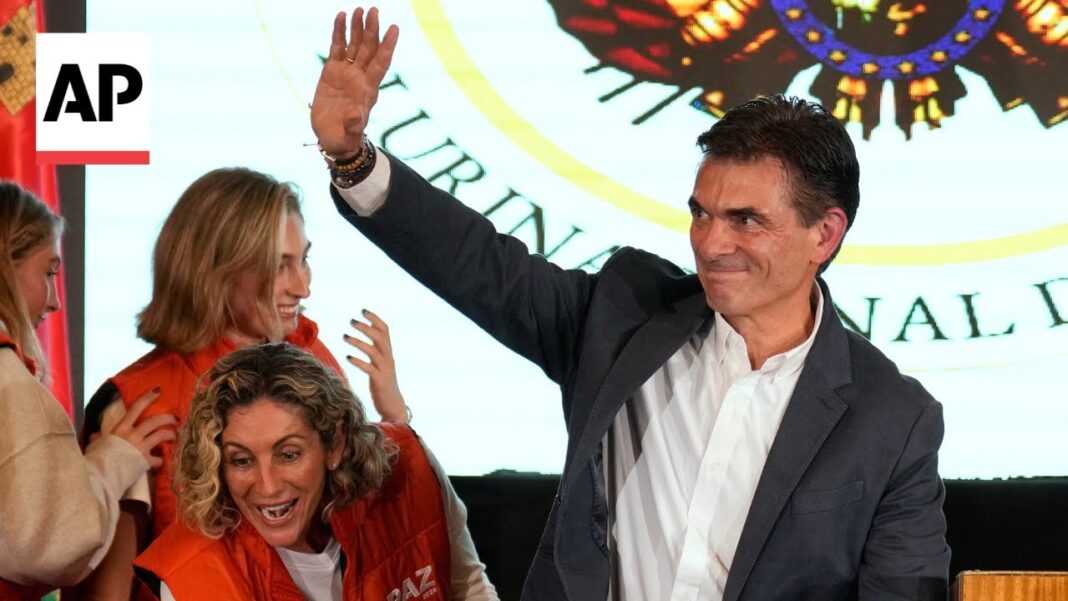
Israel’s Foreign Minister Gideon Sa’ar on Monday extended his congratulations to Bolivia’s president-elect Rodrigo Paz Pereira, marking what many observers view as the potential dawn of a new era in Israeli–Bolivian relations. In a statement carried in a report on Monday at VIN News, Sa’ar praised Bolivia’s democratic process and expressed optimism that the incoming administration could reverse years of estrangement between the two nations.
“I congratulate President-elect Rodrigo Paz on his election as the new President of Bolivia,” Sa’ar said. “We extend our warm wishes to the Bolivian people for their democratic process and their choice for renewal.”
The message, issued just hours after the official announcement of Paz Pereira’s victory, underscores Israel’s readiness to rebuild ties with a country that, under previous leadership, had become one of its fiercest critics in Latin America.
As VIN News reported, the Bolivian election marks a seismic political shift in a nation long dominated by the Socialist MAS (Movimiento al Socialismo) party founded by former president Evo Morales. For the first time in two decades, no MAS candidate appeared on the ballot — a historic departure from the populist, left-wing leadership that had shaped Bolivia’s foreign and domestic policies since 2006.
Paz Pereira’s victory in the runoff stunned political observers. A centrist senator with roots in La Paz’s political establishment and a reputation for pragmatism, he began his campaign polling near the bottom of the field. His ascent, analysts say, reflected a groundswell of public fatigue with ideological politics and economic mismanagement.
According to the information provided in the VIN News report, Paz Pereira’s platform focused on governance reform, fiscal stability, and re-engagement with Western partners — a stance that stood in sharp contrast to his predecessors’ alliances with Cuba, Venezuela, and Iran. His election was hailed domestically as a “vote for moderation,” and internationally as a signal that Bolivia could be ready to rejoin the global mainstream.
Relations between Israel and Bolivia have long been volatile, reflecting the ideological swings of successive Bolivian governments. As the VIN News report recounted, under Morales and his successor Luis Arce, Bolivia was the first country to sever diplomatic relations with Israel following the Hamas massacre of October 7, 2023 — a day that reshaped Israel’s foreign relations worldwide. On November 1, 2023, the Bolivian government announced it was cutting all ties with Jerusalem, citing what it described as “Israeli aggression” in Gaza.
The decision drew swift praise from Hamas and condemnation from Israel and Jewish organizations around the world. Within weeks, Chile, Colombia, and Honduras followed Bolivia’s lead, recalling their ambassadors from Tel Aviv and downgrading their diplomatic missions.
At the time, Israel’s Foreign Ministry expressed deep disappointment, accusing La Paz of “aligning itself with terror.” For Bolivia, the move was widely viewed as symbolic — a reflection of its domestic political rhetoric rather than any substantive bilateral dispute. Nonetheless, the rupture marked the end of a fragile rapprochement that had begun in 2019, when Morales’s resignation briefly opened a path toward normalization.
With Paz Pereira’s victory, Jerusalem sees an opportunity to restore diplomatic ties and expand economic cooperation in Latin America, a region that once boasted a robust Israeli presence but has, in recent years, grown increasingly divided in its foreign policy orientation.
In his congratulatory message, Sa’ar signaled Israel’s intent to move quickly, writing on X (formerly Twitter):
“We look forward to opening a new chapter in our bilateral relations and advancing cooperation in a wide range of fields for the benefit of both nations.”
He added that La Paz “has a long history of friendship with Israel and the Jewish people,” a reminder that Bolivia, despite its recent estrangement, once played a supportive role in Israel’s early years. The country recognized the Jewish state in 1949, shortly after its founding, and in the decades that followed maintained generally friendly relations — even allowing Bolivian Jews to serve as informal cultural ambassadors within Latin America.
As the VIN News report emphasized, Sa’ar’s statement reflects both diplomatic optimism and a strategic pivot. For Israel, re-engaging Bolivia is not merely symbolic; it is part of a broader campaign to rebuild ties in Latin America following a wave of anti-Israel sentiment triggered by the Gaza war.
Bolivia’s election, the VIN News report noted, fits into a larger pattern of political recalibration across Latin America. After a decade dominated by leftist governments, several countries — including Argentina under Javier Milei and now Bolivia under Paz Pereira — are steering toward centrist or right-leaning administrations that prioritize economic pragmatism and global integration over ideological alignment.
For Israel, this trend offers both relief and opportunity. Milei, who was elected in 2023, became one of Israel’s most outspoken allies in the region, frequently referencing his admiration for Jewish history and values. His administration quickly reversed Argentina’s previous neutrality toward the Gaza conflict and re-strengthened ties with Jerusalem.
If Paz Pereira follows a similar trajectory, Bolivia could become another key partner in Israel’s regional outreach. According to the VIN News report, Israeli officials are already exploring the possibility of reopening consular channels and discussing cooperation in sectors such as water technology, agriculture, and medical innovation — areas where Israel’s expertise aligns closely with Bolivia’s developmental needs.
The thawing of relations, however, will not be without obstacles. Bolivia’s political institutions remain divided, and remnants of the MAS party continue to wield influence in parliament and in the street. Paz Pereira will face pressure from factions resistant to re-establishing ties with Israel, particularly within Bolivia’s indigenous and pro-Palestinian movements.
Yet, as the VIN News report observed, the new president’s pragmatic style may help navigate those tensions. “Paz Pereira understands that global partnerships are not ideological statements but instruments of progress,” one political analyst told the outlet. “He recognizes that Bolivia’s isolation has cost it economically and diplomatically.”
For Israel, the challenge will be to rebuild trust without appearing overzealous. Analysts cited in the VIN News report suggested that Jerusalem will likely adopt a cautious, step-by-step approach — beginning with humanitarian cooperation, academic exchanges, and joint initiatives in renewable energy and climate adaptation. “Bolivia’s future relationship with Israel may develop incrementally,” VIN News noted, “but the tone has already changed dramatically.”
For much of the past two years, Israel’s diplomatic posture in Latin America has been defensive. Accusations of “colonialism” and “genocide” by left-wing leaders have strained alliances once taken for granted. The Gaza conflict — and the polarization it unleashed — left Jerusalem facing protests and diplomatic downgrades from capitals that once welcomed Israeli trade and technology partnerships.
Paz Pereira’s election, therefore, is more than a bilateral story; it is a bellwether for Israel’s standing in the hemisphere. As the VIN News report observed, “Bolivia’s pivot under President-elect Rodrigo Paz offers Jerusalem a long-awaited opening — proof that even in an era of global division, dialogue and shared interest can still prevail.”
Both governments are expected to begin exploratory talks soon after Paz Pereira’s inauguration. For Israel, the focus will likely be on pragmatic cooperation rather than grand symbolism — emphasizing the benefits of partnership in health care, sustainable agriculture, and disaster response. For Bolivia, the stakes are equally high: rebuilding credibility on the international stage and attracting foreign investment after years of economic stagnation.
As the VIN News report noted, “The election of Rodrigo Paz Pereira closes one chapter in Bolivia’s history and opens another — one that may once again include friendship with the Jewish state.”
If Foreign Minister Gideon Sa’ar’s words are any indication, Israel is ready to turn the page. “We look forward,” he wrote, “to renewing the bonds of trust and cooperation that have long connected our peoples.”
In a region still riven by ideological divides, that renewal may stand as a quiet but powerful reminder: even after years of diplomatic silence, reconciliation remains possible.