



|
Getting your Trinity Audio player ready...
|
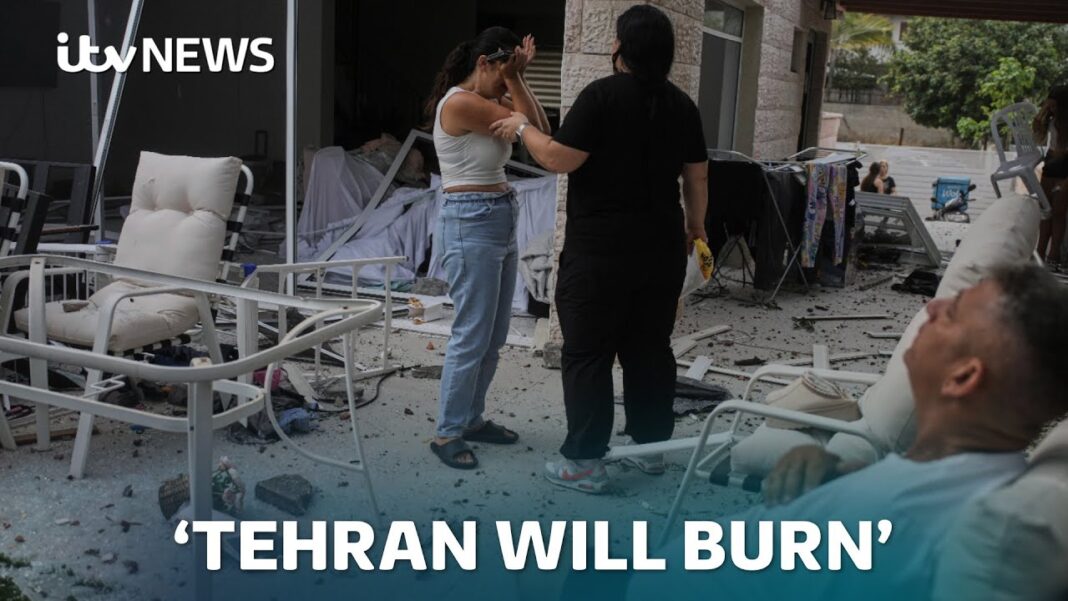
Israel Warns ‘Tehran Will Burn’ as Missile Barrage Escalates Fears of Regional War
Israel’s Defense Minister issued a stark threat on Saturday, warning that “Tehran will burn” if Iran continues to launch missiles at civilian areas within the Jewish state, amid growing fears that a prolonged and destabilizing conflict between the two adversaries could spiral into a regional war.
“If Khamenei continues to fire missiles at the Israeli home front, Tehran will burn,” declared Defense Minister Israel Katz, directly addressing Iran’s Supreme Leader Ayatollah Ali Khamenei. His warning, reported by USA Today, came as both countries traded intensifying blows—missiles, airstrikes, and public threats—over a 48-hour period that left scores dead and both nations on high alert.
Speaking from a secure location, Israeli Prime Minister Benjamin Netanyahu was defiant: “Our pilots are over the skies of Tehran. We will strike every site, every target of the ayatollahs’ regime. What they have felt so far is nothing compared with what they will be handed in the coming days.”
According to USA Today, Israel initiated the confrontation on June 13 with a sweeping air assault that struck more than 150 targets across Iran, including nuclear facilities, military bases, and top military leadership. The operation reportedly killed 78 Iranians, including nuclear scientists and senior commanders. Iran’s state television described the strikes as “heavy and destructive.”
In response, Iran launched what officials described as a three-phase counterattack, firing approximately 200 ballistic missiles at Israeli population centers. Magen David Adom confirmed the deaths of at least three civilians, while dozens more were injured as air raid sirens sent residents rushing to bomb shelters. Despite American assistance in intercepting many of the missiles, some Iranian projectiles still struck residential districts.
Israeli Air Force Chief Tomer Bar suggested that Tehran’s defenses had been decisively weakened. “The road to Iran has been paved,” he said, hinting that further Israeli incursions could be on the horizon.
USA Today reported that the Israeli military says it successfully targeted nuclear development centers in Natanz and Esfahan, including what the International Atomic Energy Agency later confirmed were “critical buildings” like the Uranium Conversion Facility and Fuel Plate Fabrication Plant. No radiation leaks were detected, but damage is expected to take weeks to repair.
Netanyahu defended the strikes, insisting, “We were at the 90th minute. There was a race by Iran’s nuclear teams to bring about the creation of nuclear bombs—atomic weapons intended for the destruction of Israel.”
Iran’s foreign ministry condemned the Israeli strikes and accused the United States of complicity. State media quoted officials saying the U.S. “cannot claim to negotiate while enabling the Zionist regime to target Iran’s territory.” Talks scheduled for June 15 in Oman were subsequently canceled, the Omani foreign ministry confirmed.
Meanwhile, regional tensions broadened. Reuters reported that Iraq called on the United States to prevent Israeli warplanes from using Iraqi airspace, citing violations of bilateral agreements. Iran also warned that it would strike at military bases of U.S. allies if they assisted in intercepting Iranian missiles.
In a further sign of regional destabilization, USA Today cited a statement from the Palestinian Red Crescent, confirming that a missile fired by Iran’s Houthi allies in Yemen went off-course, injuring five Palestinians—including three children—in the West Bank.
Yet despite Tehran’s attempts to mobilize its broader network, its regional power appears diminished. “Iran spent decades building up its so-called Axis of Resistance… that’s disappeared,” said Mohamad Bazzi, director of the Middle East Center at NYU, in comments to USA Today.
Amid rising oil prices—jumping roughly 7% on June 13—British Prime Minister Keir Starmer announced that the UK would be dispatching additional military assets, including fighter jets, to the Middle East.
Even as explosions echoed over both Tel Aviv and Tehran, the global community appealed for restraint. In Rome, Pope Leo called for “responsibility and reason” in the face of what many fear could escalate into a multi-front war.
With missile exchanges continuing into the night and diplomatic channels fraying, both sides appear braced for sustained confrontation. As USA Today reported, Israel is preparing for operations that “could last weeks,” and the world is watching closely for what comes next.
