



|
Getting your Trinity Audio player ready...
|
By: Fern Sidman – Jewish Voice News
Israel’s already-volatile northern frontier has entered a markedly more dangerous phase, according to new warnings delivered by Defense Minister Israel Katz during a closed-door briefing of the Knesset’s Foreign Affairs and Defense Committee on Wednesday. As reported on Thursday by World Israel News, Katz told lawmakers that the constellation of Arab terrorist groups operating inside Syria is rapidly expanding and embedding itself along the Golan Heights, signaling preparations for potential large-scale confrontation with the Jewish state. In parallel, Katz made clear that any notion of an imminent peace agreement with Syria—floated in speculative diplomatic reporting in recent weeks—is not grounded in current realities.
According to the information provided in the World Israel News report, which first broke details of Katz’s testimony, the defense minister emphasized that Israel is “not headed toward” a diplomatic breakthrough with Damascus. Instead, Israel is confronting a transformed threat landscape in southern Syria, where multiple Iranian-backed and Palestinian terrorist factions are entrenching themselves with strategic intent. Intelligence assessments outlined during the committee session indicated that Hamas and Palestinian Islamic Jihad, both deeply aligned with Iran’s regional agenda, are now operating openly in Syria’s southern provinces and building operational infrastructure designed for direct strikes on Israel’s northern border.
Military intelligence, as summarized in the World Israel News report, paints an increasingly bleak scenario: these factions are not merely seeking refuge or logistical extensions in Syria—they appear to be positioning themselves to carry out organized incursions into the Golan Heights. The specter of a multi-front conflict has weighed heavily on Israeli defense planning for more than a year, particularly in the wake of Hamas’s October 7 massacre and Hezbollah’s subsequent escalation along the Lebanese frontier. Katz’s remarks, delivered with uncharacteristic bluntness, suggest that the Syrian theater is now joining that wider matrix of coordinated threats.
Compounding Israeli concerns is the reported involvement of Ansar Allah—the Houthi movement of Yemen—in southern Syria. This development, which the World Israel News report described as one of the most alarming revelations from Katz’s briefing, marks a significant evolution in Iran’s strategy. The Houthis, already responsible for destabilizing Red Sea shipping lanes and launching missile volleys at Israel from hundreds of miles away, have now established physical presence along the Syrian-Golan border region. Katz indicated that Houthi operatives are helping plan a possible cross-border incursion into Israel’s north, adding yet another dimension to a region already packed with hostile actors.
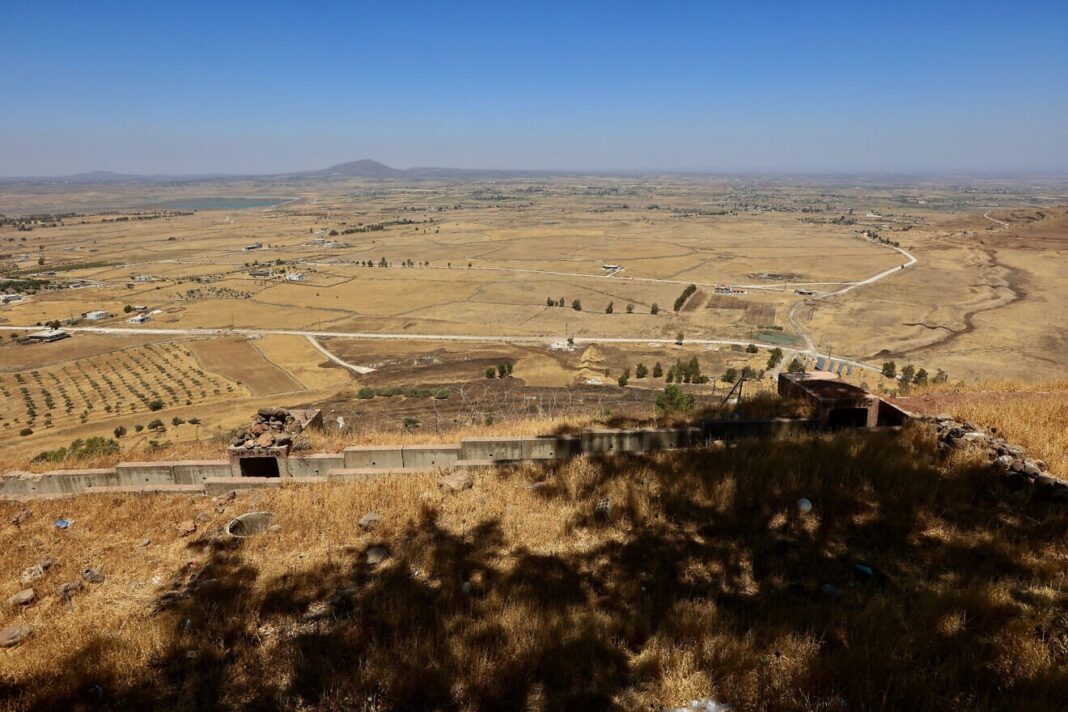
For residents of Israel’s northern communities—and for the regional leadership governing them—these developments are not merely theoretical. Uri Kelner, head of the Golan Regional Council, spoke forcefully at Wednesday’s session about the necessity of maintaining full Israeli control over the Golan buffer zone, including the strategically indispensable summit of Mount Hermon. As quoted by World Israel News, Kelner warned that Israel’s enemies “continue to think about how to harm us,” underscoring that the IDF must deepen its foothold along this frontier to maintain deterrence and ensure readiness for immediate response under any scenario.
Kelner’s comments reflect both historical memory and present-day strategy. The Golan Heights has long functioned as Israel’s critical high-ground advantage in preventing Syrian aggression, dating back to the Six-Day War and Yom Kippur War. The region’s topographical dominance allows Israel to monitor and interdict movements across southern Syria with unparalleled clarity. The possibility of ceding this advantage—as Damascus demands as a prerequisite for any new security agreement—is unacceptable to Israeli defense officials who view control of the buffer zone as an existential requirement.
The Assad regime’s insistence on Israel’s total withdrawal to pre-December 2024 lines is not merely a diplomatic position but a strategic maneuver. Such a withdrawal, Israeli officials fear, would create a vacuum that Iran and its proxies would fill instantaneously. The Druze community in southern Syria, which maintains close familial and cultural ties to the Druze population in Israel, is particularly vulnerable. Israeli leaders have expressed repeated concern that if fighting resumes around the Druze Mountain region—as it has in previous years—the IDF must retain freedom of action to intervene.
Katz, according to the World Israel News report, presented lawmakers with a clear position: the IDF already has a detailed operational plan to defend the Syrian Druze if targeted again. He emphasized that Israel “will intervene” should raid-style attacks on the Druze Mountain recur, demonstrating the extent to which humanitarian responsibility and strategic necessity are intertwined in Israel’s calculus regarding Syria.
What emerges from the defense minister’s testimony is a portrait of a northern arena that has undergone dramatic transformation. Whereas earlier phases of the Syrian civil war saw limited Palestinian involvement and an internally fractured Syrian state, the current iteration features an Iranian-directed coalition of terrorist groups embedding themselves effectively on Israel’s doorstep. This includes not only Hamas and Islamic Jihad, which are leveraging Syrian territory to escape Israeli strikes in Gaza, but also the Houthis, whose presence in Syria illustrates Iran’s ambition to connect its proxy forces along a contiguous arc from Yemen through Iraq and Syria to Lebanon.
This expanding proxy network has implications far beyond localized threats. As the World Israel News report noted, the Houthis’ appearance on the Golan frontier suggests an intent to integrate the Syrian theater into a broader regional confrontation with Israel—one that stretches across thousands of miles and involves varied operational doctrines, weapons systems, and theaters of engagement.
For Israel, this emerging reality requires a recalibration of both military posture and diplomatic expectations. The idea that a negotiated security framework with Syria is feasible in the near future grows less plausible as Damascus increasingly aligns with Tehran’s regional vision. Even if the Assad regime were theoretically willing to curtail the activities of Iranian-backed forces within its borders, its capacity to do so is deeply limited. Years of civil war have eroded the regime’s territorial control, and Iranian forces—along with Hezbollah units—often operate with greater autonomy inside Syria than Syrian forces themselves.
The Israeli public, too, appears keenly aware of the shifting dynamics. The World Israel News report indicated that there is a growing sense among residents of the north that deterrence must be restored quickly and decisively. The IDF’s ongoing fortification work, including enhanced surveillance operations, expanded troop presence, and reinforcement of critical defensive positions, reflects a strategic emphasis on dominance and preparedness rather than de-escalation initiatives that have failed to curtail Iranian spending, training, or deployment of proxies.
Within the political arena, Katz’s briefing is likely to shape internal debates over Israel’s northern policy for months to come. Lawmakers from across the political spectrum have grown increasingly vocal about Syria’s deteriorating security environment, raising concerns over whether Israel has entered a new phase of ongoing multi-front warfare—one in which the Golan Heights becomes as active a battleground as Gaza or the Lebanon frontier.
Yet amid the warnings and intelligence reports Israel’s determination to maintain agency and decisional clarity at a moment when external actors—from the United States to Russia to Iran—are all maneuvering in the Syrian arena. Katz’s words signal that, irrespective of diplomatic speculation or international pressure, Israel will not trade strategic depth for the illusion of stability.
As the northern threat picture darkens further, Israel’s focus appears increasingly anchored in realism. Control of the Golan buffer zone is not a bargaining chip, but a national necessity. Engagement with Damascus cannot be predicated on concessions that empower terrorist factions. Protection of vulnerable communities, including the Druze of southern Syria, is both a moral and strategic imperative. And in the assessment of World Israel News, the rising tide of terrorist entrenchment in Syria is not a passing trend but a structural shift that will define Israel’s northern security posture for years to come.
