



|
Getting your Trinity Audio player ready...
|
Israel Strikes Deep into Yemen After Houthi Drone Attack Injures Dozens in Eilat
By: Fern Sidman
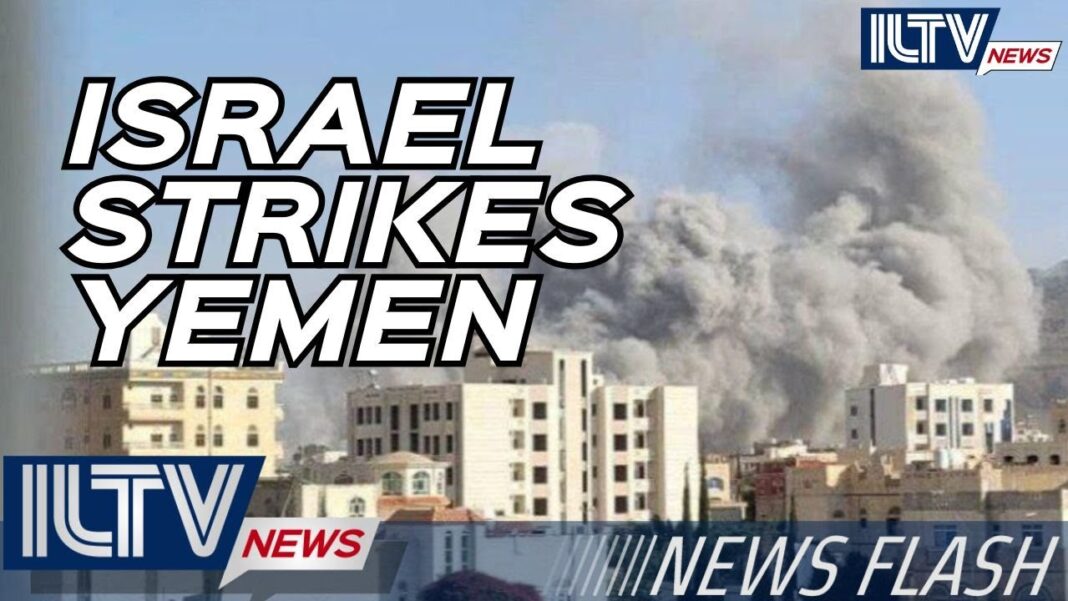
The Israel Defense Forces executed one of its most ambitious long-range operations in years on Thursday, dispatching a fleet of 20 Israel Air Force aircraft on a precision mission to strike Houthi security and intelligence infrastructure in the Sana’a region of Yemen. The mission, authorized by Prime Minister Benjamin Netanyahu while en route to the United Nations General Assembly in New York, was carried out in response to a devastating drone attack on Eilat earlier this week that left more than 40 Israeli civilians injured, two of them in critical condition.
According to a report that appeared on Thursday at VIN News, the operation, codenamed “Package Delivered,” marked the 15th Israeli strike on Yemeni territory since the Houthis began targeting Israel last year. Military officials described the latest action as both the most extensive and the most lethal, with more than 65 munitions dropped on seven carefully selected targets, including five command centers and two weapons depots.
The IDF confirmed that among the sites destroyed were the Houthis’ General Staff Command Headquarters, several compounds belonging to the group’s intelligence and security apparatus, their military public relations headquarters, and multiple training and weapons camps.
As VIN News reported, these facilities were not merely symbolic. The IDF stressed that the Houthis’ intelligence and security services play a direct operational role in planning and executing terrorist attacks against Israel, including the ongoing campaign of UAV and missile launches directed toward civilian areas.
“These facilities are not just military in nature — they represent the core of the Houthis’ ability to organize, coordinate, and repress,” an IDF statement said. “Their intelligence and security apparatus is used both to export terror abroad and to crush dissent at home, including the operation of political prisons and torture chambers.”
By striking these high-value sites, Israeli officials sought not only to degrade the Houthis’ military capabilities but also to send a deterrent message to the Iranian-backed regime that its campaign of drone and missile warfare against Israel would not go unanswered.
Defense Minister Israel Katz confirmed the strikes on Thursday, declaring that Israel had delivered a punishing response.
“We have just delivered a powerful strike against multiple terror targets belonging to the Houthi terror organization in Sana’a as part of Operation ‘Package Delivered’,’ Katz declared, as was reported by VIN News. “The IDF struck several military camps, including a Houthi General Staff camp, eliminated dozens of Houthi terrorists, and destroyed UAV and weapons stockpiles. As I promised yesterday, whoever harms us will be struck sevenfold.”
According to military sources, the scale of the strike — 20 aircraft flying nearly 2,200 kilometers from Israeli bases to deliver ordnance over Yemen — underscores the seriousness with which Jerusalem views the Houthi threat. The operation required extensive coordination by IDF intelligence (Aman), and aerial refueling was employed to ensure the strike package could reach and return safely.
The latest escalation began shortly before the conclusion of the Rosh Hashanah holiday when a UAV launched by the Houthis struck a tourist hub near Eilat’s Mall Hayam. The blast caused widespread panic in the coastal city, injuring more than 40 people. Two men were seriously wounded and had to be airlifted from Yoseftal Hospital to Soroka Medical Center in Be’er Sheva for emergency treatment.
VIN News reported that the UAV exploded near the Club Hotel, damaging its lobby and a nearby restaurant filled with diners. Magen David Adom (MDA) paramedics described a chaotic scene, with bloodied victims being evacuated amid shattered glass and debris. The attack was a grim reminder of the Houthis’ growing capacity to strike Israeli territory directly, bypassing traditional battlefronts.
The IDF’s subsequent strikes on Yemen were thus framed not merely as retaliation but as a necessity to protect Israeli civilians from further assaults.
The political symbolism of the operation was also striking. Netanyahu personally authorized the strike while aboard the “Wing of Zion” state aircraft on his way to New York. According to the information provided in the VIN News report, he received real-time updates from Defense Minister Katz, IDF Chief of Staff Lt. Gen. Herzi Halevi, and his military secretary, illustrating the prime minister’s hands-on involvement in the mission.
Netanyahu has repeatedly vowed that Israel will not tolerate attacks on its civilian population, and Thursday’s strike appeared to be a demonstration of that doctrine in action. By hitting targets deep in Sana’a, Netanyahu sought to signal not only to the Houthis but also to their Iranian patrons that Israel retains both the capability and the will to project force far beyond its immediate borders.
The IDF made clear that the Houthis do not operate in isolation. The group is part of a broader Iranian-led axis that includes Hezbollah in Lebanon and Hamas in Gaza, all of whom have targeted Israel in recent months.
As the VIN News report noted, the IDF explicitly tied the Houthis’ activities to Iranian funding and direction. The Houthis, the military said, “exploit the maritime domain to project force and carry out terror activity against the global shipping and trade routes,” threatening not only Israel but also international commerce through the Red Sea.
By striking their command and logistics infrastructure, Israel aimed to weaken this Iranian proxy network and reinforce its deterrence across multiple fronts.
Thursday’s mission was the 15th Israeli strike in Yemen, but it was by far the most extensive. Previous strikes had focused on drone warehouses, missile launch sites, and smaller command posts. The scale of this latest attack suggests that the Houthis’ persistence — and the mounting toll of their UAV attacks on Israel — has forced Jerusalem to escalate its response.
The use of more than 65 munitions on seven targets, as confirmed by the IDF, is unprecedented in Israel’s campaign against the Yemeni group. Analysts quoted by VIN News argued that the operation marked a significant shift from defensive intercepts and limited retaliatory strikes to a more offensive doctrine designed to cripple the Houthis’ ability to sustain their campaign.
While the IDF has emphasized the precision of its strikes, the risk of civilian casualties in Sana’a, a densely populated capital, cannot be dismissed. The Houthis have long been accused of embedding military facilities within civilian neighborhoods, a tactic also used by Hamas in Gaza and Hezbollah in Lebanon.
International observers will be watching closely to see how Thursday’s operation affects both the humanitarian situation in Yemen and the broader geopolitical balance in the Middle East. Some Western capitals may express concern over escalation, but within Israel, the consensus appears firm: deterrence must be reestablished.
As the VIN News report highlighted, the strike on Yemen is part of Israel’s increasingly expansive battlefield, stretching from Gaza and Lebanon to the Red Sea and beyond. The Houthis’ drone strike on Eilat highlighted the vulnerability of Israeli civilians even far from traditional front lines, while the IDF’s massive retaliatory operation in Sana’a demonstrated Israel’s determination to meet threats wherever they emerge.
For Netanyahu and Katz, the message is clear: Israel will not sit passively as Iranian-backed groups chip away at its security. “Whoever harms us will be harmed sevenfold,” Katz declared — a vow that Thursday’s strike sought to make concrete.
As Israel confronts enemies on multiple fronts, the coming weeks may reveal whether the latest show of force succeeds in deterring the Houthis — or whether it marks only the next stage in a widening conflict that spans the entire region.

Stop the ‘carefully selected targets’ garbage. It is not working. Burn the place down if Israel has to. What is Israel waiting for? For a drone that gets through and kills hundreds – even thousands of people?