



|
Getting your Trinity Audio player ready...
|
By: Fern Sidman
In a precision operation that reverberated across the Middle East and the wider international security community, the Israeli Air Force (IAF) on Friday eliminated nine senior Iranian nuclear scientists, delivering what Israeli officials described as a “critical blow” to Tehran’s capacity to produce weapons of mass destruction.
According to a military statement reviewed by the Jewish News Syndicate (JNS), the targeted scientists had each served as vital “knowledge centers” within Iran’s nuclear apparatus, possessing decades of experience in nuclear weapons development and uranium enrichment. Their deaths, said Israeli officials, strike at the intellectual core of the Islamic Republic’s most dangerous program.
“The individuals who were eliminated played a central part in the progress toward nuclear weapons. Their elimination represents a significant blow to the Iranian regime’s ability to acquire weapons of mass destruction,” the Israel Defense Forces (IDF) stated, as quoted by JNS.
Among the nine killed were some of Iran’s most influential nuclear minds, including Fereydoun Abbasi, a former head of Iran’s Atomic Energy Organization; Mohammad Mahdi Tehranshi and Akbar Motalebi Zadeh, both long believed to be involved in weapons-grade uranium processing; and Saeed Barji, a metallurgist tied to nuclear warhead design.
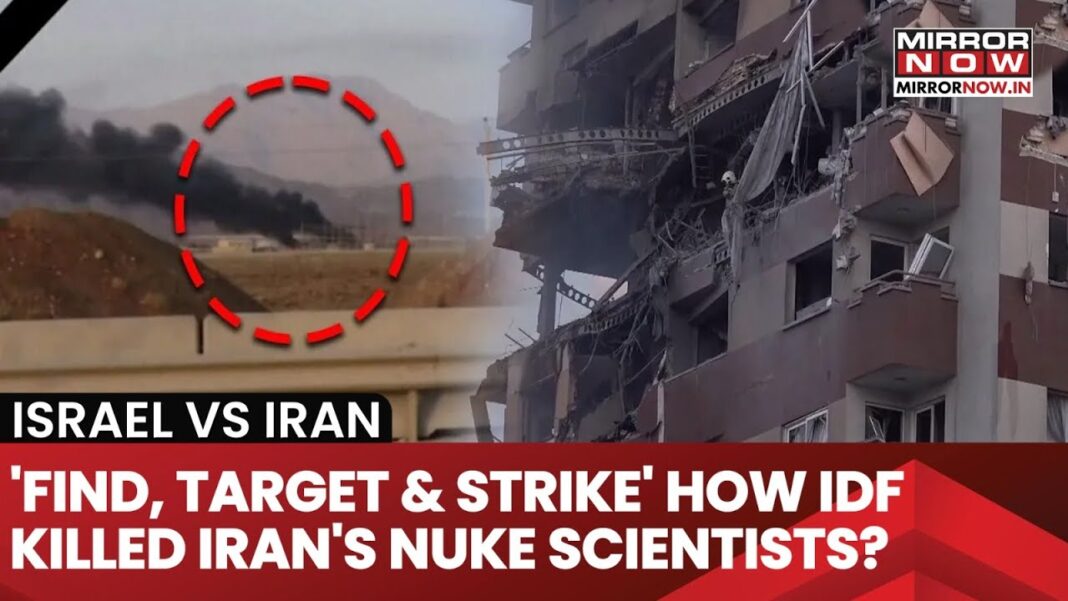
The airstrikes, launched Friday, zeroed in on a key nuclear facility in the central Iranian city of Isfahan, long known as one of the regime’s most sensitive nuclear research hubs. The IDF reported that the facility included infrastructure for producing metallic uranium, converting enriched uranium, and conducting advanced laboratory testing linked to the weaponization of nuclear material.
“The attack destroyed a structure for producing metallic uranium, infrastructure for converting enriched uranium, [and] laboratories,” the IDF said.
The strike in Isfahan followed an expansive overnight operation targeting key Iranian military and nuclear installations. According to the report at JNS, the Natanz enrichment facility, also located in Isfahan province, was hit, along with other high-value locations, including Fordow, where Iran maintains a deeply buried nuclear site designed to withstand aerial assault.
While Iranian state-run outlets, including Fars News Agency, acknowledged “explosions” in the region, they provided few details. The scope of damage has yet to be publicly confirmed by Iranian authorities, but the symbolic and strategic impact of the operation is unmistakable.
The deliberate targeting of Iran’s nuclear braintrust represents a significant escalation in Israel’s effort to disrupt Tehran’s path to a nuclear weapon—not merely by degrading infrastructure but by eliminating the rare human capital that drives innovation in tightly guarded programs.
“Even if Israel inflicted catastrophic damage on infrastructure, Iran could potentially rebuild—unless that core scientific knowledge is lost,” said Col. (ret.) Richard Kemp, a former British Army commander, in an interview with JNS. “The more that expertise is diminished, the less likely they are to recover.”
Kemp emphasized that the operation exposes deep vulnerabilities within the Iranian regime, including its inability to protect its most vital assets and personnel.
“They’ve shown themselves unable to protect their senior commanders, scientists and nuclear facilities. That signals weakness,” Kemp told JNS, adding that such exposure “could embolden the Iranian people to challenge their leaders.”
The strike is part of Operation Rising Lion, the codename for Israel’s unprecedented retaliatory and preemptive military campaign against Iran, launched after a barrage of Iranian missiles killed ten Israeli civilians. Prime Minister Benjamin Netanyahu and Defense Minister Israel Katz have vowed that Iran would pay a steep price for the attack, and the latest operation suggests that Israel is not merely responding—but reshaping the rules of engagement.
“This comes on top of Iran’s deepening economic problems and the collapse or weakening of key allies and proxies in the region,” said Brig. Gen. (res.) Yosef Kuperwasser, head of the Jerusalem Institute for Strategy and Security, in remarks to JNS.
Kuperwasser, a former senior IDF intelligence official, cited the decline of Bashar al-Assad’s regime in Syria, the crippling of Hezbollah in Lebanon, and the devastation of Hamas in Gaza as part of a broader regional pattern that undermines Iran’s hegemonic aspirations.
“All of this represents a major setback for Iran’s bid for regional hegemony and its efforts to spread radical Islamic ideology worldwide,” he told JNS.
Israeli Chief of Staff Lt. Gen. Eyal Zamir confirmed on Friday that operations were continuing “at a high pace” and urged the Israeli public to prepare for potential escalation.
“There will be difficult moments,” Zamir warned, in statements reported by JNS. “Very high readiness and discipline are required on the home front.”
While Israel’s actions have drawn measured silence from much of the international community, JNS noted that many observers see the campaign as a strategic necessity.
Kemp further observed that the precision and scale of the strikes may have broader geopolitical implications, particularly in emboldening Arab states wary of Iran.
“This may bring us closer to expanding the Abraham Accords, including potential normalization between Saudi Arabia and Israel,” Kemp told JNS. “That would be a strategically significant development for Israel’s long-term future in the region.”
While the full impact of the operation is still unfolding, Israel’s actions have already shifted the balance. By targeting not just facilities but the intellectual and strategic leadership of Iran’s nuclear enterprise, Israel has declared that there are no longer safe havens for those advancing weapons of mass destruction under the guise of scientific research.
As JNS highlighted in its report, this moment marks not only a tactical victory but also a message: that Israel will no longer tolerate ambiguity or deferral in the face of existential threat. In eliminating the minds behind Iran’s nuclear ambitions, Jerusalem may have struck the most consequential blow yet in a shadow war now spilling into the daylight.
