



|
Getting your Trinity Audio player ready...
|
Israel Set to Reopen Rafah Border Crossing as Part of Ceasefire Agreement
By: Fern Sidman
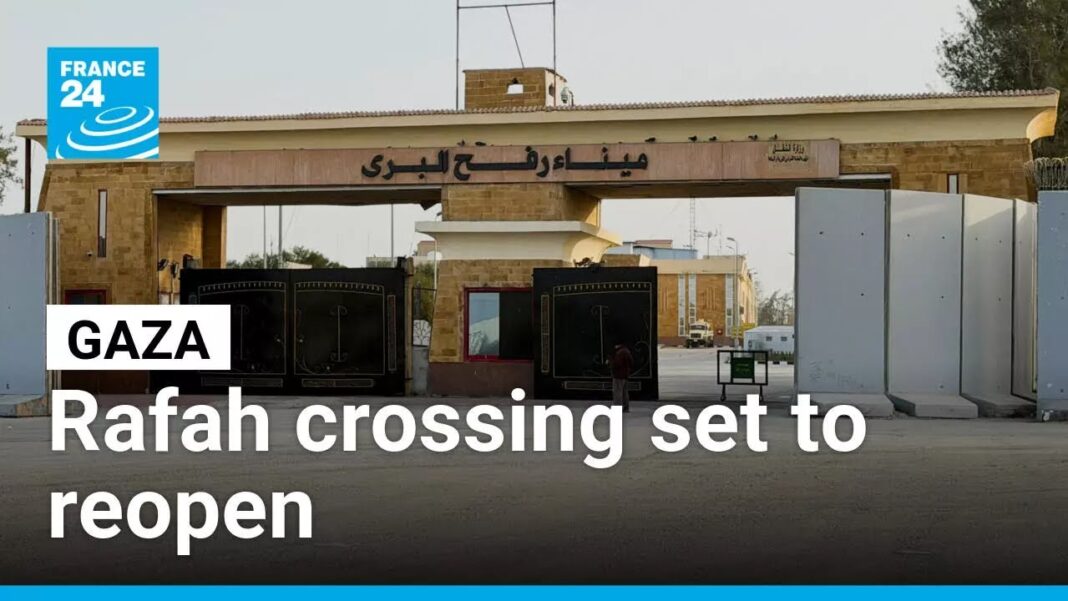
After more than two years of devastating conflict, geopolitical paralysis, and near-total isolation of Gaza’s southern gateway, Israel’s decision to reopen the Rafah Crossing for pedestrian traffic marks a moment of profound symbolic and strategic significance. As reported by The Jewish News Syndicate (JNS) on Friday, the reopening—scheduled for Sunday—represents one of the most carefully engineered border operations in the postwar landscape of Gaza, balancing humanitarian necessity with uncompromising security doctrine.
According to official statements from the Defense Ministry’s Coordinator of Government Activities in the Territories (COGAT), the Rafah Crossing between the Gaza Strip and Egypt will resume two-way pedestrian movement under a tightly regulated international framework. The operation will be conducted in full coordination with Egyptian authorities, under Israeli security clearance, and overseen by a European Union monitoring mission—reviving a model last implemented in January 2025. As JNS reported, this mechanism reflects a multilayered governance structure designed to prevent infiltration by terrorist operatives while allowing limited civilian mobility.
The reopening is not a simple restoration of prewar transit. It is, rather, a new architecture of controlled movement shaped by the traumatic lessons of the October 2023 Hamas massacre, the subsequent two-year war, and the geopolitical recalibration that followed. The JNS report noted that the decision is embedded within the framework of the U.S.-brokered ceasefire agreement reached in October 2025, which ended the longest and bloodiest confrontation between Israel and Hamas since Israel’s disengagement from Gaza in 2005.
Under the new arrangement, only a narrowly defined category of Gaza residents will be permitted to cross. Returnees from Egypt will be limited to individuals who left the enclave during the war, and even they will require explicit Israeli security approval. This policy reflects Israel’s determination to prevent Rafah from becoming a strategic escape route for senior Hamas operatives, logistical facilitators, or members of terrorist infrastructure.
COGAT data, cited by JNS, indicates that approximately 42,000 Gaza residents exited the Strip during the war, the majority of them medical patients seeking treatment abroad or individuals holding dual nationality. These populations now form the primary cohort eligible for return, though eligibility is far from automatic. Every individual must pass through a complex vetting process involving multiple sovereign and international actors.
The process begins with Egyptian authorization. Names of travelers seeking passage will be forwarded to Israel’s Shin Bet internal security service for clearance, with Israeli officials confirming that each case will be examined individually. Senior terror operatives will categorically be denied exit, and any individual flagged through intelligence databases will be barred from transit.
European Union monitors stationed at Rafah, alongside Palestinian Authority representatives, will conduct initial identity verification and screening on the Gaza side. Yet Israeli involvement remains central and technologically sophisticated. Israeli supervision of departures will occur remotely from a centralized control room, where Israeli officers will employ facial recognition technology to verify that each traveler appears on pre-approved lists. Only after biometric confirmation will passage be permitted, according to the JNS report.
This layered system reflects Israel’s broader postwar doctrine: security first, humanitarian access second, and international supervision as a stabilizing buffer between the two. Entry into Gaza from Egypt will be equally regulated. After crossing Rafah, individuals will undergo an additional Israeli security check at an IDF-controlled checkpoint before being allowed to proceed into Hamas-administered areas of the Strip. This structure ensures that Israeli security oversight extends beyond the border itself into the transit corridors inside Gaza.
The reopening comes despite renewed violence in the Rafah region. In the days leading up to the announcement, the Israel Defense Forces reported identifying eight terrorists emerging from underground infrastructure in eastern Rafah. An airstrike subsequently killed at least three of them. This operation underscores the persistent volatility of southern Gaza, even amid ceasefire arrangements and diplomatic de-escalation.
The political timing is equally significant. Israel’s decision follows the conclusion of “Operation Brave Heart,” the IDF mission to recover the remains of Israel Police Master Sgt. Ran Gvili, the last Israeli hostage held in Gaza. As the JNS report noted, the Prime Minister’s Office had explicitly linked the reopening of Rafah to the completion of that operation, framing the border decision as part of a broader transition from wartime objectives to post-conflict stabilization.
Yet stabilization in Gaza is a relative concept. While the ceasefire has halted large-scale hostilities, Hamas remains embedded in nearly half the enclave, and Israeli officials continue to insist that full demilitarization remains a non-negotiable long-term objective. In this context, Rafah’s reopening is not an act of normalization—it is a controlled concession to humanitarian reality within a still-hostile strategic environment.
The JNS report highlighted that the Rafah mechanism represents a rare instance of functional trilateral coordination between Israel, Egypt, and the European Union in the Gaza theater. Historically, Rafah has been a flashpoint of sovereignty disputes, smuggling operations, and political leverage. Its closure after Hamas’s seizure of Gaza in 2007 transformed it into a symbol of Gaza’s isolation. Its reopening now, under international supervision, reflects a reconfiguration of authority rather than a restoration of autonomy.
For Egypt, the arrangement offers stability on its Sinai border and limits the risk of militant spillover. For the European Union, it provides a diplomatic foothold in Gaza’s postwar governance. For Israel, it maintains strategic control without direct physical presence at the crossing itself. As the JNS report observed, the model reflects a broader trend toward “remote sovereignty”—control exercised through technology, intelligence, and coordination rather than territorial occupation.
Humanitarian organizations have cautiously welcomed the reopening, viewing it as a potential lifeline for medical patients, families separated by war, and civilians requiring access to services unavailable inside Gaza. Yet even among humanitarian actors, there is recognition that the system prioritizes security over volume. This is not mass transit. It is calibrated mobility, designed to move hundreds, not tens of thousands, and to do so under constant surveillance.
The symbolic weight of Rafah’s reopening extends beyond logistics. For Gaza’s civilian population, it represents the first tangible reopening of a sealed horizon after years of war, siege, and isolation. For Israel, it marks a transition from kinetic warfare to managed containment. For the international community, it offers a test case for postwar governance mechanisms in conflict zones dominated by non-state armed groups.
As the JNS report emphasized, this is not reconciliation—it is regulation. Not peace—it is process. The crossing does not signify trust between Israel and Hamas, nor normalization between Gaza and its neighbors. It signifies a controlled experiment in coexistence under surveillance.
The architecture of Rafah’s reopening also reflects the evolving nature of modern border security. Biometric verification, remote monitoring rooms, intelligence database integration, and multinational oversight illustrate a new model of border governance shaped by counterterrorism imperatives rather than traditional diplomacy. JNS reporting makes clear that this is not a return to prewar norms but the emergence of a new operational paradigm.
Politically, the decision allows Israeli leadership to signal humanitarian responsibility without compromising strategic doctrine. It demonstrates compliance with ceasefire commitments while reinforcing Israel’s red lines regarding Hamas’s leadership and operational networks. Internationally, it offers Washington and European capitals a visible sign of postwar progress without forcing premature political concessions.
For Gaza’s civilians, however, the experience will likely remain one of constraint rather than freedom. Movement will be slow, approvals selective, and scrutiny constant. Rafah will not function as an open border—it will function as a filter.
In the broader narrative of the Gaza war’s aftermath, the reopening of Rafah stands as a microcosm of the post-conflict order now taking shape: fragile, controlled, internationally mediated, technologically enforced, and deeply conditioned by security logic. As JNS reported, Gaza’s future is not being rebuilt through sweeping political settlements, but through incremental mechanisms—checkpoints, corridors, monitoring missions, and layered approvals.
Sunday’s reopening will not end Gaza’s isolation. But it will puncture it—selectively, cautiously, and conditionally. In a region long defined by absolutes—total closure or total chaos—the Rafah Crossing now embodies a third model: regulated permeability.
Whether this model can evolve into something more humane, more stable, and more durable remains uncertain. What is clear is that Rafah’s reopening is not merely a logistical development—it is a geopolitical statement, a security experiment, and a fragile bridge across one of the deepest fault lines in the modern Middle East.
