



|
Getting your Trinity Audio player ready...
|
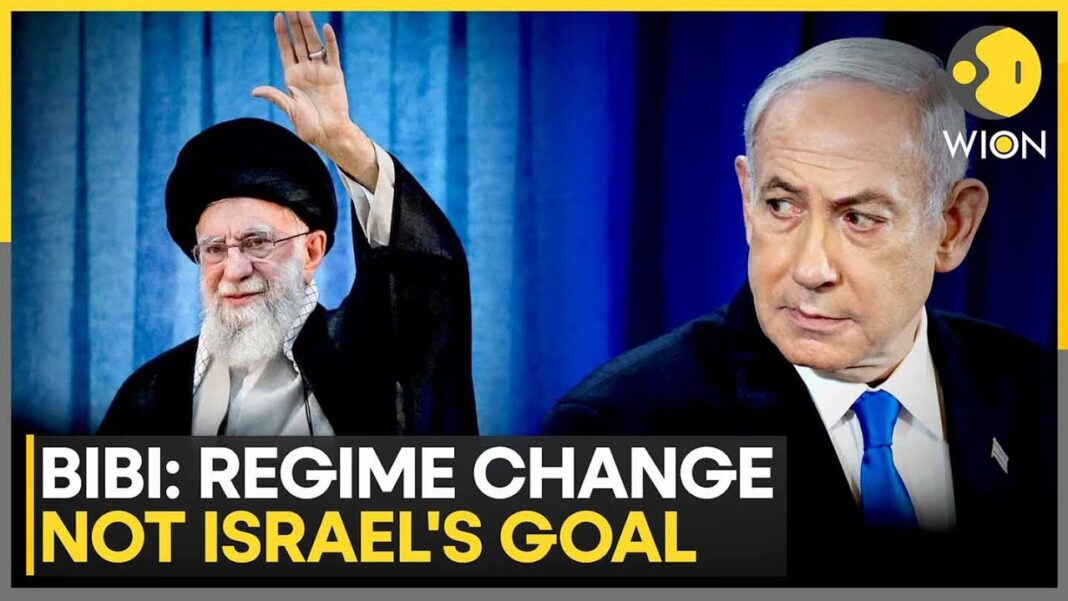
Israel Says Regime Change in Iran Is Not the Goal—But a Welcome Outcome
By: Fern Sidman
As Israeli fighter jets continue pounding Iranian military and nuclear infrastructure in an unprecedented campaign of precision strikes, Israeli officials have moved to clarify the strategic aims of the operation. While disavowing formal intentions to topple the Islamic Republic, Israeli spokespersons signaled Monday that the collapse of Iran’s regime—long accused of exporting terrorism and pursuing nuclear weapons—would be a welcome development for the region and the Iranian people.
In a briefing with journalists on Monday afternoon, David Mencer, a spokesperson for the National Public Diplomacy Directorate in the Israeli Prime Minister’s Office, emphasized that the stated aim of Israel’s current military operation is not regime change, but rather the neutralization of Tehran’s nuclear ambitions and missile threat. However, when pressed by a reporter from The Jewish News Syndicate (JNS), Mencer acknowledged that if the campaign leads to the fall of the Islamic Republic, “that would be a welcome objective.”
“As the prime minister said yesterday, it is not the government’s objective to produce regime change,” Mencer said. “But if the war leads to the Iranian people shaking off the shackles of this oppressive regime that has dominated them for nearly five decades, that would be a most welcome outcome.”
Mencer’s comments draw attention to the nuanced line that Jerusalem is attempting to walk: asserting its right to defend itself from existential threats, while carefully sidestepping the kind of explicit support for regime change that could destabilize delicate diplomatic relationships. As JNS reported, Israeli military action remains tightly focused on dismantling Iran’s uranium enrichment capacity and neutralizing its ballistic missile program—particularly its launcher infrastructure.
“There is no need for an enrichment capability—zero need—except for a nuclear weapon,” Mencer reiterated, echoing longstanding Israeli concerns that Tehran’s nuclear program is not civilian in nature, but weapons-oriented.
Yet the broader implications of the war are difficult to ignore. The Iranian economy is reeling under international sanctions, civil unrest has steadily grown since the 2022 protests following Mahsa Amini’s death, and recent Israeli strikes have directly hit the heart of Iran’s nuclear weapons research network. Under these conditions, the notion that the regime in Tehran may not survive this conflict is gaining increasing currency.
In a dramatic gesture aimed at galvanizing opposition inside Iran, Prime Minister Benjamin Netanyahu delivered a special televised message to the Iranian public via the London-based opposition network Iran International, just days before Mencer’s briefing. The message, quoted in JNS coverage, drew on themes of shared history and hope for liberation.
“I believe in you. I respect you. I admire you,” Netanyahu said to the Iranian people. “I know that Iran can be great again. It was a great civilization, and this theological thuggery that has kidnapped your country will not stand for long.”
The prime minister’s message, which referred to the Iranian regime as a form of “theological thuggery,” stopped short of calling directly for insurrection. However, his words were laced with encouragement for what he clearly sees as an inevitable popular uprising. “A light has been lit—carry it to freedom,” Netanyahu concluded. “Your hour of freedom is near; it’s happening now.”
According to the information provided in the JNS report, this public outreach marks a striking departure from traditional Israeli policy, which has generally shunned direct appeals to the Iranian populace during periods of active conflict. The shift is perhaps indicative of a belief in Jerusalem that Tehran’s grip on power may now be weakening—and that a post-theocratic Iran could be part of a new regional order.
Compounding the signal from Jerusalem was President Donald Trump’s own social media post late Sunday, in which he hinted at the possibility of regime change despite official U.S. policy maintaining the contrary. “It’s not politically correct to use the term, ‘Regime Change,’” Trump posted on his Truth Social platform. “But if the current Iranian Regime is unable to MAKE IRAN GREAT AGAIN, why wouldn’t there be a Regime change???”
While neither the White House nor the Pentagon has formally adopted a regime change doctrine, Trump’s statement introduced ambiguity into American messaging and further emboldened speculation—reflected prominently in the JNS analysis—that the fall of Iran’s clerical regime is no longer unthinkable.
Heritage Minister Amichai Eliyahu also drew attention on Monday when he told i24News that Israel may be quietly cooperating with elements of the Iranian opposition.
“Unlike the Gazan population that supports Hamas and still hasn’t disavowed Hamas, in Iran we know that many of the local people despise the regime,” Eliyahu said, according to the JNS report. When asked directly whether Israel was working with Iranian opposition figures, Eliyahu replied, “I won’t go into details now; I don’t think it’s right to get into details.”
His vague yet suggestive remarks appear to echo Israeli efforts from decades past—such as its clandestine support for Kurdish factions or anti-Hezbollah elements—to align strategically with dissident forces behind enemy lines. If true, it could signal a new phase in Israel’s confrontation with the Islamic Republic, not just militarily but ideologically.
Netanyahu’s remarks to Fox News on June 12 further illustrated this tightrope approach. Asked whether Israel’s campaign could result in the fall of Iran’s government, the prime minister responded, “It could certainly be the result.” However, he quickly qualified this, adding: “The decision to act, to rise up, at this time is the decision of the Iranian people.”
He also made a point of invoking ancient Persian-Jewish friendship, referring to Cyrus the Great, who allowed the Jews to return to Jerusalem after the Babylonian exile. “The Persian people and the Jewish people have had an ancient friendship,” Netanyahu said. “That could happen again.”
Such historical framing is not accidental. As JNS noted in its analysis, Israel’s leadership is deliberately appealing to a pre-revolutionary Iranian identity, one that views its current rulers not as protectors of tradition, but as interlopers suppressing the true cultural spirit of the nation.
As of now, Israel’s stated military objectives remain tightly focused: neutralize the nuclear threat, disable Iran’s ability to strike with ballistic missiles, and preserve Israeli strategic superiority. But the political rhetoric from Jerusalem—amplified by Trump’s online provocations and echoed by ministers like Eliyahu—makes clear that the potential toppling of the Islamic Republic is no longer an unspeakable concept.
As JNS has reported, the Israeli leadership sees the current war as more than just a campaign of survival. It is increasingly viewed as an opportunity to reshape the strategic architecture of the Middle East, and possibly, to usher in a new era in Iran itself.
Whether regime change in Iran becomes the central legacy of this conflict or remains a byproduct of deeper military objectives, one thing is clear: Israel is not just playing defense anymore. It is betting on history.
