



|
Getting your Trinity Audio player ready...
|
By: Fern Sidman
By any measure, the deliberations now unfolding between Jerusalem and Washington over the future security architecture of Gaza are among the most delicate diplomatic exchanges since the end of the active phase of the war. Yet according to a report that appeared on Thursday at Israel National News (INN), one American idea has already been met with an unequivocal Israeli veto: any role—however distant—for Turkey in the international force envisioned to stabilize Gaza.
The proposal, first disclosed by Kan News, suggested that Ankara could be included in the multinational mission in a “remote capacity.” Turkey would not deploy troops inside the Gaza Strip itself but would operate from rear bases in neighboring countries such as Jordan and Egypt, providing logistical assistance, intelligence coordination, and support infrastructure for a broader international coalition.
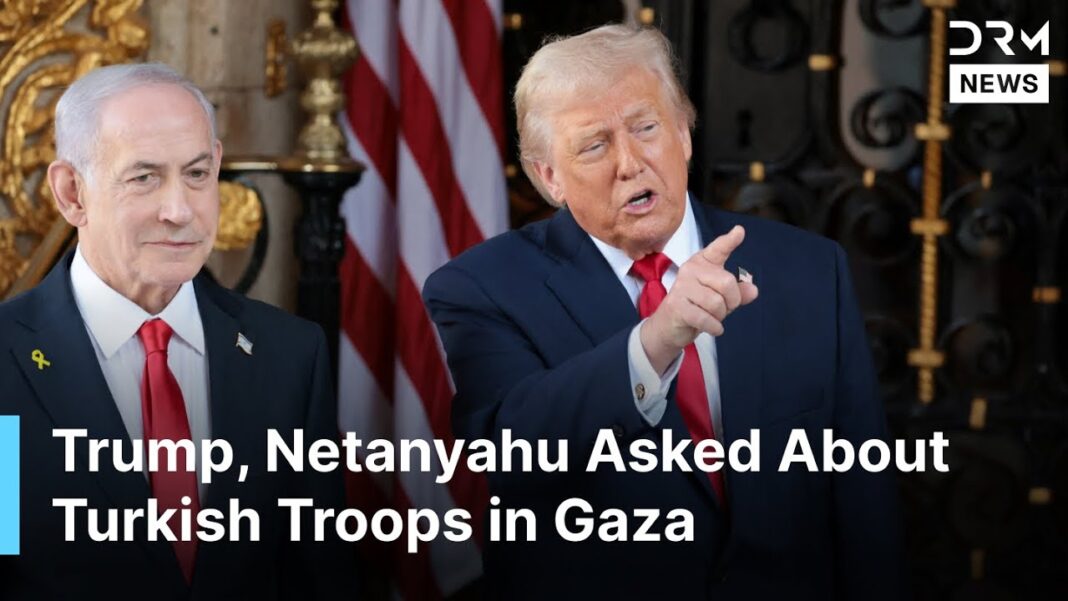
But before Prime Minister Benjamin Netanyahu even boarded his flight to Florida to meet President Donald Trump, his message was unambiguous. According to sources cited by Israel National News, Netanyahu informed the American side that Israel “does not want Turkey involved in the second phase of the Gaza ceasefire agreement—at all.” He was even more categorical behind closed doors: “Turkey will not be in Gaza and will not take any part in the second phase of the agreement.”
The American idea emerged in the run-up to the Netanyahu-Trump meeting this week, as Washington scrambled to assemble a workable framework for the “day after” in Gaza. With Hamas weakened but not eradicated, the Biden-era diplomatic paradigm has given way to a Trump administration eager to showcase muscular solutions that promise both stabilization and burden-sharing.
According to the information provided in the Israel National News report, U.S. officials believed that Turkey—an established NATO member with deep regional ties—could lend credibility and manpower to a multinational mission without provoking domestic backlash inside Israel, so long as its presence remained outside Gaza proper. Ankara’s role would have been confined to command-and-control facilities in Jordan or Egypt, supplemented by Turkish logistical and intelligence expertise.
Yet in Jerusalem, the very suggestion of Turkish involvement was interpreted not as a compromise but as a strategic red line.
No Israeli official articulated the depth of opposition more bluntly than Minister of Energy and Infrastructure Eli Cohen, a senior member of the security cabinet. In a wide-ranging interview with Israel National News, Cohen dismissed the Turkish concept outright.
“Turkey will not be part of the peace force. This issue is not up for negotiation,” Cohen declared. “Neither Turkey nor Qatar will be included. Both are part of the Muslim Brotherhood axis. Turkey’s actions would work directly against Israeli and American interests. It would try to ensure Hamas maintains some form of power, and that is something we will not agree to.”
For Cohen, the concern is not symbolic but existential. Ankara’s ideological proximity to the Muslim Brotherhood, he argued, renders it structurally incapable of acting as a neutral stabilizer in Gaza. Any Turkish footprint—whether in Amman, Cairo, or Gaza City—would inevitably tilt the postwar balance toward Hamas or its ideological cousins.
The Israeli anxiety is deeply rooted in the past decade of Turkish policy under President Recep Tayyip Erdoğan. Once a strategic partner of Israel, Turkey has repositioned itself as one of the most outspoken defenders of Hamas in the Muslim world. Erdoğan has repeatedly branded Hamas as a “resistance movement” rather than a terrorist organization, and Ankara has hosted Hamas political leaders even after the October 7 massacre.
Israel National News has documented how Israeli intelligence officials increasingly view Turkey not merely as a difficult ally but as an active ideological adversary—one whose ambitions in Gaza could collide directly with Israel’s core security doctrine.
From Jerusalem’s perspective, Turkish involvement in a Gaza stabilization force—even in a logistical or rear-base role—would give Erdoğan a foothold in shaping Gaza’s political rebirth. That, Israeli officials fear, would enable Ankara to influence reconstruction funds, mediate local power structures, and subtly entrench Islamist governance under the guise of international legitimacy.
Sources close to the Prime Minister, cited by Israel National News, said Netanyahu delivered a firm message to President Trump during their Florida meeting: Israel will accept international participation in Gaza only from actors aligned unequivocally with Israeli and American strategic interests.
“Turkey will not be in Gaza,” Netanyahu reportedly said, leaving no room for reinterpretation.
The Prime Minister’s posture reflects a broader Israeli insistence that the second phase of the ceasefire agreement must not replicate the failures of the past, when international frameworks—UNRWA most notably—became conduits for radicalization rather than engines of stability.
The phrase “Muslim Brotherhood axis,” repeated by Cohen and echoed throughout Israel National News coverage, is central to Israel’s reasoning. In Israeli strategic doctrine, Turkey, Qatar, and to some extent Jordan are increasingly viewed not merely as states but as ideological hubs within a transnational Islamist ecosystem.
This axis, Israeli officials contend, is not interested in a demilitarized Gaza integrated into a moderate regional order. Instead, it seeks to preserve Hamas as a political actor—stripped perhaps of overt military capabilities but entrenched as the de facto ruler of the Strip.
In this reading, Turkish involvement would function as a Trojan horse: outwardly humanitarian, inwardly political.
Beyond the diplomatic chessboard, Cohen also addressed the humanitarian catastrophe unfolding in Gaza. In his interview with Israel National News, he painted a bleak picture of the enclave’s future.
“The issue with Gaza is that it will not recover in the near future,” he said. “It’s in ruins after the devastation Hamas caused.”
In a striking departure from previous Israeli rhetoric, Cohen suggested that Gaza’s residents should be granted what he termed “the basic right to leave the region.”
“We must give Gaza’s residents the basic right to leave the region, to go anywhere else in the world, not just to Egypt,” he said.
The statement spotlights a growing sentiment within Israel’s security cabinet: that Gaza’s rehabilitation cannot be confined to bricks and mortar. Demographic mobility—whether temporary or permanent—may be the only viable escape valve for a territory ravaged beyond recognition.
For the Trump administration, the Israeli veto on Turkey complicates an already fraught diplomatic mission. The White House is attempting to assemble an international coalition capable of enforcing security in Gaza while avoiding a prolonged Israeli military occupation.
Yet as the Israel National News report emphasized, the list of acceptable partners in Jerusalem is shrinking. Qatar is out. Turkey is out. UN-linked bodies are viewed with suspicion bordering on hostility.
What remains are U.S. allies such as the United Arab Emirates, possibly Egypt, and perhaps selected European contingents—actors with neither ideological sympathy for Hamas nor ambitions to shape Gaza’s political future.
The confrontation over Turkey is not merely about logistics or troop deployments. It reflects a profound divergence between Washington’s instinct for inclusive multilateralism and Jerusalem’s insistence on ideological vetting.
For Israel, the lesson of October 7 is stark: any ambiguity in Gaza’s postwar architecture will be exploited. Israel National News has repeatedly reported that Israeli defense planners now see the “day after” as no less dangerous than the war itself.
If Hamas is allowed—even tacitly—to retain influence, they argue, Gaza will revert to a launchpad for terror within a decade, if not sooner.
As the negotiations proceed, one thing appears settled. According to the information contained in the Israel National News report, Israel has drawn a line in sand and steel: Turkey will have no role—direct or indirect—in the second phase of Gaza’s ceasefire framework.
Whether Washington will acquiesce or attempt to press the issue remains to be seen. But for now, the message from Jerusalem could not be clearer. The future of Gaza, whatever shape it takes, will not be engineered with the assistance of those Israel believes are aligned with the very forces it just spent months fighting to dismantle.
In the volatile landscape of Middle Eastern diplomacy, this is not merely a policy disagreement. It is a declaration of sovereignty over the terms of peace itself.
Hamas will use Gaza as a launchpad, not “within decades,” but tomorrow. Everyone knows Turkey and Qatar should not be involved but President Trump and his clueless advisors. Those useful idiots who recognized “Palestine,” should put their skin in the game. Call in Ireland, France, Australia and Spain. Let them risk their people’s lives for the cause so dear to their hearts.