



|
Getting your Trinity Audio player ready...
|
By: Andrew Carlson
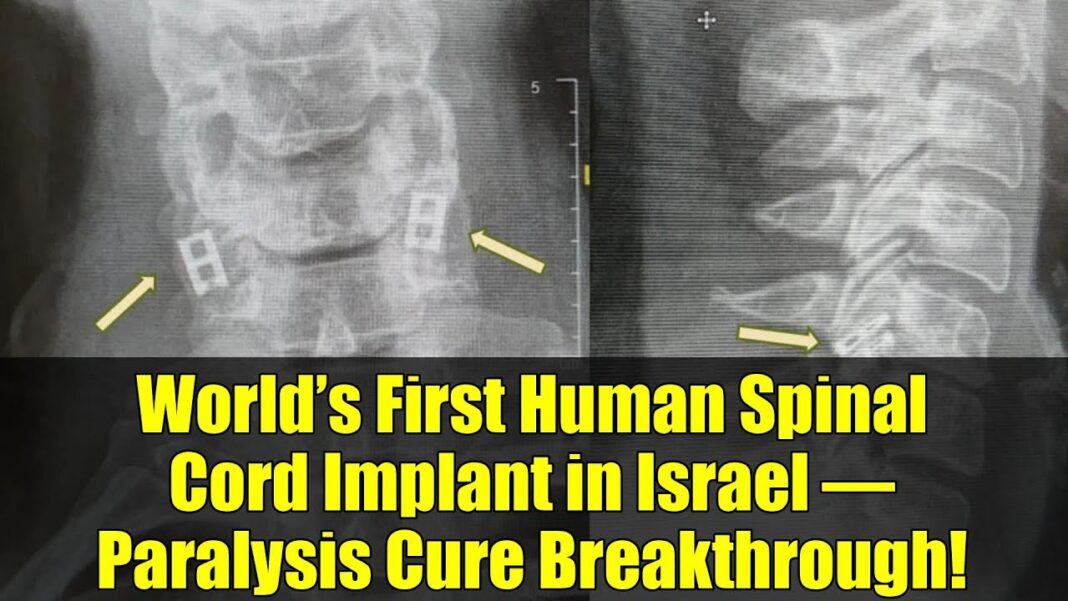
In a development that could reshape the future of regenerative medicine and the treatment of paralysis, Israel is preparing to perform the world’s first human spinal cord implant utilizing a patient’s own cells. According to an announcement by Tel Aviv University, the groundbreaking procedure is slated to take place in the coming months under the direction of Professor Tal Dvir, the pioneering scientist who heads the Sagol Center for Regenerative Biotechnology.
As reported by VIN News on Wednesday, this achievement represents a profound medical and scientific milestone. For decades, spinal cord injuries have been regarded as irreparable, with patients facing a lifetime of immobility and associated health complications. Now, for the first time, there is credible hope that a procedure developed in Israel may enable paralyzed individuals to rise from their wheelchairs and walk again.
The essence of the innovation lies in transforming a patient’s own biological material into a fully functioning spinal cord implant. The procedure involves extracting blood and fat cells from the individual, reprogramming them in the laboratory, and cultivating them into a lab-grown spinal cord that can be surgically implanted to replace damaged tissue. This replacement tissue is designed to reconnect the nervous system, allowing the brain to once again transmit signals through the spinal column.
Animal trials have provided compelling evidence of the therapy’s potential. In controlled studies, paralyzed rats receiving the implant regained the ability to walk, demonstrating the extraordinary promise of this technique. As the VIN News report highlighted, such results represent not merely an incremental advance but a paradigm shift in the treatment of conditions long considered beyond the reach of modern medicine.
Professor Tal Dvir, whose leadership has been instrumental in moving the project from theoretical science to practical application, explained that the ultimate goal is nothing short of life transformation. “We want to give patients back their independence,” he said. “This is about people being able to rise from wheelchairs and reclaim basic mobility.”
The move from animal testing to human application reflects years of rigorous research and development. The technology has been brought to commercial readiness through Matricelf, an Israeli biotechnology company founded to translate these laboratory innovations into therapeutic reality. Matricelf’s leadership has worked closely with Tel Aviv University to refine the implants for safe human use.
In a statement carried by VIN News, Matricelf CEO Gil Hakim described the approval as “a step toward transforming an area of medicine long considered untreatable.” He emphasized the broader implications for the field of regenerative biotechnology, noting that spinal cord injuries are only one of several conditions that may one day be addressed through personalized tissue implants.
The project recently achieved a critical milestone when Israel’s Ministry of Health granted preliminary authorization for “compassionate use” trials. This regulatory step allows the procedure to be tested in eight patients who have exhausted all other options, offering them a chance at recovery while providing invaluable data for researchers.
As the VIN News report explained, “compassionate use” refers to a regulatory mechanism permitting patients with life-altering or terminal conditions to access experimental therapies prior to full clinical approval. In this case, the ministry’s decision reflects both the urgency of spinal cord injury treatment and the extraordinary potential of the Israeli innovation.
For patients, the trials represent a rare opportunity to move beyond conventional palliative care and to access a therapy that could restore lost function. For scientists and clinicians, the trials provide an indispensable opportunity to test safety, effectiveness, and long-term outcomes in human subjects.
This delicate balance between patient need and scientific rigor has defined Israel’s approach to medical innovation, particularly in fields like biotechnology and neuroregeneration where the stakes are high and the possibilities transformative.
Globally, millions of people suffer from spinal cord injuries, many of them the result of accidents, violence, or degenerative diseases. Current medical interventions focus largely on rehabilitation, pain management, and adaptation to permanent paralysis. The prospect of reversing paralysis through a patient-specific implant could fundamentally alter the landscape of neurology and orthopedics worldwide.
According to the report at VIN News, Israel’s breakthrough has already drawn the attention of medical researchers, bioethicists, and patient advocacy groups internationally. If the upcoming human procedures prove successful, they may trigger a cascade of clinical trials and accelerate the development of similar regenerative techniques for other organs and tissues.
The principle underlying the technology—the ability to reprogram and grow replacement tissues from a patient’s own cells—also addresses one of the most persistent challenges in transplantation medicine: immune rejection. By using the patient’s own biological material, the risk of rejection is virtually eliminated, a feature that dramatically increases the likelihood of long-term success.
Yet even amid the optimism, scientists caution that many hurdles remain. The transition from laboratory animal models to complex human physiology is fraught with uncertainties. Factors such as the severity of the injury, the timing of treatment, and the patient’s overall health will influence outcomes. Moreover, long-term monitoring will be required to assess the durability of restored mobility and the potential for unforeseen complications.
As the VIN News report noted, the path from compassionate use to mainstream clinical adoption is a long one. Regulatory authorities will demand extensive data not only on safety and efficacy but also on reproducibility, manufacturing standards, and ethical considerations. Nevertheless, the fact that the procedure has reached this stage at all is viewed by many as an extraordinary achievement.
The project also calls attention to Israel’s growing stature as a global leader in regenerative medicine and advanced biotechnology. Institutions such as Tel Aviv University and companies such as Matricelf are at the forefront of innovations ranging from stem cell therapies to lab-grown organs. This concentration of scientific expertise, combined with a culture of entrepreneurial innovation, has enabled Israel to push boundaries in fields where many other nations have lagged.
The VIN News report emphasized Israel’s unique ability to combine academic research, government support, and private-sector investment in ways that produce rapid scientific breakthroughs. The spinal cord implant project is a quintessential example of this model, uniting laboratory discovery with clinical application in record time.
For patients and their families, the announcement has generated a surge of hope. Advocacy groups for individuals with paralysis have welcomed the news while acknowledging that the road ahead will be challenging. “Even the possibility of regaining some mobility is a miracle,” one advocate told VIN News, “and the fact that this is being pioneered in Israel is a source of pride for our community.”
Medical ethicists, too, have noted the significance of Israel’s approach, which balances compassion for patients with rigorous scientific oversight. “This is precisely the kind of responsible innovation we need,” said a leading bioethicist interviewed by VIN News, stressing that such projects must remain anchored in both hope and honesty.
The forthcoming surgery in Israel is more than a medical procedure; it is a defining moment in the history of regenerative biotechnology. If successful, it will not only alter the lives of the initial patients but also redefine what is possible in the treatment of paralysis and related conditions.
Israel is preparing to take a step that could transform the lives of millions: harnessing the patient’s own biology to repair what was once considered irreparable. It is a leap of science, of medicine, and ultimately of human imagination—one that highlights Israel’s role as a pioneer in the quest to heal through innovation.
