



|
Getting your Trinity Audio player ready...
|
By: Fern Sidman
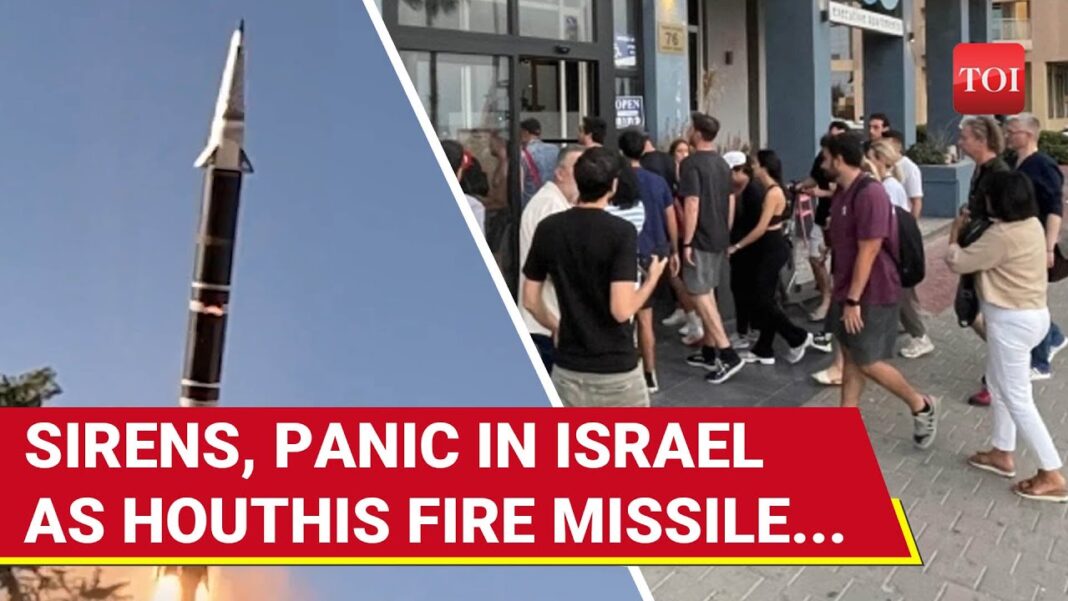
Amid escalating tensions in the region and a renewed barrage of missile threats, the Israel Defense Forces (IDF) are preparing for a fresh wave of retaliatory airstrikes against Houthi-controlled targets in Yemen. This response follows the interception of a ballistic missile launched by the Iranian-backed Houthi militia toward central Israel—an act seen by defense analysts as a significant escalation in the regional shadow war gripping the Middle East.
According to statements issued by the IDF on Sunday, urgent evacuation warnings have been disseminated to residents in the Yemeni port cities of Hodeidah, Ras Issa, and Salif, as well as those in the vicinity of the Hodeidah-Ras al-Khatib power station. All of these sites fall under Houthi jurisdiction and are believed to be integral components of the group’s military and logistical infrastructure.
The announcement signals what is expected to be a large-scale and targeted air campaign designed to dismantle Houthi launch capabilities and deter future attacks. Israeli officials have not specified the timing of the operation, but military sources suggest the strikes are imminent, given the urgency of the evacuation directive and the strategic importance of the listed targets.
The Houthi missile assault, intercepted by Israel’s Arrow missile defense system, marks the latest in a string of provocations dating back to October 2023, when the Houthis declared solidarity with Hamas in Gaza and began targeting Israeli territory and commercial vessels in the Red Sea. While most of these strikes have been intercepted or fallen short of their targets, the persistent nature of the threat has prompted Israel to widen its military focus beyond Gaza and Lebanon, to the broader Iranian axis stretching across the region.
As Israeli defense officials have repeatedly emphasized, these attacks are not merely symbolic gestures of solidarity with the Palestinians. Rather, they represent a coordinated regional campaign spearheaded by Iran and executed by its various proxies—including Hezbollah in Lebanon, Islamic Jihad in Gaza, and the Houthis in Yemen—with the intent of encircling Israel and overwhelming its defense systems.
“The Houthi missile threat is not an isolated nuisance. It is a calculated element in Iran’s multi-front strategy against the State of Israel,” a senior IDF officer told reporters in a closed briefing. “We will not allow our citizens to live under threat from terrorists operating hundreds of miles away.”
The upcoming Israeli strikes follow earlier IDF air operations targeting Houthi assets in Yemen. In January 2025, Israeli warplanes struck several missile launch sites and radar installations near Sana’a and Taiz, in what was then described as a “preventive deterrence operation.” More recently, in May 2025, the IDF intensified its efforts with a coordinated assault on Houthi-controlled port infrastructure, disrupting maritime logistics the group was allegedly using to smuggle weapons.
That campaign also came with a stark warning from the Israeli government: Any continued aggression from Yemen would invite a full-scale naval and aerial blockade, a strategy that remains on the table should hostilities persist.
While Israel has not formally declared war on the Houthis, the recurring military engagements underscore the shifting geographic scope of Israel’s defense doctrine—a posture increasingly defined by proactive, transnational military responses to asymmetric threats, whether they arise in Lebanon, Iraq, Syria, or Yemen.
The IDF’s rare step of issuing a public evacuation order ahead of a military operation reflects a dual strategy: first, to minimize civilian casualties in the target areas; second, to assert a clear moral and strategic distinction between the IDF and its adversaries. The warning also serves as a psychological tool, signaling to the Houthi leadership that their assets are under surveillance and can be struck at will.
International military experts believe that the ports of Hodeidah and Salif, in particular, play a critical role in Houthi military operations—both as entry points for smuggled weapons and as launchpads for long-range missile attacks. Destroying or incapacitating these ports would not only blunt the Houthis’ operational capabilities but also undermine Iran’s broader regional logistics network.
“The IDF’s posture reflects a precise understanding of regional asymmetries,” said Col. (ret.) Amos Harel, a defense analyst and former IDF strategist. “Israel cannot afford to absorb threats passively. By striking decisively and publicly, it reshapes the regional calculus.”
The looming airstrikes also reflect the complexity of the current Middle East crisis. What began as a war between Israel and Hamas has metastasized into a multi-front, transnational conflict, involving Iranian proxies from Lebanon to the Red Sea. While Gaza remains the central arena of hostilities, it is increasingly clear that Israel is now entangled in a broader campaign to assert regional deterrence and dismantle Iran’s influence.
At the same time, the involvement of the Houthis introduces additional humanitarian and geopolitical challenges. Yemen, already ravaged by a decade-long civil war, remains a fragile state where international organizations have warned of severe civilian suffering should wider military operations unfold. The IDF’s efforts to mitigate collateral damage may find little resonance in a region already saturated with suffering.
As of Sunday night, no timeline had been provided for the launch of the IDF operation, but the urgency of the warning—paired with the strategic significance of the targets—indicates that the airstrikes may already be underway by the time of publication. What is unmistakable, however, is the message being sent from Tel Aviv to Sanaa: Israeli airspace is not a testing ground for proxies, and retaliatory silence will not be mistaken for weakness.
The looming confrontation over Yemen’s skies represents not only a military response to a missile launch but also a deeper assertion of Israeli deterrence at a time of historic regional volatility. For the people of Hodeidah, Ras Issa, and Salif, the IDF’s warning is clear. For the international community, the time to reckon with the reach and resolve of Israel’s defense strategy has come.

Bon chance! I understand the argument for warning the blood soaked, Muslim monsters that the IDF will strike them.
Personally, I prefer the results so by Houties be visited upon them. They are trying to slaughter my people. I think we should kill them first without protecting them in any way.
Bucking for the Nobel Peace Prize, eh Guy?
I give Guy credit, he is consistant lol, TjV reader of the year
Why does the PM of Israel continue to cock around with the Houthis? Burn the place to the ground if Israel has to. Where are the Chief Rabbis and others like them? Doesn’t the Torah have an opinion concerning what to do with the Houthis? They say nothing while Israel is attacked by them. Its Kamtza and Bar-Kamtza all over again. Even King Ahab would never tolerate this kind of behavior but these Rabbis are quiet when Israel is under attack. Why???