



|
Getting your Trinity Audio player ready...
|
By: Arthur Popowitz
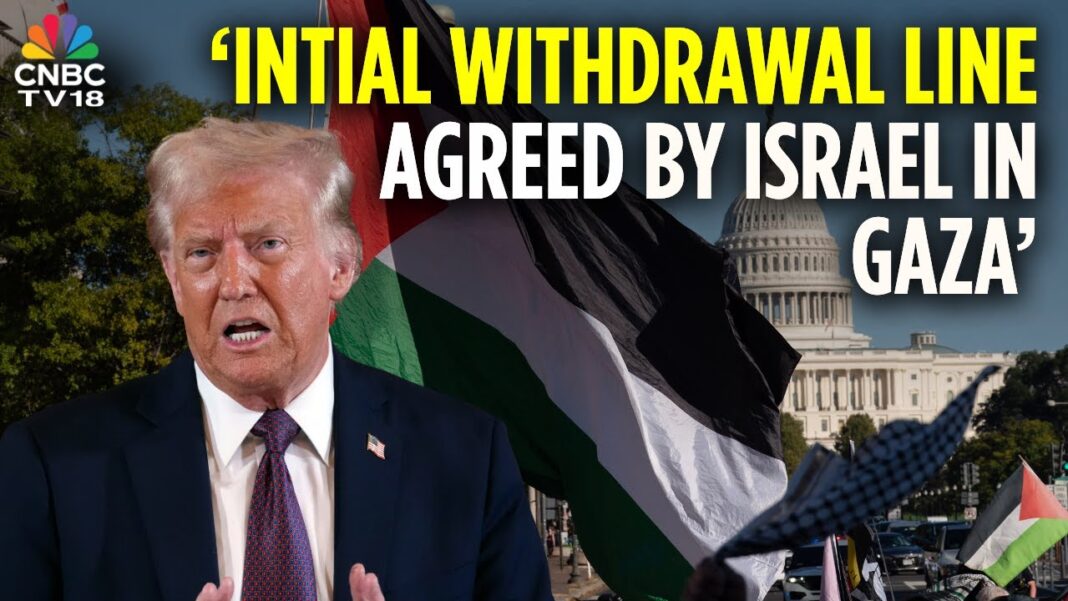
Israel has agreed to the first stage of a phased withdrawal of troops from the Gaza Strip, President Donald Trump announced over the weekend, a move that has injected both momentum and uncertainty into fragile negotiations over hostages, ceasefire terms, and the long-term future of the enclave. According to a report on Sunday at CNN, Trump confirmed that Jerusalem has committed to what he called a “line of initial withdrawal,” a geographic marker that would allow for a temporary halt to hostilities once Hamas formally accepts the arrangement.
The announcement marks the most concrete step yet in the American-led effort to broker a ceasefire agreement after months of relentless fighting. Trump, who has cast himself as the indispensable architect of the deal, stressed in remarks reported by CNN that a ceasefire and prisoner exchange would take effect “immediately” once Hamas confirms the terms.
For Israeli Prime Minister Benjamin Netanyahu, the agreement represents both a tactical concession and a carefully calibrated gambit. While Israel has agreed to reposition forces, Netanyahu has insisted that key areas of Gaza will remain under Israeli control during the initial phase. This includes the Philadelphi Corridor along the Egypt-Gaza border and other strategic points designed to prevent Hamas from rearming.
According to the information provided in the CNN report, Netanyahu has dispatched negotiators to Egypt, where discussions are taking place under the mediation of Cairo, Washington, and Doha. The prime minister has urged that talks “should only take a few days,” while accusing Hamas of intentionally dragging out the process to buy time. “Hamas has perfected the art of delay,” he told reporters, according to CNN’s coverage. “We cannot and will not allow stalling to dictate the pace of these talks.”
As outlined by Israeli officials and reported extensively by CNN, the emerging framework rests on a two-stage process:
Initial Withdrawal and Hostage Release
Israeli forces would reposition away from heavily populated areas but maintain control of critical security corridors.
Hamas would release a group of hostages — both Israeli nationals and foreign citizens — in exchange for an initial pause in hostilities.
Demilitarization of Gaza
In the second phase, Hamas would be disarmed and Gaza demilitarized, either voluntarily through diplomacy or forcibly through Israeli action. Netanyahu has insisted that demilitarization is non-negotiable, describing it as a “prerequisite for lasting peace.”
As CNN noted in its analysis, this sequencing reflects Israel’s longstanding doctrine that any ceasefire must not simply freeze the conflict but decisively reduce Hamas’s military capabilities.
Central to the negotiations is the fate of the hostages, whose plight has galvanized Israeli society and shaped the trajectory of the war. According to the information provided in the CNN report, Israel estimates that 48 hostages remain in Hamas custody, including around 20 believed to be alive. Their return has become a national priority, driving public opinion and constraining Netanyahu’s political maneuvering.
Trump, in his announcement, emphasized that hostage release must occur in the opening phase of the deal. “There will be no peace without their return,” he said, according to CNN. Netanyahu has echoed this view, underscoring that the Israeli delegation in Egypt has been instructed to make the hostages’ safe recovery the immediate focus of talks.
Hamas has not yet confirmed acceptance of the proposed withdrawal line. In reports cited by CNN, Hamas leaders indicated that while they are open to discussing the framework, they remain deeply suspicious of Israel’s intentions. Analysts quoted by CNN suggested that Hamas may demand additional concessions — including guarantees of humanitarian aid, assurances against future Israeli raids, or leniency on prisoner releases — before committing to the deal.
For now, Hamas appears to be calibrating its response, balancing pressure from international mediators with internal demands from its leadership and base. “They are weighing whether agreeing to this plan will allow them to survive politically,” one regional analyst told CNN.
The deal’s momentum is being driven, in part, by Trump’s public pressure campaign. The president has made clear that Hamas faces stark consequences if it rejects the proposal. As CNN reported, Trump warned that if Hamas does not agree to the ceasefire, it risks “complete obliteration.”
The blunt language reflects Trump’s transactional approach to international negotiations, mixing threats with offers of political cover. In remarks to CNN’s Jake Tapper, Trump responded to questions about whether Hamas had effectively rejected the plan by declaring, “We will find out. Only time will tell!”
Secretary of State Marco Rubio has sought to add nuance to the administration’s stance, acknowledging in interviews with CNN that “the war is not yet over.” Rubio described the release of hostages as the first and most urgent priority but cautioned that shaping Gaza’s long-term governance and demilitarization would be far more difficult. “All that work is going to be hard,” he said. “But without it, you’re not going to have lasting peace.”
According to CNN’s diplomatic correspondents, Egypt has emerged as a critical mediator, leveraging its border access and longstanding intelligence ties with Hamas. Qatar, too, has played a behind-the-scenes role, particularly in financing and facilitating discussions. For both countries, the negotiations represent not only a humanitarian imperative but also a chance to assert regional influence.
At home, Netanyahu faces the challenge of balancing competing pressures. On one side are families of hostages demanding swift action to secure their loved ones’ release. On the other are hawkish members of his coalition, who fear that any withdrawal, however partial, risks leaving Hamas in place to regroup.
As CNN reported, Netanyahu has tried to straddle this divide by emphasizing that the current deal does not end the war but merely pauses it to achieve specific objectives. “This is not the end,” he said. “Phase two will ensure Hamas can never again threaten our people.”
Internationally, the tentative agreement has been met with cautious optimism. European leaders, according to the CNN report, welcomed Israel’s willingness to consider a withdrawal, framing it as a necessary step toward a sustainable peace. At the same time, they warned that the deal’s success will depend on whether Hamas complies in good faith.
Human rights groups have urged both sides to ensure that humanitarian aid is allowed to flow into Gaza during the ceasefire. As the CNN report noted, aid agencies are preparing contingency plans to scale up deliveries if hostilities pause, though they remain wary of the fragility of the truce.
The coming days in Cairo will prove decisive. Israeli negotiators, backed by the United States and Egypt, are pressing Hamas for a firm commitment to the first-phase terms. Trump has set an implicit deadline, warning that patience is limited and consequences severe.
According to the information contained in the CNN report, the Israeli security establishment remains skeptical that Hamas will accept full demilitarization, a sticking point that could derail later stages of the plan. But for now, officials are focused on the achievable: securing the release of hostages and achieving a temporary cessation of hostilities.
The initial agreement to a withdrawal line in Gaza marks the closest the region has come to a ceasefire since the outbreak of war last year. For Netanyahu, it represents a careful attempt to balance security imperatives with international pressure. For Trump, it is an opportunity to cast himself as the peacemaker who can achieve what others could not.
But as CNN’s coverage has emphasized, the deal remains precarious. Hamas’s silence looms large, and the risks of collapse are ever-present. Whether the plan becomes a turning point or another missed opportunity will depend on decisions made in the coming days — decisions that carry profound consequences not just for Israel and Gaza, but for the broader Middle East.
Ridiculous that TJV is relying on anti-Israel leftist CNN for the news. I see this as “defeat being snatched from the jaws of victory”. The IDF was methodically effectively crushing Hamas when it was suddenly at the 11th hour instructed to stand down by Trump, who has been corrupted by the muslim monsters, the worst in the world which are Qatar (and Iran). Netanyahu had the no choice but to comply. I do not understand the idea of Israel “negotiating” with the Muslim monsters. The only thing which should be discussed is the method of complete surrender by Hamas, which the IDF should supervise. If this is a legitimate surrender we should very quickly never again see an armed Hamas terrorist in Gaza.
Meanwhile, publicity-hungry narcissistic hostage “families“ (cousins, aunts, uncles, and every other fringe relative) get to play out their celebrity fantasies on TV. The real “hostages” have been the Israeli people making huge sacrifices for these noisy fringe few. As I have been saying sense it became clear that the hostages were being held by the totality of the Gazan Muslim monsters with virtually 100% “Palestinians’” support, “ Israel’s response should have been to focus on the millions of Gazan monsters, eliminate them en masse, and help the tortured hostages to an early painless death. (The other thing which is galling and disgusting is to see the overwhelmingly young lefty female Israeli useful idiot “protesters” making a spectacle of themselves.)