



|
Getting your Trinity Audio player ready...
|
Israel Launches Gaza Airstrikes After Truce Breach, Eliminates Hamas Operative Linked to Oct. 7 Attack
By: Fern Sidman
In the early hours of Sunday morning, the uneasy quiet that has intermittently settled over the Gaza Strip since the U.S.-brokered ceasefire of October was once again punctured by the thunder of Israeli airstrikes. According to the Israel Defense Forces, the operations were launched in response to what the military described as a “blatant violation” of the ceasefire only hours earlier. VIN News, which has been closely monitoring developments on the ground, reported on Sunday that the strikes targeted multiple sites across northern Gaza, Gaza City, and Khan Younis, underscoring the geographic breadth of Israel’s response and the fragility of the truce that has sought, with uneven success, to halt more than two years of brutal conflict.
The IDF stated that among those killed in the overnight raids was Ahmad Bayouk, identified as a Hamas operative who infiltrated Israel and participated in the assault on the Re’im military base during the October 7, 2023 onslaught that marked the opening salvo of the current war. Bayouk’s role in that attack placed him among a cohort of militants long sought by Israeli intelligence, figures whom the military regards not merely as battlefield adversaries but as architects of the most traumatic episode in Israel’s recent security history. The announcement of his death, therefore, carried both tactical and symbolic weight, signaling Israel’s continued pursuit of those it holds responsible for the initial breach of its defenses.
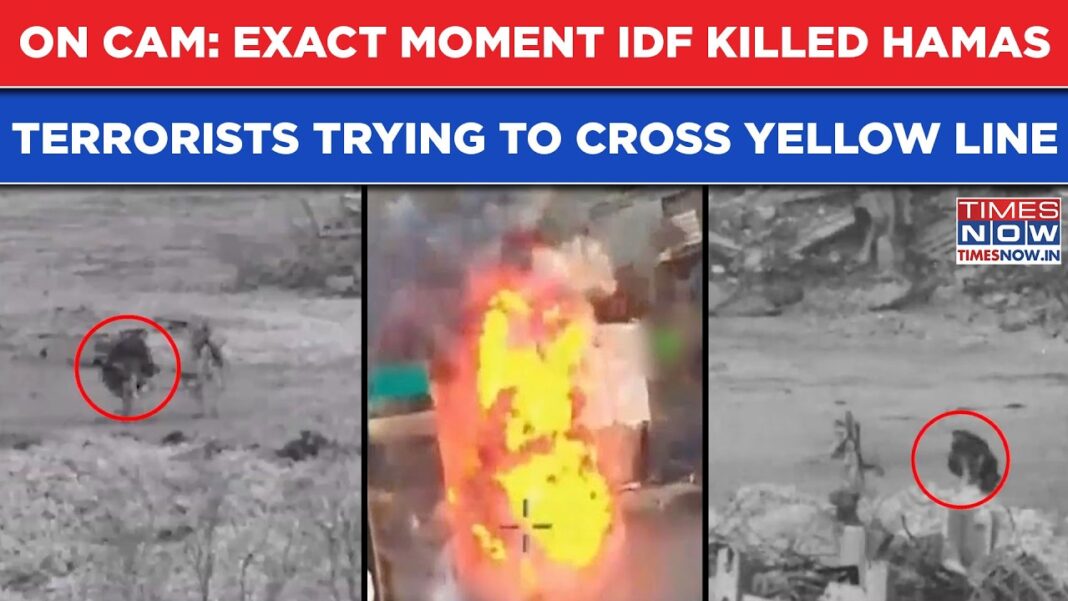
The immediate trigger for the airstrikes, as reported by VIN News, was an incident late Saturday in which five Palestinian gunmen reportedly emerged from a tunnel and advanced toward Israeli troops positioned on the Israeli side of the ceasefire line. The IDF described the episode as a direct and dangerous encroachment, one that underscored the persistent threat posed by subterranean infrastructure even during periods nominally defined by restraint. In its statement, the military asserted that the targeted operatives had been engaged in efforts to restore the capabilities of terror organizations in the Strip and were actively advancing plans for attacks against IDF forces and Israeli territory. The tunnel incident, in this telling, represented not an isolated provocation but part of a broader pattern of reconstitution and preparation by armed groups operating under the cover of ceasefire.
The strikes were framed by Israeli officials as calibrated responses, intended to reassert deterrence without collapsing the broader ceasefire architecture. This balancing act—between enforcing red lines and avoiding a slide back into full-scale war—has defined Israel’s military posture since October. The ceasefire, brokered with American involvement, was designed to arrest the spiral of violence that had consumed Gaza and southern Israel since the October 7 attacks. Yet, the truce has been punctuated by sporadic incidents, ranging from attempted infiltrations to localized exchanges of fire, each testing the elasticity of the agreement and the patience of both sides.
The IDF’s announcement did not end with the overnight strikes. In a separate operation conducted Monday in southern Gaza’s Rafah, Israeli forces eliminated Azem Abu Huli, described as a commander within Palestinian Islamic Jihad’s elite forces in central Gaza. According to the military, Abu Huli played a pivotal role in supplying weapons to operatives and in advancing attacks against Israeli troops. The IDF further alleged that he had commanded Islamic Jihad fighters who crossed into Israel during the October 7 invasion and had overseen training programs focused on scenarios involving the abduction of Israeli soldiers.
The targeting of Abu Huli thus extended the scope of Israel’s response beyond Hamas to include its allied militant factions, reflecting a strategic calculus that views the Gaza battlefield as an interconnected network of armed actors rather than a monolithic adversary.
The VIN News report, while relaying the IDF’s account, also noted the absence of immediate casualty figures from Palestinian sources and the lack of independent verification regarding the identities and roles of those killed. This asymmetry of information has become a recurring feature of the conflict, complicating efforts by outside observers to assess the precise impact of Israeli operations. In the fog of war, claims and counterclaims often circulate in parallel, with each side seeking to shape the narrative of legitimacy and proportionality. For Israel, the emphasis on specific targets and operational rationales serves to frame its actions as narrowly tailored responses to concrete threats. For Palestinian factions and their supporters, the airstrikes are often depicted as violations of a ceasefire that is already perceived as unevenly enforced.
The broader strategic context is one of uneasy containment. The ceasefire has curtailed large-scale hostilities, but it has not resolved the underlying dynamics of the conflict. Armed groups in Gaza continue to maintain infrastructure and personnel, while Israel remains vigilant against any attempt to exploit the lull to rebuild offensive capabilities. The tunnel incident described by the IDF epitomizes this tension: even as overt clashes have diminished, the subterranean war—hidden networks, covert movements, and clandestine preparations—persists beneath the surface. The VIN News report highlighted how this undercurrent of activity perpetuates mutual suspicion, rendering the ceasefire less a stable peace than a temporary suspension of overt confrontation.
The targeting of figures such as Bayouk and Abu Huli also reflects Israel’s ongoing campaign of decapitation strikes aimed at degrading the leadership and operational coherence of Hamas and other terrorist groups. VIN News has reported extensively on the Israeli security establishment’s belief that removing experienced commanders disrupts planning cycles and complicates efforts to mount coordinated attacks. Yet the efficacy of this strategy remains contested. Critics argue that such strikes, while tactically successful, risk perpetuating cycles of retaliation and undermining prospects for a more durable political settlement. Supporters contend that in the absence of a comprehensive diplomatic framework capable of dismantling terrorist infrastructures, targeted military action remains a necessary instrument of self-defense.
The overnight strikes also reverberate beyond the immediate military sphere, intersecting with regional and international diplomatic efforts to stabilize Gaza. The ceasefire’s credibility is intimately tied to perceptions of enforcement. If violations go unanswered, deterrence erodes; if responses are perceived as excessive, the truce risks unraveling. The IDF’s characterization of the strikes as responses to a “blatant violation” seeks to anchor its actions within the logic of conditional restraint: force is deployed not as a repudiation of the ceasefire but as a mechanism to preserve its boundaries.
As dawn broke over Gaza on Sunday, the echoes of explosions receded, leaving in their wake the unresolved tension between deterrence and de-escalation. VIN News, in chronicling these developments, has underscored the central paradox of the current moment. The overnight airstrikes, and the deaths of figures like Ahmad Bayouk and Azem Abu Huli, illustrate how quickly that equilibrium can be tested. In this precarious interlude between war and peace, every tunnel breach and every retaliatory strike becomes a referendum on the durability of an agreement that, while halting the worst of the violence, remains perpetually on the brink of rupture.