



|
Getting your Trinity Audio player ready...
|
By: Fern Sidman
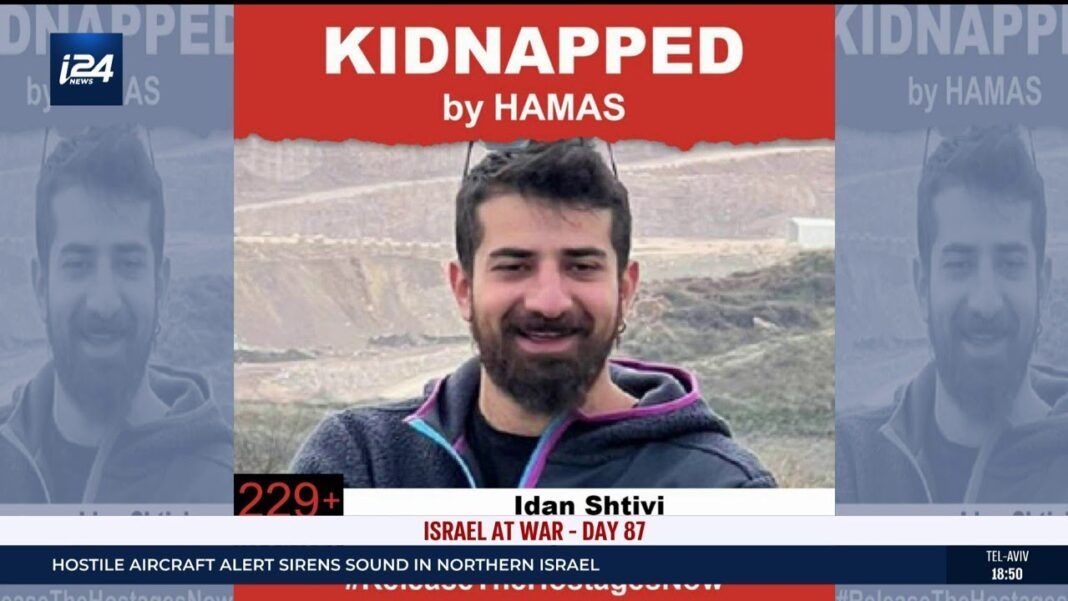
The Israeli government confirmed on Saturday that the second body recovered in a recent joint military and intelligence operation inside Gaza belonged to Idan Shtivi, a 28-year-old Israeli murdered by Hamas during the October 7, 2023 attacks. His remains were identified at the National Institute of Forensic Medicine, a day after officials revealed that the body of Ilan Weiss, deputy commander of Kibbutz Be’eri’s emergency response team, had also been brought home.
The announcement, which drew emotional responses from Israel’s top leadership, underscored both the immense personal sacrifices made by ordinary Israelis on that day and the continuing national anguish over the fate of those still held captive in Gaza. According to figures cited in a report that appeared on Sunday at The Jewish News Syndicate (JNS), Hamas is believed to be holding 20 living hostages and another 28 bodies more than ten months after its unprecedented cross-border assault.
Born in 1995, Idan Shtivi devoted much of his short life to environmental studies, photography, and the pursuit of extreme sports. He was known among friends and family as both an adventurer and a young man with a deep commitment to sustainability and community.
According to the Hostages and Missing Families Forum, and cited in the JNS report, Shtivi “was a student of environmental sustainability, a person who wanted to make the world a better place. He was passionate about extreme sports and free diving. He loved nature, photography, animals, and especially dogs.”
On October 7, 2023, Shtivi was at the Nova music festival near Kibbutz Re’im, where thousands had gathered to celebrate Simchat Torah. When Hamas launched its brutal assault, indiscriminately murdering festivalgoers and hunting down survivors, Shtivi acted instinctively to rescue others. Witnesses later recounted how he tried to evacuate attendees from the killing fields that stretched across the southern Negev.
It was during those efforts that he was killed, his body abducted by the terrorists and transported into Gaza. For nearly a year, his family lived in limbo, clinging to hope but fearing the worst. Now, with the confirmation of his death and return, they face the devastating finality of grief — tempered only by the knowledge that he died while saving lives.
Israeli Prime Minister Benjamin Netanyahu, whose office released a statement following the identification, called Shtivi a man of uncommon courage.
“Idan was a talented student of sustainability and government, and a courageous individual,” the Prime Minister’s Office said, as quoted in the JNS report. Netanyahu personally telephoned the families of both Shtivi and Weiss, joining them “in their sorrow and praising the courage of Ilan and Idan, who acted on October 7 to save lives.”
Netanyahu stressed that the joint effort by the Israel Defense Forces (IDF) and the Israeli Security Agency (Shin Bet) had succeeded in bringing their loved ones back for a proper Jewish burial, and he pledged that “efforts are ongoing, without pause, to return all hostages, both living and deceased.”
Israeli President Isaac Herzog echoed that sentiment in a post on X, saying he hoped the news would bring “a measure of comfort to his beloved parents, Eli and Dalit, and to his siblings, who have shown remarkable strength in their determined struggle for his return.” He added: “These moments of deep sorrow remind us of one truth: Hamas’ crimes are crimes against humanity. The world must act with moral clarity and press for the release of all the hostages. Every last one.”
The Hostages and Missing Families Forum, which has become a central voice in Israel’s public diplomacy since the massacre, emphasized that Shtivi’s story is emblematic of the human toll of Hamas’s brutality.
The Forum described him as a man who had gone to the Nova festival to “photograph and document his friends who were playing music and leading workshops.” What began as a day of joy and celebration ended with carnage, as Hamas gunmen executed over 360 festivalgoers, according to figures reported in the JNS report.
Shtivi’s parents, Eli and Dalit, together with his siblings, have been among the thousands of Israeli families pressing the government and international community to secure the release of those still held captive. Their ordeal — oscillating between despair, resilience, and advocacy — has become part of the larger national trauma that continues to shape Israeli society nearly a year after the attack.
The IDF and Shin Bet described the retrieval of Shtivi’s and Weiss’s bodies as a “complex intelligence-led operation.” Conducted under the command of the IDF’s Southern Command and aided by Military Intelligence, the mission relied on precise data provided by the Hostage Task Force.
As JNS reported, the process of recovery was meticulous, involving collaboration between security forces, forensic teams, and the Israeli police to ensure proper identification. The secrecy surrounding operational details underscores the extreme risks involved; Israeli forces have repeatedly emphasized that Hamas uses the remains of victims as both bargaining chips and propaganda tools.
While the recovery provides some closure for families, it also highlights the grim reality that many hostages may not return alive. The confirmation of Shtivi’s death compounds the sense of urgency for the Israeli government as it faces mounting international pressure and domestic outrage over the hostages’ plight.
The deaths of Shtivi and Weiss call attention to two recurring themes in the October 7 narrative: the selfless bravery of ordinary Israelis and the sheer depravity of Hamas’s assault.
Weiss, 56, died defending his kibbutz and was taken into Gaza, while Shtivi died saving strangers at a music festival. Both were abducted — their bodies weaponized by Hamas to torment families and a nation.
As JNS has frequently noted, October 7 was not simply a military attack but a campaign of terror aimed at civilians. More than 1,200 Israelis were murdered, and at least 251 people were abducted into Gaza, including women, children, and the elderly. The cruelty of the assault — massacres, torture, kidnappings — shocked the world and continues to reverberate in diplomatic forums.
Hamas, in turn, has consistently used hostages, both living and dead, to extract concessions, delay negotiations, and project leverage. For Israel, bringing them home has become both a moral imperative and a central element of its military campaign in Gaza.
The retrieval of bodies such as Shtivi’s illustrates the dilemma Israel faces. Every rescue or recovery operation carries risks to soldiers’ lives. At the same time, many families, including those of the deceased, have urged the government to pursue negotiated solutions, even if it means making concessions, to prevent further loss of life.
As JNS reported, some kibbutzim, including Be’eri, have openly cautioned against dangerous missions that could cost more Israeli soldiers. Instead, they call for international mediation — a reflection of the complex balance between military action and diplomacy.
The Israeli government has pledged to continue both tracks, intensifying military pressure on Hamas while participating in negotiations mediated by Egypt, Qatar, and the United States. But with every passing week, the hostages’ condition grows more precarious.
The identification of Idan Shtivi’s body prompted a wave of tributes across Israel. Vigils and memorials are expected in his hometown, at universities where he studied, and among the community of environmental activists and photographers with whom he worked.
His story, as reported extensively by JNS, epitomizes the heroism of ordinary citizens who acted in extraordinary circumstances on October 7. In a nation still grappling with profound trauma, Shtivi has become another symbol of sacrifice — a reminder of the price Israel has paid and the resilience it continues to demonstrate.
The return of Idan Shtivi and Ilan Weiss for proper burial is both a consolation and a heartbreak. Their families now have a grave to visit, a place to mourn. But the broader national wound remains unhealed.
As President Herzog warned, Hamas’s crimes are crimes against humanity. Until the hostages — all of them — are returned, Israel will remain in a state of suspended grief.
For now, Shtivi’s legacy endures: a young man who lived with passion for the environment, for exploration, and for humanity — and who died while saving others. His story, and that of Weiss, reinforces Israel’s determination never to forget October 7, never to relent in the fight against Hamas, and never to abandon the promise of bringing every hostage, living or fallen, back home.
