



|
Getting your Trinity Audio player ready...
|
By: Fern Sidman
In a sweeping and emotionally charged display of gratitude, Israel paid tribute on Sunday to the United States and President Donald J. Trump following the American military’s decisive aerial strike on Iranian nuclear facilities. The operation, codenamed “Midnight Hammer,” was hailed by Israeli leaders as a historic turning point in the global campaign to prevent the Islamic Republic from acquiring weapons of mass destruction.
The Jewish News Syndicate (JNS) reported on the coordinated series of national gestures carried out across Israel, from Jerusalem to Tel Aviv, designed to honor the United States for its bold intervention in what many Israeli officials have characterized as an existential moment for the Jewish state.
At the heart of the Israeli capital, the Knesset, Israel’s parliament, became the focal point of a symbolic and poignant tribute. Its iconic façade was bathed in red, white, and blue, while American flags were hoisted high around the ceremonial plaza. An official honor guard stood at attention, and Knesset Speaker Amir Ohana presided over the solemn occasion.
“On behalf of the Knesset, which represents all the citizens of Israel,” Ohana declared, “I wish to thank President Trump for a historic, courageous and profoundly moral act—one that will be remembered in the annals of history as the day the U.S. saved the world from the tremendous danger of weapons of mass destruction in the hands of the ayatollah regime.”
Ohana’s words, as reported by JNS, reflected the deep reverence with which Israeli political leadership has received the U.S. operation. “President Trump proved today,” he added, “that he is not only the leader of the free world, but also the most important president the U.S. has had in modern history, the best friend the Jewish people have ever had in the White House, and the closest partner Prime Minister Netanyahu has ever had, without whom this day would not have happened.”
The expressions of appreciation were not confined to the halls of government. In Jerusalem’s Old City, perhaps the most symbolically charged location in the Jewish world, both Israeli and American flags were projected in vibrant color onto the ancient limestone walls. The JNS report described the scene as “a powerful testament to the enduring alliance between the two nations,” one that visually connected the spiritual core of Jewish identity with the diplomatic and military lifeline extended by Washington.
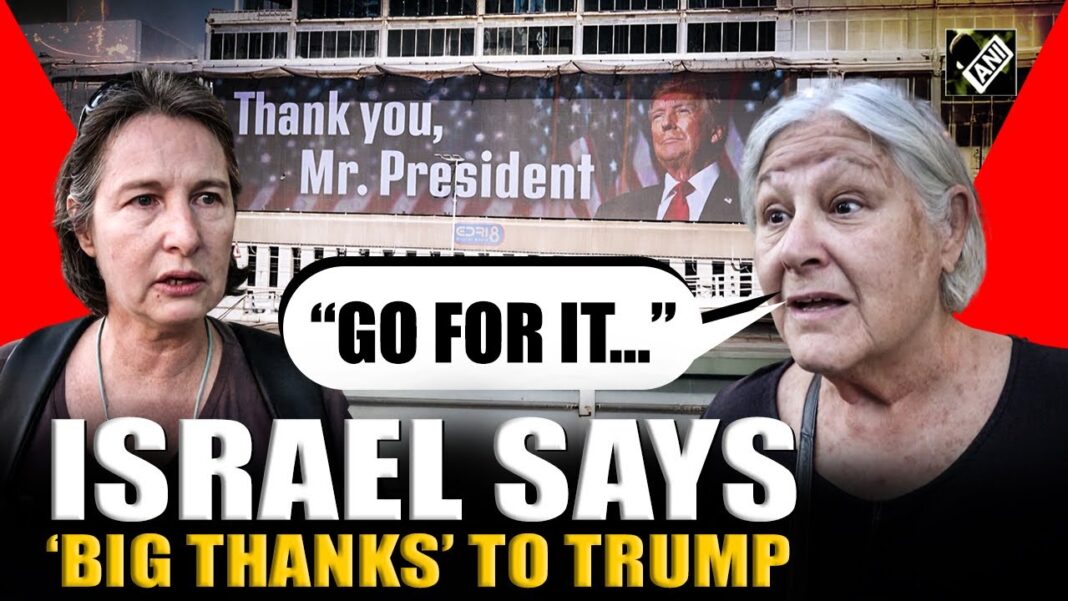
In Tel Aviv, City Hall mirrored the same design, its façade aglow with the intertwined flags of Israel and the United States. Crowds gathered beneath the lights in spontaneous rallies, many waving American flags and holding signs bearing slogans like “Thank you, Mr. President,” and “America Stands with Israel.” The gestures were not choreographed merely as diplomatic theater, but as authentic expressions of national relief and appreciation.
According to the report at JNS, Defense Secretary Pete Hegseth confirmed that the strike, carried out early Sunday morning, had achieved its strategic objectives. “The U.S. military completed its mission to destroy or severely degrade Iran’s nuclear program,” he said in a press briefing, noting that Operation Midnight Hammer had obliterated Tehran’s critical uranium enrichment facilities without seeking regime change.
“This was not and has not been about regime change,” Hegseth emphasized. “It was about neutralizing a clear and present danger to our allies and to international stability.”
The strikes, conducted in tandem with Israeli intelligence, targeted Iran’s fortified nuclear infrastructure in Fordow, Natanz, and Isfahan—facilities long suspected of harboring covert weapons development programs. Satellite imagery released Sunday appeared to confirm extensive damage to the underground sites, and U.S. military sources suggested that Iran’s ability to produce weapons-grade material had been “crippled for years to come.”
In a deeply symbolic gesture of his own, Prime Minister Benjamin Netanyahu, accompanied by his wife Sara, visited the Western Wall in Jerusalem’s Old City shortly after sunrise on Sunday. There, the Israeli leader recited the ancient Jewish prayer Hanoten Teshuah (“He who grants deliverance”), invoking divine blessing upon President Trump and the American people for their intervention.
According to Israel’s Channel 12 News, Netanyahu also prayed for the safety of Israeli security forces and the release of the 50 Israeli hostages who remain in Hamas captivity after 626 harrowing days. JNS reported that the prime minister’s prayer was a solemn reminder that even amid strategic victories, Israel continues to bear the burden of war and the suffering of its citizens.
Beyond the ceremonial displays, the political and strategic reverberations of the U.S. action are profound. The JNS report highlighted that Israel’s intelligence establishment had been preparing for such an operation for weeks, sharing satellite data, underground facility schematics, and real-time surveillance with American counterparts. The coordination between the two nations—both overt and covert—has reached unprecedented levels.
Public sentiment in Israel has responded with overwhelming support. A flash poll conducted Sunday evening by the Maagar Mochot Institute and reported by JNS found that 78% of Israelis viewed the U.S. strike favorably, with 62% saying they now feel “more secure” knowing that Iran’s nuclear ambitions have been significantly set back.
The same survey revealed that a full 84% of respondents agreed with the statement, “Israel could not have achieved this level of strategic deterrence without American assistance.”
The political implications of this moment extend well beyond national security. Israeli commentators cited by JNS have framed the strike as a defining chapter in the already close relationship between Trump and Netanyahu, comparing it to previous U.S.-Israel milestones such as the recognition of Jerusalem as Israel’s capital and the Abraham Accords.
As tensions remain high and the international community watches for Iran’s next move, the images projected across Jerusalem and Tel Aviv serve as a visual coda to a moment of geopolitical clarity. Israel is not alone. And in the aftermath of Operation Midnight Hammer, the alliance between Washington and Jerusalem appears not only resilient—but radiant.
As Speaker Ohana concluded in his remarks, echoing the sentiment of millions of Israelis now breathing a little easier: “On this day, history was not merely made—it was safeguarded.”
