



|
Getting your Trinity Audio player ready...
|
By: Fern Sidman
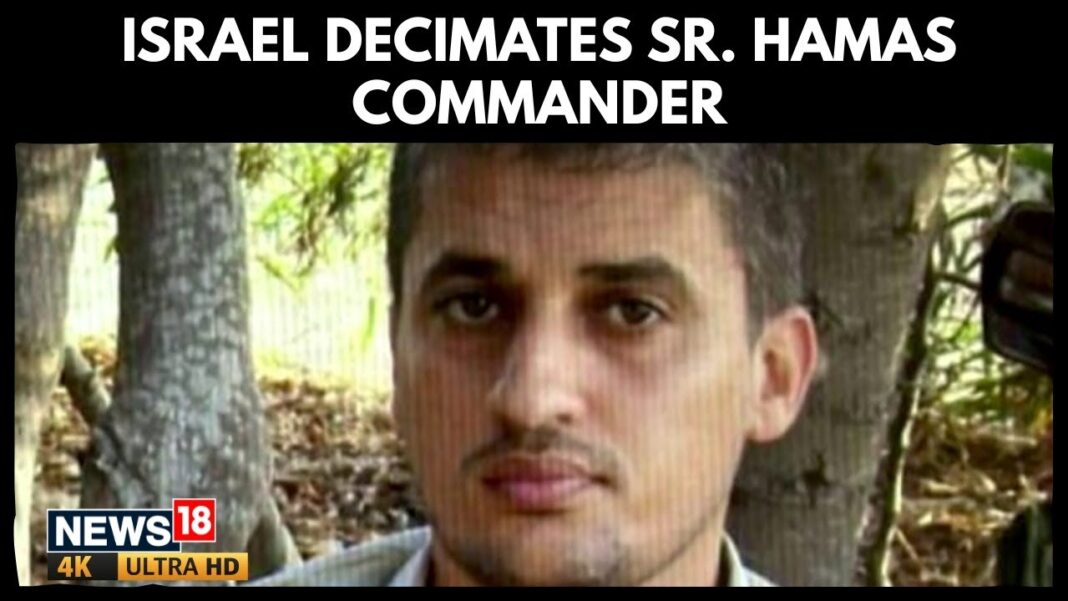
By any measure, the Israeli military’s announcement on Saturday that it had killed Raed Saed, a senior Hamas commander described as one of the architects of the October 7, 2023 attacks on Israel, represents a moment of profound consequence in the post-war landscape of Gaza. As reported on Saturday by Reuters and analyzed in depth by The Algemeiner, the strike marked the most high-profile targeted killing of a Hamas figure since a ceasefire agreement came into effect in October, raising immediate questions about the durability of that truce and the trajectory of the conflict that has already reshaped the region.
According to the Israeli Defense Forces, Saed was killed in an airstrike on a vehicle in Gaza City on Saturday, in what Israeli officials characterized as a precise and deliberate response to a Hamas attack earlier that same day. That earlier incident, Israeli authorities said, involved an explosive device that wounded two Israeli soldiers—an act Jerusalem described as a direct violation of the ceasefire. The Israeli government’s message, as conveyed jointly by Prime Minister Benjamin Netanyahu and Defense Minister Israel Katz, was unequivocal: the truce would not serve as a shield for senior Hamas operatives seeking to rebuild the group’s military capabilities.
Reuters reported that the strike on the car in Gaza City killed five people and wounded at least 25 others, citing Gaza health authorities. Hamas did not immediately confirm whether Saed was among the dead, and medics in Gaza likewise offered no independent verification of his fate. The absence of confirmation from Hamas has left room for uncertainty, but Israeli officials have been emphatic in their assessment, framing the killing as a decisive blow against a key figure in the group’s military hierarchy.
Israeli military officials described Raed Saed as a high-ranking member of Hamas who played a pivotal role in establishing and advancing the organization’s weapons production infrastructure. According to the information provided in the Reuters report, one Israeli official said Saed had, in recent months, been actively working to reconstitute Hamas’ weapons manufacturing capabilities—activities Israel characterized as a “blatant violation” of the ceasefire agreement.
The Algemeiner reported that Saed was widely regarded as the second-in-command of Hamas’ armed wing, subordinate only to Izz eldeen Al-Hadad. He previously headed Hamas’ Gaza City battalion, one of the group’s largest and best-equipped fighting units. That battalion, analysts note, played a significant role in both the October 7 assault on Israel and in the subsequent fighting within Gaza.
Israeli intelligence assessments, cited in The Algemeiner report portray Saed as a strategic planner rather than merely a battlefield commander—a figure deeply involved in logistics, weapons development, and long-term operational planning. If confirmed, his death would represent a substantial loss for Hamas’ military apparatus, particularly at a time when the group is attempting to regroup after months of devastating Israeli operations.
The significance of Saed’s killing cannot be disentangled from the events of October 7, 2023, when Hamas launched a large-scale assault on southern Israel that killed approximately 1,200 people and resulted in the abduction of hundreds more. Reuters has repeatedly described that attack as the deadliest single day for Israelis in decades, and Israeli officials have vowed ever since to dismantle Hamas’ leadership and military capabilities.
Israeli authorities have consistently framed targeted killings of senior Hamas figures as acts of accountability for October 7. The Algemeiner report noted that Israeli leaders see these operations not only as tactical necessities but also as moral imperatives—part of a broader campaign to ensure that those who planned and executed the attack cannot evade responsibility under the cover of ceasefire arrangements.
In that context, the targeting of Saed appears to reflect Israel’s determination to pursue what it considers unfinished business, even amid diplomatic efforts to stabilize Gaza and prevent a renewed full-scale war.
The October 10 ceasefire, brokered after months of intense fighting, has brought a measure of respite to Gaza’s civilian population. As Reuters reported, the agreement has enabled hundreds of thousands of Palestinians to return to Gaza City’s shattered neighborhoods. Israeli forces have withdrawn from many positions within the city, and humanitarian aid flows have increased, offering a fragile sense of normalcy amid widespread devastation.
Yet the ceasefire was never intended to signify an end to hostilities in the traditional sense. Israeli officials have repeatedly stressed that the agreement does not preclude targeted actions against what they describe as imminent threats. The strike on Saturday appears to test that interpretation to its limits.
Hamas, for its part, condemned the attack as a violation of the ceasefire agreement, according to the report at Reuters. However, the group stopped short of confirming Saed’s death or issuing an explicit threat of retaliation. That restraint, analysts told The Algemeiner, may reflect Hamas’ current strategic calculus: weighing the desire to respond forcefully against the risk of triggering a renewed Israeli offensive that Gaza can ill afford.
In their joint statement, Israeli Prime Minister Netanyahu and Israeli Defense Minister Katz framed the strike as a defensive necessity. They emphasized that the operation followed a Hamas attack that injured Israeli soldiers earlier in the day, reinforcing Israel’s claim that Hamas has continued hostile activities despite the ceasefire.
The Algemeiner report highlighted the political significance of the joint statement, noting that Netanyahu and Katz have at times differed in tone and emphasis regarding Gaza policy. Their unified messaging on this issue suggests a shared determination to maintain military pressure on Hamas’ leadership while avoiding a complete collapse of the ceasefire framework.
Israeli officials have also sought to send a broader message to Hamas and its supporters: that any attempt to rebuild military infrastructure under the cover of civilian reconstruction will be met with decisive action. Reuters quoted an Israeli military source as saying that Saed’s alleged efforts to revive weapons production were a “red line” that Israel could not ignore.
As with many Israeli strikes in Gaza, the attack has drawn scrutiny over its civilian impact. Gaza health authorities reported five deaths and at least 25 wounded, figures that Reuters relayed while cautioning that they could not be independently verified. The presence of civilians near the targeted vehicle has once again fueled debate over the humanitarian consequences of targeted assassinations in densely populated urban areas.
The Algemeiner reported that Israeli officials insist extensive intelligence and surveillance preceded the strike, and that every effort was made to minimize civilian casualties. Nonetheless, the incident underscores the inherent risks of military operations in Gaza City, where returning residents are navigating ruins, unexploded ordnance, and the lingering presence of terrorist networks.
International reactions have been cautious but attentive. While some governments have reiterated calls for restraint and adherence to the ceasefire, others have emphasized Israel’s right to self-defense. The Reuters report noted that several diplomatic sources expressed concern that high-profile assassinations could destabilize the fragile calm and complicate ongoing efforts to expand humanitarian access.
Hamas’ measured response—or lack thereof—has been notable. In its initial statement condemning the strike, the group refrained from confirming Saed’s status or issuing immediate threats. The Algemeiner report suggested this silence could be strategic, allowing Hamas time to assess the damage, verify facts, and determine its next steps without being boxed into a retaliatory commitment.
Historically, Hamas has oscillated between restraint and escalation following the killing of senior figures. Analysts cited by Reuters noted that the group’s leadership may be reluctant to provoke a large-scale Israeli response while Gaza remains in a precarious humanitarian state and reconstruction efforts are just beginning.
At the same time, Hamas’ credibility among its supporters depends in part on its ability to respond to Israeli actions. Whether that response takes the form of military retaliation, diplomatic maneuvering, or internal reorganization remains to be seen.
Saed’s death represents one of the most significant blows to Hamas’ military leadership since the ceasefire began. The Algemeiner emphasized that his loss could disrupt command-and-control structures and delay efforts to rebuild the group’s operational capacity. Yet the publication also cautioned that Hamas has historically demonstrated an ability to regenerate leadership over time, often elevating younger commanders hardened by conflict.
From Israel’s perspective, the operation reinforces a doctrine that targeted killings remain a central tool in its counterterrorism strategy, even during periods of relative calm. Reuters reported that Israeli officials view such actions as essential to preventing future attacks and maintaining deterrence.
For Gaza’s civilians, however, the strike serves as a stark reminder that the ceasefire is provisional and fragile. The return to Gaza City, while symbolically powerful, is unfolding under the shadow of potential renewed violence.
As the dust settles from Saturday’s strike, the region stands at a crossroads. The October ceasefire has brought tangible, if limited, relief to Gaza and reduced the immediate risk of full-scale war. Yet the killing of Raed Saed calls attention to the unresolved nature of the conflict.
Reuters and The Algemeiner both noted that the coming days will be critical. Confirmation of Saed’s death could shape Hamas’ response. International mediators, meanwhile, face the challenge of preserving the ceasefire while addressing Israel’s security concerns.
What is clear is that the shadow of October 7 continues to loom large. For Israel, the pursuit of those it holds responsible remains unfinished. For Hamas, the loss of senior commanders threatens its capacity to project strength.