



|
Getting your Trinity Audio player ready...
|
Israel Defends IDF Spokesman’s Challenge to Gaza Starvation Imagery, Citing Hamas Propaganda & UN Distribution Failures
By: Fern Sidman
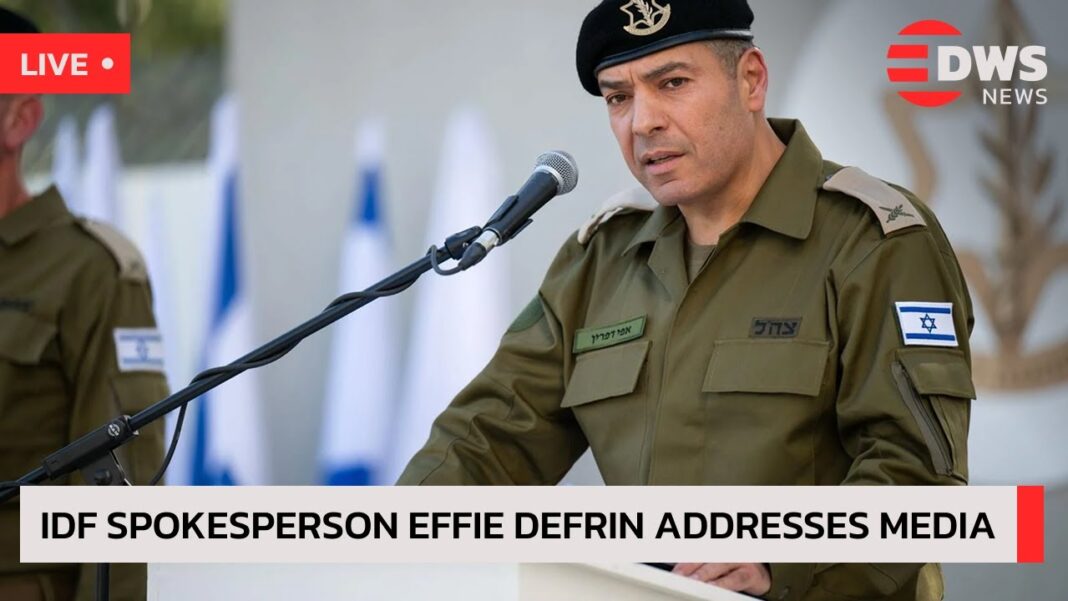
The Israeli government is standing firmly behind a senior Israel Defense Forces officer who questioned the authenticity of widely circulated images of starvation in Gaza, underscoring Jerusalem’s contention that Hamas is orchestrating an aggressive information campaign while diverting aid on the ground. As reported by The Los Angeles Times on Monday, the weekend remarks by Effie Defrin—an IDF commanding officer and spokesman—have become a focal point in a charged debate over humanitarian conditions and wartime messaging, even as President Donald Trump said Monday he believes the photos are real and pledged additional U.S. efforts to get food into the territory.
In a press tour of a small area of the Gaza Strip, Defrin acknowledged that visuals emerging from the enclave are “breaking our hearts,” but maintained that “most of it is fake, fake distributed by Hamas.” According to the information provided in The Los Angeles Times report, Defrin described what he called a deliberate “campaign” that has seeped into both Israeli and international media, “creating an image of starvation which doesn’t exist.” Prime Minister Benjamin Netanyahu echoed that position a day earlier, telling reporters there is “no starvation in Gaza,” a statement that The Los Angeles Times noted was issued amid an intense international glare and mounting calls for expanded relief access.
The divergence with Washington was laid bare on Monday. During a visit to Scotland, Trump dismissed the idea that the pictures were fabricated, saying, “That’s real starvation… I see it, and you can’t fake that,” as quoted by The Los Angeles Times. Trump added that “Israel can do a lot,” framing the crisis as a solvable logistics and access challenge. Yet an Israeli official told The Los Angeles Times that the government stands by Defrin’s remarks and the broader assessment that the problem is not entry of aid, but distribution inside the Strip.
Against this backdrop, The Los Angeles Times reported that Israel opened additional corridors for humanitarian deliveries and began conducting its own airdrops of food on Sunday. Israeli officials emphasized that, while aid has been flowing into Gaza, United Nations agencies and affiliated organizations have struggled to collect and distribute supplies at scale, citing persistent security concerns amid ongoing combat. Humanitarian workers have argued, as documented by The Los Angeles Times, that the conflict environment itself—marked by active hostilities and damaged infrastructure—has made it extraordinarily difficult to operate. The Prime Minister’s Office, for its part, has consistently asserted that Hamas is diverting food and aid for its fighters as a war tactic, a charge that aligns with Defrin’s contention that the Iranian-backed terror group is manipulating both relief flows and global perception.
The stakes are not merely rhetorical. As The Los Angeles Times report observed, the imagery of desperate Palestinians crowding aid stations and of emaciated children has ricocheted across the world, magnifying diplomatic pressure on Israel while fueling claims—now including, in a first, two Israeli human rights organizations—that the operation in Gaza constitutes genocide. Israeli officials have rejected that characterization, pointing instead to what they call Hamas’s deliberate embedding in civilian areas, systematic exploitation of humanitarian infrastructure, and weaponization of information as integral features of the conflict. From Israel’s perspective, as outlined repeatedly in The Los Angeles Times, the army’s operational objective remains the dismantling of Hamas’s military capability while enabling humanitarian access under conditions that prevent appropriation by the group.
Within that framework, the Israeli message—recounted by The Los Angeles Times—treats the imagery battle as a distinct theater of war. Defrin’s assertion that “most” of the starvation pictures are “fake” drew condemnation online but is consistent with Israel’s broader claim that Hamas curates content to portray a mass-famine scenario that the IDF says is not borne out by its own tracking of aid deliveries. The Los Angeles Times report further noted that Israeli officials view the narrative contest as consequential not only for international opinion, but for the leverage dynamics involved in ceasefire and hostage negotiations, where Hamas benefits from heightened portrayals of civilian catastrophe.
Even amid the dispute with Washington, The Los Angeles Times reported that Israel has moved to blunt accusations by increasing humanitarian access points and supplementing ground deliveries with air drops—steps that officials insist demonstrate a commitment to civilian welfare independent of political narratives. The Israeli official who spoke to The Los Angeles Times maintained that the binding constraint is the last-mile distribution environment, which is fraught with insecurity and vulnerability to Hamas seizure. Netanyahu’s office has framed the United Nations’ difficulties not as evidence of Israeli policy, but as the predictable result of a battlefield that Hamas has designed to collapse civil administration and deepen dependency under its control.
For Israeli policymakers, the context remains October 7, 2023, when Hamas launched a devastating attack that killed nearly 1,200 Israelis—civilians and security personnel—and abducted 251 others, as The Los Angeles Times report recounted. That heinous attack not only triggered the current operation but also illuminated the depth of Hamas’s military entrenchment within Gaza’s civilian fabric. Israel’s argument, reflected throughout The Los Angeles Times coverage, is that any assessment of humanitarian conditions must include Hamas’s deliberate efforts to siphon aid, infiltrate shelters, and manipulate footage—actions Israel says complicate both relief provision and the accuracy of external reporting.
The rupture with Trump over the authenticity of starvation images, while striking, does not appear to have altered Israel’s near-term approach. According to the information contained in The Los Angeles Times report, Jerusalem plans to keep corridors open, continue airdrops as needed, and press international agencies to improve pickup rates at crossings while assuring safe routes for convoys. Israeli officials also intend to keep spotlighting cases in which Hamas or affiliated actors intervene to seize food stocks—episodes that Israeli spokespeople argue debunk accusations of intentional deprivation by the state.
This posture places a premium on granular logistics: precise coordination windows for convoy movement, expanded deconfliction channels, and a documentation trail that, Israeli officials told The Los Angeles Times, can withstand public scrutiny. The aim is twofold—sustain civilian aid flows and, at the same time, counter the narrative that Israel is indifferent to humanitarian suffering. It is in that second arena that Defrin’s weekend comments were intended to bite: to warn that a portion of the most harrowing content is cultivated or distorted by Hamas for strategic effect, and that repeating it uncritically risks laundering the group’s information objectives.
The policy debate will continue to revolve around evidence: warehouse turnover rates, crossing throughput, convoy interdiction incidents, and verifiable distribution to civilians rather than terrorists. The Los Angeles Times has traced this arc across successive stages of the war, noting that each incremental adjustment—more crossing lanes, new corridors, airdrops—has been accompanied by fresh disputes over impact and intent. For Israel, the proof-point remains the operational ledger: trucks cleared, corridors secured, airdrops completed—set against the persistent claim that Hamas’s tactics, not Israeli policy, are the primary cause of bottlenecks and imagery of deprivation.
In that sense, the clash over photographs becomes a proxy for a larger argument about agency and accountability in wartime humanitarianism. As The Los Angeles Times report detailed, Israel’s position is that it has expanded access, enabled deliveries, and publicized routes, while the United Nations and partners have struggled to function in a combat zone shaped by Hamas’s designs. Those same designs, Israeli officials maintain, extend to the camera lens—where the story told to the world is, in their estimation, too often curated by the very actors most responsible for civilian harm.
However the imagery debate is ultimately judged and the Israeli government’s defense of Defrin signals that it will continue to contest not only on the battlefield but in the narrative of the battlefield. Jerusalem is likely to keep pressing three claims in tandem: Hamas bears primary responsibility for civilian suffering; Israel is increasing humanitarian facilitation while fighting; and much of what the world is seeing is either misattributed or manipulated by a group that has made information warfare central to its strategy. Within that protracted contest, airdrops, corridors, and convoy schedules are not only lifelines—they are evidentiary exhibits in a war of facts that Israel insists it cannot afford to lose.
Who are the alleged “human rights organizations”? The ones recently in the news are nazi George Soros propaganda tools.
https://www.newsbusters.org/blogs/business/joseph-vazquez/2025/07/28/7-lefty-outlets-parrot-soros-funded-groups-squawk-genocide