



|
Getting your Trinity Audio player ready...
|
By: Fern Sidman
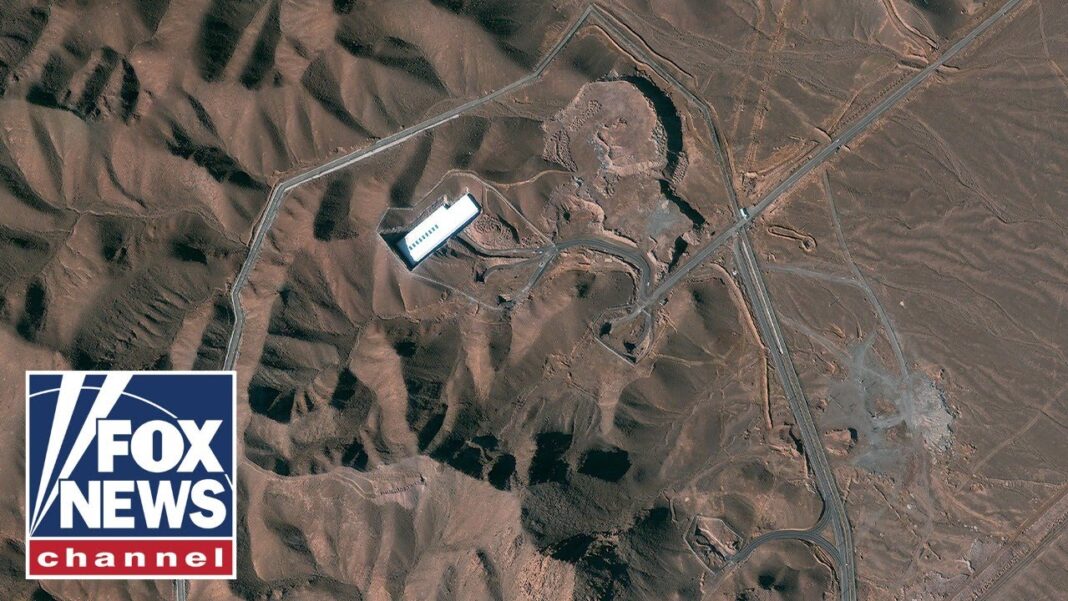
In a candid and far-reaching interview, Israel’s National Security Advisor Tzachi Hanegbi has for the first time publicly confirmed that the Fordow uranium enrichment facility — one of Iran’s most heavily fortified nuclear sites — is a central objective in the current Israeli military campaign against the Islamic Republic. Speaking to Israel’s Channel 12 on Tuesday, Hanegbi stated unequivocally: “This operation will not conclude without a strike on the Fordow nuclear facility.”
As reported by The Jewish Insider (jewishinsider.com) on Tuesday, the declaration highlights Israel’s deep commitment to dismantling Iran’s nuclear ambitions through direct action, even in the absence of American military support. The Fordow site, buried nearly 300 feet beneath a mountain and fortified against conventional attack, houses thousands of advanced centrifuges central to Iran’s capacity to enrich uranium to weapons-grade levels.
Hanegbi’s comments reveal that while Israel is keenly aware of the facility’s resilience against Israeli airpower alone, it is not waiting for American intervention to proceed. “We didn’t ask and we won’t ask,” Hanegbi said, referring to speculation that Prime Minister Benjamin Netanyahu had requested American assistance in targeting Fordow. “We will leave it to the Americans to make such dramatic decisions about their own security.”
Still, The Jewish Insider report noted that Israel has coordinated with the United States on defensive measures, particularly in light of recent missile barrages launched by Iran and its proxies. Hanegbi confirmed that Israel had requested access to the U.S. Terminal High Altitude Area Defense (THAAD) system to bolster its homeland protection. “The U.S. is not only committed to protecting Israeli lives,” he added, “but also the hundreds of thousands of American citizens living in Israel.”
At a time of growing regional volatility, Hanegbi’s clarity offers rare insight into Israel’s military and diplomatic posture. As The Jewish Insider reported, the campaign was presented to the Israeli Security Cabinet over a year ago as a fully independent operation—what Hanegbi described as “totally blue and white,” a reference to its entirely domestic planning and execution.
However, Washington’s role remains a critical backdrop. While the United States has intercepted Iranian missiles aimed at Israel in recent days, the Trump administration has not signaled a willingness to directly participate in offensive strikes. Hanegbi acknowledged that the administration has not yet made a decision on whether to assist militarily in neutralizing Fordow, a task only the U.S. is believed to have the bunker-busting munitions and aircraft necessary to accomplish.
The report at Jewish Insider also addressed rumors swirling in international media that Israel sought U.S. approval for a targeted assassination of Iran’s Supreme Leader, Ayatollah Ali Khamenei. Hanegbi dismissed the reports outright: “Fake from the land of fake.” He reiterated that while Israel maintains close security coordination with the United States, it does not seek permission for its national defense operations, nor does it inform Washington of every operational detail. “The U.S. doesn’t expect us to share [our plans] with them,” he said.
On the contentious issue of regime change, Hanegbi was equally forthright. “I think every sane person, not only in Israel, would be happy to see this loathsome, murderous, cruel regime fall,” he said, “but can we set that as a goal for ourselves? No.” He acknowledged that while a new, peace-oriented government in Tehran would be the optimal way to permanently neutralize the nuclear threat, “that is not something we can attain kinetically right now.”
Hanegbi also spoke to the broader strategy, stating that while the Iranian regime is unlikely to sue for peace in the early stages of this conflict, Israel has received no serious messages from Tehran seeking to initiate negotiations. “The Iranians are a proud people,” he said. “I don’t think they will wave the white flag at the beginning of the campaign.”
As The Jewish Insider report emphasized, this is a long-term operation with a wide spectrum of targets. Hanegbi made it clear that Iranian energy infrastructure is no longer off-limits. “Iranian gas fields and its energy sector do not have immunity,” he stated. Within the last 24 hours, he confirmed, the Israeli Air Force struck a refinery used by the Iranian military.
Iran’s strategy, according to Hanegbi, includes retaliatory attacks on Israel’s own energy infrastructure — particularly the refineries in Haifa — to sow chaos and economic disruption. “They know what they’re doing,” he warned, implying that further escalation should be expected.
In sum, Hanegbi’s remarks, as reported by The Jewish Insider, mark a significant moment in the trajectory of Israel’s campaign. They signal not only the depth of Israel’s strategic planning but also its growing willingness to act alone in the face of what it views as an existential threat. Whether the United States joins in a direct strike on Fordow or remains in a supportive role, Israel appears prepared to finish what it has started.
