



|
Getting your Trinity Audio player ready...
|
By: Fern Sidman
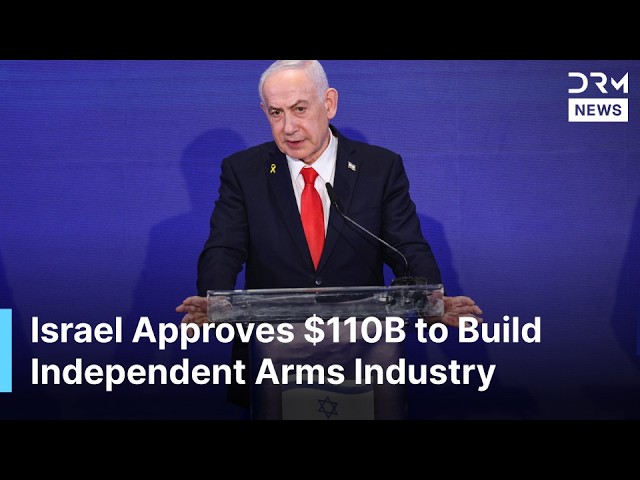
In a declaration that may come to define the next era of Israel’s national security doctrine, Prime Minister Benjamin Netanyahu announced on Wednesday that the Jewish state intends to invest an unprecedented 350 billion shekels—approximately $110 billion—into the development of an independent domestic arms industry. Speaking at a ceremony honoring newly graduated Israeli Air Force pilots, Netanyahu articulated a strategic vision that seeks to fundamentally reduce Israel’s reliance on foreign weapons suppliers while reinforcing its capacity to defend itself in an increasingly volatile regional and global environment. The announcement, reported by AFP, underscores a profound recalibration of Israel’s long-term military and industrial priorities.
According to the AFP report, Netanyahu framed the initiative not as a rejection of Israel’s alliances, but as a sober acknowledgment of the realities of modern geopolitics. “We will continue to acquire essential supplies while independently arming ourselves,” the prime minister said, emphasizing that Israel’s goal is not isolation, but resilience. He candidly acknowledged that complete independence may be unattainable for any nation in an interconnected world, yet stressed that Israel would strive to ensure that as much of its weaponry as possible is produced on its own soil, AFP reported.
Israel’s security doctrine has always been shaped by necessity. Since its founding, the state has navigated arms embargoes, shifting alliances, and geopolitical constraints that have repeatedly underscored the vulnerability of dependence on external suppliers. The AFP report noted that Netanyahu’s remarks reflect lessons learned over decades in which Israel has, at times, found itself constrained by political considerations in allied capitals, even as it faced existential threats.
The proposed 350 billion shekel investment signals not merely a budgetary decision, but a philosophical one. By committing to the large-scale expansion of domestic arms production, Israel is asserting that strategic autonomy is as critical to national survival as diplomatic ties. Netanyahu’s statement that the goal is to reduce dependency “on any party, including allies,” as cited by the AFP, carries particular resonance in an era when arms transfers are increasingly entangled with political pressure, public opinion abroad, and legal challenges in foreign courts.
The AFP has repeatedly highlighted the regional backdrop against which Netanyahu’s announcement was made. Israel faces persistent threats from Iran and its network of proxies, including Hezbollah in Lebanon and Hamas and Palestinian Islamic Jihad in Gaza. At the same time, the proliferation of advanced weaponry across the Middle East—from precision-guided missiles to armed drones—has raised the stakes of military preparedness.
In this environment, the ability to rapidly produce, adapt, and replenish arms is no longer a luxury; it is a strategic imperative. Israeli officials, speaking in contexts reported by AFP over recent years, have increasingly warned that supply-chain disruptions, export restrictions, or diplomatic rifts could impede Israel’s operational readiness during prolonged conflicts. Netanyahu’s announcement appears to be a direct response to those concerns, transforming them into a long-term industrial strategy.
While the announcement was delivered in a military setting, its implications extend far beyond the battlefield. According to analysts cited in AFP’s broader coverage of Israel’s defense sector, a massive investment in domestic arms production is likely to generate ripple effects across the economy. Israel’s defense industry—already a global leader in areas such as missile defense, cybersecurity, unmanned systems, and intelligence technologies—stands to gain from sustained government funding and expanded production mandates.
The infusion of 350 billion shekels over time could catalyze job creation, stimulate advanced research and development, and deepen collaboration between the military, academia, and the private sector. AFP has previously reported on Israel’s unique defense innovation ecosystem, in which military needs often drive technological breakthroughs that later find civilian applications. Netanyahu’s vision, therefore, may not only enhance Israel’s security but also reinforce its status as a high-tech powerhouse.
Despite the bold rhetoric of independence, Netanyahu was careful to strike a measured tone regarding Israel’s relationships with its allies. The AFP report quoted him as saying that Israel would “continue to acquire essential supplies,” signaling that partnerships—most notably with the United States—remain vital. The distinction, however, lies in reducing vulnerability rather than severing ties.
For decades, Israel has relied heavily on U.S. military aid and access to advanced American systems. While that relationship remains a cornerstone of Israeli defense policy, AFP’s reporting suggests that Israeli leaders are increasingly aware of the political sensitivities surrounding arms exports in democratic societies. Domestic arms production offers a hedge against uncertainty, ensuring that Israel’s security decisions are not subject to shifting political winds abroad.
Netanyahu’s announcement carries a dual message. To allies, it signals that Israel seeks to shoulder a greater share of its own defense burden, potentially easing political friction associated with arms transfers. To adversaries, it sends a clear warning: Israel is preparing for long-term self-reliance and will not allow external constraints to weaken its deterrent capabilities.
The setting of the speech—an air force ceremony—was itself symbolic. The Israeli Air Force has long been a centerpiece of Israel’s military power, and its pilots represent the cutting edge of the country’s defense apparatus. By addressing them directly, Netanyahu linked the future of Israel’s military independence to the next generation of officers tasked with implementing it.
Yet the ambition of the plan also raises complex questions. AFP has noted in other contexts that large-scale defense investments require careful oversight to avoid inefficiencies, cost overruns, and duplication of capabilities. Building an independent arms industry at this scale will demand not only financial resources but also strategic discipline and long-term planning.
Moreover, complete independence in arms production remains elusive even for major powers. Modern weapons systems rely on global supply chains for components, raw materials, and specialized technologies. Netanyahu himself acknowledged this reality, conceding that no country can be entirely independent, according to the AFP report. The challenge, therefore, will be to strike a balance between autonomy and integration in a globalized defense economy.
Israeli security policy is often shaped by the intersection of immediate threats and historical memory. Netanyahu’s announcement fits squarely within that tradition. It reflects a deep-seated determination to ensure that Israel’s survival is never contingent on the decisions of others, even friendly nations.
In committing to spend 350 billion shekels on domestic arms development, Israel is not merely investing in weapons; it is investing in sovereignty. The initiative represents a strategic bet that technological self-reliance, industrial capacity, and national resilience will prove decisive in an uncertain future.
Whether this vision will fully materialize remains to be seen. But as AFP’s reporting makes clear, the declaration itself marks a watershed moment—one that signals Israel’s intent to redefine the parameters of its defense posture for decades to come. In a region where uncertainty is the only constant, Netanyahu’s call for an independent arms industry stands as a bold assertion of agency, resolve, and strategic foresight.
The Lubavitcher Rebbe Zatzal advocated that Israel can and should become militarily independent (meaning the United States in particular). Only now, all these years later, do we see how important this is in today’s political climate. We are also dealing with the rise in antisemitism around the world. The same countries that eagerly buy Israel’s high tech weapons for their own defense, embargo arms sales to Israel! While the United States has the financial wherewithal to develop very expensive high-tech weapons systems, “there’s no free lunch”. The military aid that they supply to israel comes with the requirement to buy from US firms. So, the money actually goes to provide jobs and financing for the United States own defense industry! It’s time to make a substantial investment in Israel’s defense industry.
The writing is on the wall. Glad Netanyahu is reading it.
Better late than never.