



|
Getting your Trinity Audio player ready...
|
By: Ariella Haviv
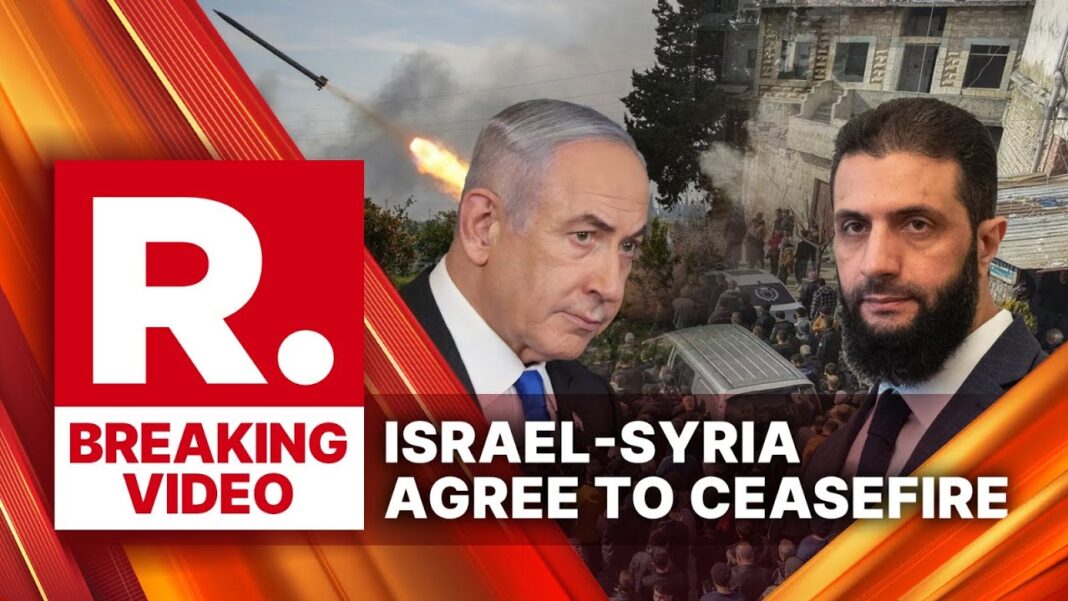
In what Jewish Breaking News has described as a “stunning diplomatic breakthrough,” Israeli Prime Minister Benjamin Netanyahu and Syrian President Ahmed al-Sharaa have reached a ceasefire agreement brokered with active support from the United States. The deal, confirmed Friday, also carries the endorsement of key regional powers, including Turkey, Jordan, and neighboring states — signaling a rare alignment of interests in a region often marked by deep divisions and conflict.
According to the information provided in the Jewish Breaking News report, the ceasefire announcement was made by U.S. Ambassador to Turkey Tom Barrack, who praised the agreement as a pivotal moment in Middle Eastern diplomacy. Barrack called attention to the role of Secretary of State Marco Rubio, whose efforts were instrumental in advancing the deal.
“@Netanyahu and Syrian President Ahmed al-Sharaa @SyPresidency supported by the U.S.A. @SecRubio have agreed to a ceasefire embraced by Turkey, Jordan, and its neighbors,” Barrack posted on X, formerly known as Twitter.
The ceasefire comes amid a period of heightened tensions along Israel’s northern border and within the broader region, where hostilities had increasingly involved a range of local militias, foreign fighters, and cross-border skirmishes. The agreement is designed not only to halt direct conflict between Israel and Syria but also to serve as a framework for encouraging internal Syrian reconciliation.
As part of the ceasefire terms the parties have jointly called on various Syrian internal factions—including the Druze, Bedouin tribes, and Sunni groups—to lay down their arms. The goal, as articulated in Barrack’s statement, is for these groups to work together toward a unified Syrian identity rooted in peace and cooperation with neighboring countries.
“We call upon Druze, Bedouins, and Sunnis to put down their weapons and together with other minorities build a new and united Syrian identity in peace and prosperity with its neighbors,” Barrack stated in his announcement, as was reported in the Jewish Breaking News report.
While comprehensive details of the agreement have not yet been made public, the ceasefire represents a rare convergence of interests in a region historically riven by rivalries and mistrust. For Israel and Syria—nations technically in a state of war since 1948—this agreement could mark a significant shift in bilateral relations, potentially opening doors for broader diplomatic engagement and easing regional hostilities.
Observers quoted in the Jewish Breaking News report have described the agreement as a “rare moment of alignment” and suggested that it may set a precedent for future cooperation or at least a reduction in direct hostilities. The potential impact on border security, regional stability, and internal Syrian politics remains a subject of intense international scrutiny.
The role of the United States, particularly the involvement of Secretary of State Marco Rubio, was a focal point in Jewish Breaking News’ coverage of the agreement. Rubio, whose active engagement in Middle East diplomacy has been closely followed, is credited with helping to navigate the complex web of regional interests that culminated in the ceasefire announcement.
Although the White House has yet to issue a formal statement, a senior administration official confirmed to Jewish Breaking News that President Trump was briefed on the agreement earlier in the day and expressed support for the diplomatic initiative. The president’s backing adds significant political weight to the effort, underscoring Washington’s ongoing commitment to fostering regional stability.
The international community is now watching closely to see if the ceasefire will hold—particularly given the volatile landscape of Syrian internal factions and the presence of foreign fighters. The durability of the agreement will likely depend on whether militias and local armed groups honor the ceasefire terms and whether the Syrian government under al-Sharaa can assert effective control over its territory.
While the ceasefire offers a promising diplomatic opening, it also poses substantial challenges. The deeply entrenched conflicts within Syria, the influence of external actors, and the long-standing distrust between Israel and Syria mean that implementing and sustaining the ceasefire will require vigilant international oversight and continued diplomatic engagement.
As the Jewish Breaking News report indicated, the Netanyahu-al-Sharaa ceasefire agreement represents a potentially defining moment in Middle Eastern diplomacy. The active involvement of the United States, the endorsement by neighboring countries, and the expressed hope for internal Syrian reconciliation suggest a broader vision of stability that extends beyond the immediate cessation of hostilities.
The coming weeks are expected to reveal whether the ambitious goals outlined in the ceasefire announcement—peaceful coexistence, a new Syrian identity, and regional cooperation—can withstand the complexities of real-world politics and deeply rooted conflicts.
For now, the agreement stands as a rare diplomatic achievement in a region where such moments are often fleeting but potentially transformative.
