



|
Getting your Trinity Audio player ready...
|
By: Ariella Haviv
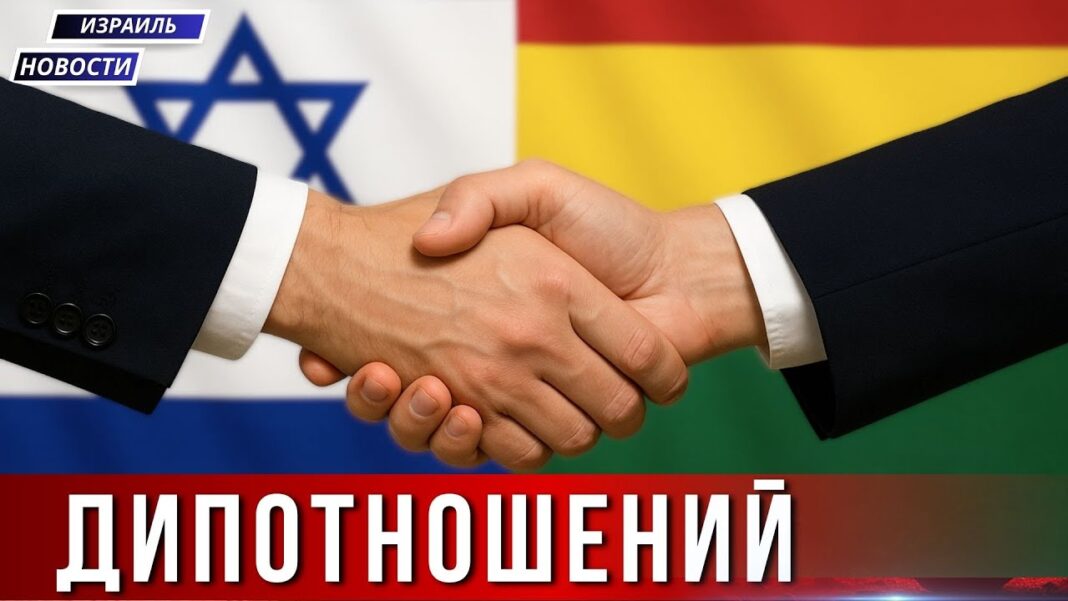
In a development described in a report on Tuesday on i24News as both historic and strategically consequential, Israel and Bolivia formally restored full diplomatic relations on Wednesday, ending more than a year of estrangement and opening a new chapter in a relationship marked for decades by abrupt political reversals. The renewal agreement, signed in Washington by Israeli Foreign Minister Gideon Sa’ar and his Bolivian counterpart Fernando Armayo, in the presence of Bolivian Minister of Finance and Economy José Gabriel Espinoza, represents what both governments call a “return to normalcy” after a prolonged rupture triggered by Bolivia’s condemnation of Israel’s military response to the October 7 massacres.
According to the information provided in the i24News report, the ceremony was conducted with a tone of measured optimism, as both parties emphasized their desire not merely to restore bilateral ties, but to fortify them on a cultural, political, and economic level. Sa’ar, who has made re-engagement with Latin America a central pillar of his 2026 foreign policy doctrine, called the agreement “a vital correction” to what he described as years of unnecessary estrangement between the two nations.
“Today, we are putting an end to a long and unnecessary chapter of disconnection between our two nations,” Sa’ar said, as quoted in the i24News report. “Israel and Bolivia are aware of the historic opportunity before us—to unite in a joint effort to promote a more stable, secure, and prosperous future for our peoples.”
The text of the agreement, reviewed by i24News, places unusual emphasis on cultural and spiritual “rediscovery” as a foundation for renewed diplomatic engagement. In language more evocative of cultural diplomacy than traditional international agreements, the document highlights “the rediscovery of the spiritual and cultural heritage of the Holy Land by Bolivians, and Israelis returning to explore the breathtaking natural beauty, rich cultural traditions, and warm hospitality of Bolivia.”
In practice, this cultural bridge may be strengthened immediately by the removal of visa requirements for Israeli tourists—a step that Sa’ar told i24News could bring “thousands of Israeli travelers to Bolivia each year.” Israel’s appetite for South American travel has grown steadily in the last decade, and the Bolivian minister present at the signing praised the renewed influx of Israeli visitors as a potential economic boon.
The renewal of ties marks the latest turn in a long and often turbulent diplomatic relationship that began in the 1950s. As the i24News report noted, relations between Israel and Bolivia have been severed and restored multiple times, almost always in response to Bolivian internal political changes and ideological shifts within the ruling government.
Relations were first severed in 2009 under left-wing President Evo Morales, who frequently aligned Bolivia with anti-Israel positions in international forums. They were briefly revived again in 2019 after Morales resigned amid domestic turmoil and a transitional government sought renewed engagement with Western partners. However, in October 2023, current President Luis Arce abruptly cut ties once more, accusing Israel of committing “crimes against humanity” in Gaza following its military response to the Hamas-led massacre of October 7.
The decision came despite Israel’s insistence that the operation was a direct response to one of the most brutal terror attacks in its history, in which Hamas terrorists murdered more than 1,200 people and abducted over 250 others. The rupture placed Bolivia alongside Venezuela and Iran in the narrow category of nations maintaining no diplomatic relationship with Israel.
According to Sa’ar, a “political change” inside Bolivia paved the way for renewed rapprochement. In October’s elections, center-right candidate Rodrigo Paz Pereira won the presidency with more than 54 percent of the vote, becoming the first non–Movement for Socialism (MAS) candidate in twenty years to reach the final round, as reported by i24News.
This political shift—signaling wider voter fatigue with the left-populist model associated with Morales—created new diplomatic space for pro-Western engagement. In the weeks following the election, the new Bolivian administration quietly signaled to Israel its willingness to revisit the 2023 rupture and explore a pragmatic path forward. Behind-the-scenes consultations intensified through the fall, culminating in the formal restoration of ties.
As i24News analysts have pointed out, Paz Pereira’s pragmatic center-right posture represents a marked departure from Morales’s ideological orientation, which had led Bolivia to deepen ties with Venezuela, Cuba, and Iran. The new government’s readiness to restore relations with Israel is widely interpreted as part of a broader realignment toward the political center—as well as a signal that Bolivia seeks to diversify its diplomatic relationships at a time of increasing global polarization.
The rapprochement with Bolivia fits into a much broader Israeli foreign-policy effort in Latin America. Sa’ar, in conversations reported by i24News, has frequently stressed that the region is entering a moment of transformation, with several governments taking steps toward closer military, technological, and political ties with Israel.
In late November, Sa’ar visited Argentina and Paraguay—two countries whose incoming administrations are openly enthusiastic about deepened cooperation with Jerusalem. The Israeli foreign minister has also cited progress with Costa Rica and Ecuador as evidence that Israel’s diplomatic strategy is bearing fruit across the region.
As an official quoted by i24News put it, “Latin America is changing, and Israel must be there—consistently, actively, and strategically.”
One of the immediate consequences of the agreement is the commitment by both countries to appoint ambassadors “in the near future,” according to the foreign ministries. The decision to move quickly reflects a mutual desire to institutionalize diplomatic engagement before political winds in either country can shift again.
The two governments also agreed to exchange invitations for high-level delegations involving both governmental and private-sector leaders—a move that the i24News report noted could accelerate cooperation in trade, water technology, agriculture, cybersecurity, and natural resources management.
Such fields are natural zones of cooperation: Bolivia possesses vast lithium reserves crucial for electric vehicle production, while Israel is a global leader in water desalination, irrigation, and agricultural technology. Israeli companies have previously sought to enter the Bolivian market, but political instability and anti-Israel posture under previous governments constrained those opportunities.
For Israel, the renewal of ties with Bolivia carries symbolic resonance. After the October 7 attacks, several countries in the Global South adopted increasingly hostile diplomatic positions toward Israel. Restoring diplomatic relations with Bolivia—one of the most outspoken critics—serves as what one i24News analyst described as “a diplomatic counterweight” to growing anti-Israel sentiment in certain international circles.
Sa’ar has emphasized repeatedly that re-engaging partners, even after ruptures fueled by political rhetoric, is a central component of Israel’s mission in the post–October 7 environment.
While the restoration of diplomatic ties is widely welcomed by both governments, observers caution that the relationship remains fragile. As the i24News report noted, future shifts in Bolivia’s domestic politics—or renewed regional tensions surrounding the Israel-Hamas conflict—could once again test the durability of the newly reestablished bond.
Still, the agreement marks a decisive step. For Israel, it is evidence of a broader diplomatic revival in Latin America. For Bolivia’s new government, it sends a message of openness and willingness to break from decades of ideological rigidity.
And for both peoples, the agreement signals a renewed opportunity to rediscover and appreciate each other’s cultures, histories, and aspirations—an opportunity that, as the agreement itself suggests, is “historic” in more than just name.