



|
Getting your Trinity Audio player ready...
|
By: Fern Sidman – Jewish Voice News
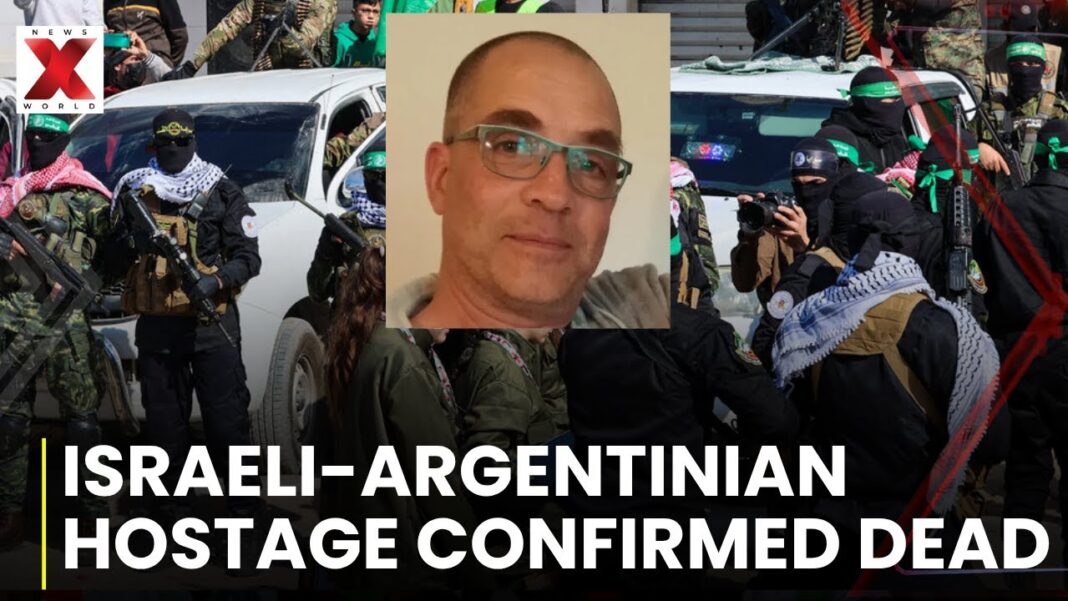
In a somber and symbolic exchange marking one of the most delicate phases of the current Gaza ceasefire, the Palestinian terrorist organization Islamic Jihad handed over the body of an Israeli hostage on Friday, an act that underscores both the fragility and the complexity of the tenuous truce between Israel and Hamas. As The Algemeiner reported on Saturday, Israeli authorities later confirmed that the remains belonged to Lior Rudaeff, a 61-year-old resident of Kibbutz Nir Yitzchak, who was abducted during the October 7, 2023 Hamas-led assault on southern Israel.
According to a statement issued by the Israel Defense Forces (IDF) and cited in The Algemeiner report, the identification was completed on Saturday after a meticulous forensic examination. The return of Rudaeff’s body, via the International Committee of the Red Cross, was coordinated through security channels operating under the terms of the U.S.-brokered ceasefire agreement that has—at least temporarily—halted the full-scale hostilities in the Gaza Strip.
“Lior was one of the victims of the brutal massacre that began this war,” an Israeli government official told The Algemeiner, expressing the dual anguish and relief that has accompanied every such exchange. “His return, though heartbreaking, brings a measure of closure to his family and the nation.”
The ongoing ceasefire, fragile as it is, represents the culmination of painstaking negotiations mediated by the United States, Qatar, and Egypt. As The Algemeiner report detailed, the accord stipulates the exchange of both living hostages and the bodies of deceased captives for Palestinian prisoners and war casualties held by Israel.
Under the agreement finalized in late October, Hamas released all 20 living hostages still in its custody—mostly women, elderly civilians, and foreign nationals—in exchange for approximately 2,000 Palestinian prisoners and wartime detainees. The deal further required the repatriation of 28 deceased Israeli hostages in exchange for the return of 360 bodies of Palestinian terrorists killed in Israeli strikes or during infiltration attempts.
The transfer of Rudaeff’s remains brings to 23 the total number of Israeli hostage bodies recovered through this exchange framework. The Algemeiner report noted that, while most have been identified through DNA and dental forensics, several others remain unidentified due to the condition of the remains and the challenges posed by Gaza’s chaotic war environment.
Islamic Jihad—an Iranian-backed terrorist faction allied with Hamas—claimed that Rudaeff’s body was found in the southern Gaza city of Khan Younis, a former Hamas stronghold now largely reduced to rubble after months of Israeli operations. The group’s statement, carried by The Algemeiner, described the handover as a “humanitarian gesture” under the ceasefire arrangement, though Israeli officials dismissed such framing as cynical propaganda.
“There is nothing humanitarian about those who murder and abduct civilians,” an Israeli defense source told The Algemeiner. “The release of a corpse does not cleanse the horror of what these groups continue to represent.”
Rudaeff, a paramedic and longtime volunteer in his kibbutz’s emergency response team, was among dozens taken captive from border communities during the October 7 attacks, which left more than 1,200 Israelis dead and over 250 abducted into Gaza. According to the information provided in The Algemeiner report, he was known in his community for his dedication to medical service and his quiet heroism during previous rounds of rocket attacks from Gaza.
His abduction, and now his confirmed death, have once again cast a spotlight on the enduring trauma of Israeli families still awaiting news of their loved ones. Though most hostages have now been accounted for—either returned alive or confirmed deceased—the Hostage and Missing Families Forum continues to advocate for the recovery of the remaining bodies and for accountability regarding those who have not been conclusively identified.
“Each return reopens the wound,” the organization said in a statement quoted in The Algemeiner report, “but it also reinforces our collective determination that none of our people will be forgotten in Gaza’s sands.”
Despite the exchanges, the ceasefire’s implementation remains precarious. The Algemeiner reported that while major combat operations have been suspended, isolated skirmishes persist, particularly in Gaza’s southern districts and in the periphery of Rafah. The Israeli withdrawal from several urban centers has enabled hundreds of thousands of displaced Palestinians to return to the ruins of their homes, even as humanitarian agencies warn of a deepening crisis due to infrastructural collapse, sanitation failures, and food shortages.
Israel, meanwhile, has allowed an increase in aid deliveries through the Kerem Shalom crossing, including medical supplies, fuel, and food shipments coordinated with international agencies. The IDF maintains that the easing of restrictions is contingent upon the continued cessation of rocket fire and the verification of ceasefire compliance by Hamas and Islamic Jihad.
“The quiet is fragile,” one senior Israeli officer told The Algemeiner. “There are still terrorist cells regrouping, still weapons caches being uncovered, and still the ideological machinery of Hamas and Islamic Jihad at work. We are maintaining vigilance even as we extend our hand for humanitarian relief.”
The involvement of Islamic Jihad in the ceasefire process illustrates the complex web of militant alliances in Gaza. As The Algemeiner report observed, the group, while formally subordinate to Hamas’s political leadership, operates with considerable autonomy, particularly in southern Gaza. Its leadership maintains close coordination with Iran’s Islamic Revolutionary Guard Corps (IRGC) and with Hezbollah operatives in Lebanon.
Over the course of the conflict, Islamic Jihad has claimed responsibility for numerous rocket barrages against Israeli cities, suicide drone attacks on IDF positions, and the kidnapping of civilians. Its participation in the October 7 assault was both logistical and operational, with its fighters taking part in coordinated incursions across the Gaza border fence.
The Algemeiner report pointed out that the group’s decision to hand over Rudaeff’s body likely stems from a tactical calculation—an effort to preserve its standing within Gaza’s internal power hierarchy and to signal compliance with the ceasefire framework brokered by its allies in Tehran and Doha.
The international response to the latest exchange has been muted but cautiously supportive. The U.S. State Department welcomed the continued implementation of the ceasefire terms, urging all parties to uphold their commitments. However, American and European officials also expressed concern over ongoing violations, including sporadic rocket launches and reports of Hamas interference with aid distribution.
As The Algemeiner reported, Israeli officials remain skeptical about the long-term durability of the truce, viewing it primarily as a tactical pause rather than a pathway to permanent peace. “There can be no lasting ceasefire with organizations that define themselves by our destruction,” an Israeli diplomat told the publication.
Within Israel, the return of Rudaeff’s body has renewed public debate over the ethics of prisoner exchanges—a deeply emotional issue in a country that has repeatedly faced the painful calculus of trading convicted terrorists for the remains of its citizens. Critics argue that such deals embolden terrorist factions, while others maintain that recovering hostages—living or dead—is a sacred national duty.
As the ceasefire limps forward, the reality on the ground remains one of unease and exhaustion. The war that began with Hamas’s massacre on October 7 has exacted a heavy toll on both sides—devastating Gaza’s infrastructure and testing Israel’s resilience.
In its editorial analysis, The Algemeiner described the truce as “a pause born of necessity, not reconciliation,” warning that without fundamental changes in Gaza’s governance and demilitarization, any peace will be temporary at best.
For now, the image of Lior Rudaeff’s coffin, draped in an Israeli flag and carried solemnly by soldiers through the Kerem Shalom crossing, stands as a stark reminder of the human cost that underlies every headline.
It is, as The Algemeiner report observed, “a ceasefire written not in ink, but in tears.”
