



|
Getting your Trinity Audio player ready...
|
By: Fern Sidman
In a devastating escalation of the ongoing conflict, Iran launched a massive ballistic missile and drone attack against Israel early Thursday morning, striking at least eight sites across the country—including Soroka Medical Center in Be’er Sheba, one of the country’s most critical trauma and treatment hubs in the south. According to initial reports from Ynet News, the attack caused significant structural damage, sparked fears of a hazardous materials leak, and left dozens injured, with at least three people in serious condition.
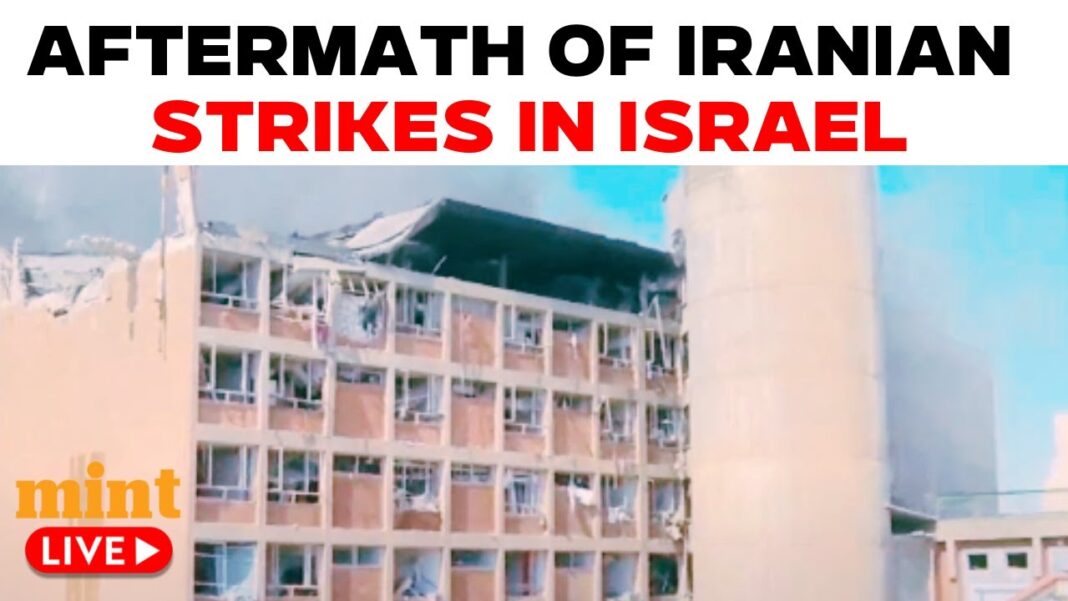
The most shocking development of the morning came with the direct hit on Soroka University Medical Center, where doctors, nurses, and patients were forced to shelter in fortified areas as alarms blared and missile fragments slammed into the building. Shortly after impact, Ynet News reported that police and emergency crews were investigating a possible hazardous material leak on an upper floor, prompting an urgent evacuation of patients and staff from parts of the facility.
“There is almost no place in the hospital that was not damaged,” Ilanit, a witness on site, told Ynet. “The ceilings fell, the medical teams rushed to get the patients into a protected space. Now they have evacuated us to the grass, but I don’t know how protected we are.”
Ynet News confirmed that Be’er Sheba police and specialized hazmat units are currently assessing contamination risks and attempting to contain any potential chemical exposure. Water was seen flooding parts of the hospital, and one witness described the dining hall building collapsing entirely, leaving behind a “mass of rubble.”
Patients and healthcare workers recounted the harrowing moments immediately following the strike. Gal, a resident of Ofakim and a patient in the emergency room, told Ynet News, “We heard a very big boom inside the hospital. We were here in the emergency room. It was very stressful.”
Another patient recalled, “We went to the stairwell after the siren. Suddenly there was an abnormal boom, and then everything was flying—the ceiling, equipment. It was terrifying.”
In addition to Be’er Sheba, seven other locations across central and southern Israel were targeted in the coordinated missile barrage. Ynet News reported that Holon, Ramat Gan, and multiple municipalities across the Gush Dan region suffered direct impacts.
BREAKING- The Iranian regime targeted Soroka Hospital in Beersheba with a ballistic missile – hitting a major medical center. @SorokaHospital @BR7City @Israel @Iran #iranisraelwar https://t.co/Mj6c7Ivyka
— The Jewish Voice (@TJVNEWS) June 19, 2025
In Holon, two individuals were found in serious condition at the impact site and were rushed to area hospitals. Two more were moderately and lightly injured, respectively. In Ramat Gan, twelve people suffered light injuries, with buildings and vehicles showing significant signs of blast damage and fire.
Magen David Adom (MDA), Israel’s national emergency service, confirmed a 60-year-old man in serious condition and at least 22 others lightly injured across the various strike sites. Emergency crews, already on heightened alert, rapidly deployed to affected areas, treating victims and searching for anyone possibly trapped under debris.
Iran has officially taken responsibility for the attack, characterizing it as a combined missile and drone operation in retaliation for Israel’s recent preemptive strikes under Operation Rising Lion—an ongoing military campaign aimed at crippling Iran’s nuclear infrastructure and strategic missile capabilities.
According to the information provided in the Ynet News report, Thursday morning’s barrage follows a relatively quiet night, heightening the psychological impact of the sudden escalation. Air raid sirens were activated throughout the country, with alerts sounding in Tel Aviv, Jerusalem, and southern urban centers as missile defense systems intercepted multiple threats in midair.
However, the scale and precision of the attack overwhelmed some local defenses, leading to what one IDF official described to Ynet News as “one of the most dangerous mornings of the conflict to date.”
Breaking – Soroka Hospital in the Negev hits by Iranian missiles. @SorokaHospital @Israel @bengurionu @Iran https://t.co/nnSLtXBWui
— The Jewish Voice (@TJVNEWS) June 19, 2025
The strike on Soroka Medical Center represents a disturbing milestone in the conflict. While Israeli hospitals have long been targets in enemy rhetoric, this is one of the few times in history that a major Israeli hospital has been directly hit during wartime.
Soroka is the largest hospital in southern Israel and plays a critical role in treating both civilians and IDF soldiers. According to the information contained in the Ynet News report, the medical center had previously reinforced portions of its structure to meet civil defense standards, but officials now believe the facility may require a partial evacuation and reconstruction due to the extensive damage sustained.
Local authorities are now working with the Ministry of Health to evaluate the long-term operational capacity of the hospital. Meanwhile, neighboring hospitals in Ashkelon and Tel Aviv are preparing to receive transferred patients.
In Jerusalem, government officials convened for emergency security consultations as IDF commanders reviewed new intelligence and considered the possibility of a second wave of Iranian attacks. A senior Israeli defense official told Ynet News that retaliation is imminent, but that civilian protection remains the immediate priority.
Prime Minister Benjamin Netanyahu is expected to address the nation later this evening, and his office has already released a statement condemning Iran’s “war crimes” and promising “a powerful and justified response.”
As Israel enters a critical phase in its conflict with Iran, the direct targeting of civilian infrastructure—especially hospitals—has galvanized public outrage and drawn international attention. The strike on Soroka Hospital, detailed by Ynet News in real time, shines a spotlight on the widening scope of this war and the increasingly perilous conditions facing Israeli citizens.
What was once a battle over strategic facilities has now entered an arena that threatens the country’s most sacred institutions of care and healing. For now, emergency responders continue to work tirelessly amid the rubble, while the nation braces for what may come next.
