



|
Getting your Trinity Audio player ready...
|
Iran Warns It Will Strike Israel’s Nuclear Site in Dimona if Regime Change Pursued
By: Fern Sidman
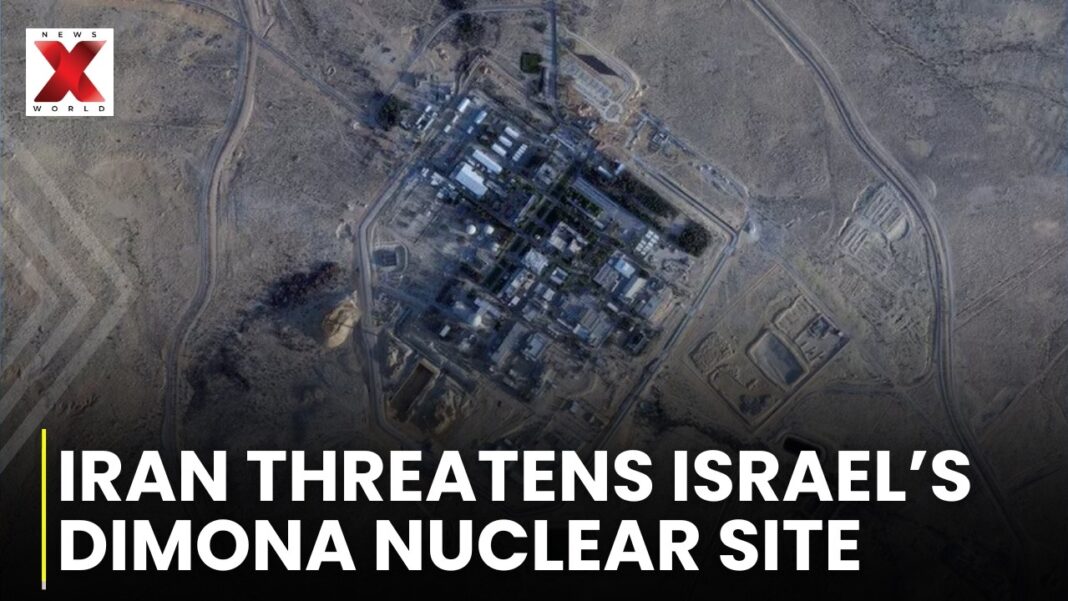
In a stark escalation of rhetoric amid an intensifying military confrontation, Iran has warned that any attempt by Israel and the United States to overthrow the Islamic Republic will trigger a direct strike on one of Israel’s most sensitive strategic installations — the Negev Nuclear Research Center in Dimona. The threat, reported Wednesday by Iran’s semi-official ISNA news agency and widely cited in a report on Thursday by World Israel News, signals that Tehran is prepared to broaden the scope of the conflict beyond conventional battlefields and into the realm of high-value national infrastructure.
According to the ISNA report, an unnamed Iranian defense official declared that if Washington and Jerusalem pursue regime change in Tehran, Iran will target the Dimona facility, widely understood to be at the core of Israel’s nuclear deterrent capability. The Negev Nuclear Research Center, long shrouded in official ambiguity, is believed by foreign analysts to have provided fissile material for Israel’s strategic arsenal. It is also one of the most heavily defended locations in the country, protected by layered air defense systems and considered indispensable to Israel’s long-term security architecture.
The World Israel News report emphasized the gravity of the statement, noting that direct threats against Dimona are rare and typically reserved for moments of acute regional tension. The reference to the site by name — even indirectly — represents a significant rhetorical escalation in a conflict that has already seen missile barrages, air campaigns, and naval engagements.
The Iranian official did not stop at Dimona. In comments cited by World Israel News, he further warned that if regime change becomes the objective of Israeli and American operations, Tehran would deploy what he termed its “final effective missiles” to devastate energy infrastructure across the Middle East. “This is a scenario we have already prepared for,” the official reportedly said, suggesting contingency planning for a broader regional conflagration.
The timing of the threat is particularly significant. Israel’s current air campaign against Iran, known as Operation Rising Lion, has been framed by Israeli leaders as more than a punitive strike on military assets. As World Israel News has reported, Israeli officials have openly acknowledged that weakening the regime’s military and security apparatus could create conditions conducive to internal political upheaval. The language emerging from Jerusalem has at times hinted at an ambition to facilitate the Islamic Republic’s collapse by empowering dissident forces.
The United States, by contrast, has delivered more nuanced messaging regarding its parallel operation, dubbed Operation Epic Fury. President Donald Trump initially appeared to signal that the strikes might serve as a catalyst for regime change, urging opponents of the Iranian government in late February to seize an opportunity for transformation. The president’s remarks were widely interpreted as encouragement for internal opposition movements to mobilize.
Yet days later, Defense Secretary Pete Hegseth tempered that interpretation. “This is not a so-called regime change war,” Hegseth stated, even as he acknowledged that “the regime sure did change, and the world is better off for it.” The ambiguity in phrasing left open questions about the administration’s ultimate objectives, reinforcing perceptions that Washington is balancing strategic deterrence with rhetorical flexibility.
Tehran’s warning appears designed to deter further escalation by raising the specter of catastrophic retaliation. By threatening Dimona, Iran is targeting not only a physical site but a symbol of Israel’s strategic resilience. Analysts cited by World Israel News observe that such threats serve multiple purposes: signaling resolve to domestic audiences, attempting to fracture allied unity, and introducing uncertainty into the strategic calculus of adversaries.
The Dimona facility occupies a unique place in Israel’s security doctrine. Although Israel maintains a longstanding policy of nuclear ambiguity, it is widely believed to possess a sophisticated deterrent capability. The Negev Nuclear Research Center has for decades been considered central to that posture. An attack on the site — even a failed attempt — would represent an unprecedented breach of red lines and could provoke a far-reaching response.
The Iranian reference to “final effective missiles” also carries weight. Tehran’s missile arsenal has been progressively degraded in recent weeks under sustained Israeli and American airstrikes. Coalition forces have targeted missile launchers, storage depots, and command-and-control nodes with precision-guided munitions. Nevertheless, Iran retains the capacity to launch medium- and long-range ballistic missiles capable of reaching Israeli territory and Gulf energy installations.
Energy infrastructure across the Middle East remains a vulnerable and strategically significant target set. Strikes against refineries, export terminals, or pipeline networks could disrupt global markets and exert pressure on Western governments. The World Israel News report highlighted concerns that Tehran may seek to leverage economic shock as a means of shaping diplomatic outcomes.
The broader regional context compounds the stakes. Gulf states, already targeted in Iranian retaliation earlier in the conflict, have fortified defenses and increased coordination with U.S. and Israeli forces. The prospect of further missile attacks on energy assets would deepen anxieties in capitals from Riyadh to Abu Dhabi. European governments, too, are monitoring developments closely, aware that energy volatility could reverberate across their economies.
Within Iran, the regime faces a delicate balancing act. Projecting defiance is essential to maintaining domestic legitimacy, particularly after the death of senior leadership figures in recent strikes. Yet overt threats against high-profile targets risk inviting overwhelming countermeasures. World Israel News reported that Israeli and American officials have reiterated their readiness to respond decisively to any escalation targeting civilian or strategic infrastructure.
The rhetorical duel over regime change reflects a deeper strategic contest. For Israel, dismantling Iran’s military capabilities and constraining its regional proxies remain paramount objectives. Whether that campaign evolves into active facilitation of regime collapse is a question that remains publicly unsettled. For the United States, the calculus involves not only military efficacy but geopolitical stability and alliance cohesion.
Tehran’s warning may also be aimed at exploiting perceived fissures between Washington and Jerusalem. By framing regime change as a shared objective of both governments, Iranian officials seek to bind them together rhetorically and to justify expanded retaliation. The World Israel News report noted that differences in tone between Israeli and American leaders have fueled speculation about divergent endgames, even as operational coordination remains robust.
The coming days will test whether Iran’s threats remain rhetorical or translate into tangible escalation. Israel’s air defenses, including advanced interceptor systems, are designed to counter ballistic missile threats. Yet no defense is impenetrable, and even attempted strikes could heighten regional volatility.
As the World Israel News report noted, one theme emerges with clarity: the confrontation has entered a phase where symbolic targets carry as much strategic weight as military objectives. Dimona, as both a physical installation and a national emblem, embodies that reality. Tehran’s decision to invoke it by name underscores the intensity of the moment.
For now, both sides appear locked in a cycle of warning and response. Israel advances its campaign under Operation Rising Lion; the United States calibrates its messaging under Operation Epic Fury; and Iran signals readiness to escalate should regime survival be directly threatened. In this precarious equilibrium, words themselves function as instruments of strategy, shaping perceptions and potentially foreshadowing action.
Whether deterrence will hold or whether the rhetoric presages a new and perilous chapter remains uncertain. What is clear is that the stakes now extend beyond conventional battlefield engagements to encompass the very symbols and foundations of national security.
