



|
Getting your Trinity Audio player ready...
|
By: Fern Sidman
As President Donald Trump welcomed Israeli Prime Minister Benjamin Netanyahu to the White House on Wednesday, the carefully choreographed pageantry of alliance diplomacy unfolded against a backdrop of increasingly explicit threats, hardened red lines and a regional military buildup that has rendered the prospect of miscalculation perilously real. At the precise moment when Washington and Tehran were seeking to revive a fragile channel of indirect dialogue, Iran’s leadership drew an unmistakable boundary around what it considers untouchable: its ballistic missile program.
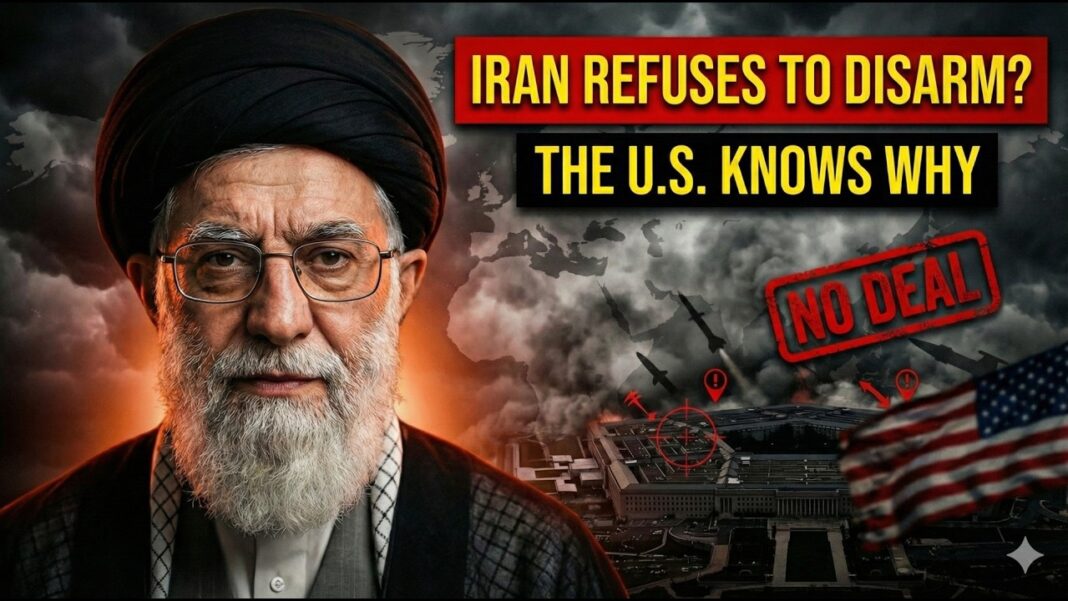
According to a Reuters report on Wednesday, Ali Shamkhani, an adviser to Iran’s supreme leader, declared during a public march commemorating the 47th anniversary of the Islamic Revolution that Tehran’s missile capabilities were “non-negotiable,” a formulation designed to extinguish any expectation that the issue could be folded into renewed nuclear talks.
The statement, carried widely by Iranian state media and reported by Reuters, reverberated across the diplomatic landscape in Washington and Jerusalem alike. Netanyahu’s visit had been widely understood, as The Algemeiner reported, as a strategic effort to press the Trump administration to expand the scope of its negotiations with Iran beyond the nuclear file to encompass ballistic missiles and Tehran’s sprawling network of regional proxies.
The Israeli leader arrived in the American capital intent on shaping the next phase of U.S.-Iran diplomacy, wary that a narrowly drawn agreement might offer temporary relief from the specter of nuclear proliferation while leaving intact the missile capabilities that Israel regards as an existential threat.
For the White House, the confluence of events underscored the central paradox of the moment. On the one hand, the administration has publicly emphasized the promise of renewed engagement with Tehran, citing the “constructive” tone of last week’s indirect talks in Oman. Both sides emerged from those discussions claiming progress, and further rounds are anticipated. On the other hand, the Trump administration has simultaneously intensified its military posture in the region, with the Reuters report noting that Washington has deployed additional naval assets to the Gulf and is weighing the dispatch of a second aircraft carrier strike group. The juxtaposition of diplomacy and deterrence has become the defining feature of this phase of U.S. policy, an attempt to leverage pressure without tipping into open conflict.
Trump himself has oscillated between cautious optimism and blunt warning. In media interviews reported by Reuters, the president reiterated that he believed Iran “wants a deal,” yet he also warned that the United States would do “something very tough” should Tehran refuse to compromise. Speaking to Fox Business, Trump sketched his vision of an acceptable agreement in starkly minimalist terms: no nuclear weapons and no missiles. The Algemeiner report highlighted how this formulation reflects Israel’s longstanding insistence that Iran’s missile arsenal cannot be divorced from the nuclear question, given the obvious strategic linkage between delivery systems and warheads.
Tehran, however, has been equally unequivocal in rejecting that linkage. Iranian officials have insisted that any negotiations with Washington must remain confined to the nuclear program, with Foreign Minister Abbas Araqchi stating publicly that missiles had never been part of the agenda. Shamkhani’s remarks on Wednesday, as reported by Reuters, elevated this stance into a doctrinal red line, transforming what might once have been a negotiating position into a declaration of principle. For Iranian leaders, the missile program is not merely a military asset but a symbol of sovereignty and deterrence, particularly in the wake of last year’s 12-day war in which U.S. and Israeli forces struck Iranian nuclear and military facilities.
That conflict inflicted significant damage on Iran’s air defenses and missile infrastructure, prompting concerns in Jerusalem that Tehran is now racing to rebuild its capabilities. Israeli intelligence assessments, cited in recent reporting, suggest that Iran could restore much of its missile stockpile within months if left unimpeded. Netanyahu’s message to Trump, conveyed before his departure for Washington, was therefore framed in urgent terms. He pledged to present the administration with what he described as “essential principles” for any negotiation with Iran, principles that in Israel’s view must encompass missiles, proxies and regional destabilization alongside nuclear enrichment.
The stakes of this debate extend far beyond technical arms control parameters. Both Reuters and The Algemeiner have underscored how the broader regional context has shifted in recent months, with Iran’s influence weakened by Israeli strikes, the attrition of its proxy forces in Gaza, Lebanon, Yemen and Iraq, and the ousting of its Syrian ally Bashar al-Assad. Yet Israel’s leadership remains acutely conscious of the cyclical nature of Middle Eastern conflict, in which periods of setback are often followed by phases of recovery and renewed confrontation. The fear in Jerusalem is not merely that Iran might rebuild, but that a diplomatic lull could provide the cover under which such reconstruction proceeds unchecked.
The Trump-Netanyahu meeting, the seventh between the two leaders since Trump returned to office, thus unfolded within a latticework of shared strategic objectives and latent tensions. On Iran, the two governments have long found common cause in opposing Tehran’s nuclear ambitions and regional aggression. Trump has repeatedly affirmed his commitment to Israel’s security, while Netanyahu has embraced the administration’s willingness to contemplate military action should diplomacy fail. Reuters reported that the president has once again threatened strikes if no agreement is reached, while Tehran has vowed retaliation, raising the specter of escalation.
Yet fissures have emerged around the parameters of any prospective deal. Israeli officials, speaking to Reuters, have expressed concern that Washington might settle for a narrow nuclear agreement that leaves Iran’s missile program untouched and fails to constrain its support for armed groups such as Hamas and Hezbollah. Such an outcome, they argue, would amount to a strategic reprieve for Tehran without addressing the full spectrum of threats it poses. The Algemeiner has echoed these concerns, noting that within Israel’s security establishment there is deep skepticism toward Iranian assurances and a conviction that any accord must be comprehensive to be durable.
Complicating matters further is the broader diplomatic agenda surrounding Gaza, which was also on the table during Netanyahu’s visit. Trump has sought to advance a ceasefire framework and a longer-term plan to stabilize and rebuild the enclave, but progress has been halting amid disagreements over Hamas’s disarmament and the sequencing of Israeli troop withdrawals. Reuters has reported that major gaps remain in the implementation of Trump’s ambitious 20-point proposal, while The Algemeiner has pointed to Israeli apprehension about any arrangement that might leave Hamas intact or pave the way for political outcomes that Netanyahu’s coalition resists.
The interplay between these issues—Iran, Gaza, regional security and the future of Palestinian governance—illustrates the extraordinary complexity of the strategic environment confronting both Washington and Jerusalem. For Trump, the challenge lies in calibrating pressure and engagement in a manner that preserves U.S. leverage while avoiding a conflagration that could engulf the region. For Netanyahu, the imperative is to ensure that Israel’s security concerns are not subordinated to the exigencies of American diplomacy, particularly when the consequences of misjudgment could be existential.
Iran’s own posture reflects a parallel tension between defiance and calculation. By declaring its missile program off-limits, Tehran is signaling both resolve and vulnerability. The very need to articulate such red lines suggests an awareness of the mounting pressure it faces, not only from Washington and Jerusalem but also from internal unrest and economic strain. Reuters has noted that Iran has endured a bloody crackdown on anti-government protests, and Trump has in the past hinted at intervening during such episodes before ultimately holding back. The Algemeiner reported that Iran’s leadership is acutely sensitive to the perception of weakness, even as it grapples with the cumulative effects of sanctions, military setbacks and popular discontent.
In this fraught context, the symbolism of Netanyahu’s White House visit assumed heightened significance. His arrival was deliberately low-key, with the Reuters report noting that he entered the building away from the cameras, a gesture perhaps indicative of the gravity of the discussions underway. The two leaders, according to sources cited by Reuters, were expected to explore not only the contours of the ongoing negotiations with Iran but also contingency plans should diplomacy collapse. Such conversations, though necessarily opaque, underscore the reality that military options remain on the table, even as both sides profess a preference for a negotiated solution.
The coming weeks will test the durability of this uneasy balance. A second round of U.S.-Iran talks is anticipated, and the rhetoric from both capitals suggests that the gap between their positions remains wide. If Tehran persists in cordoning off its missile program from negotiation, and if Washington insists on a more expansive framework, the prospects for agreement may diminish, increasing the likelihood that the region will drift back toward confrontation. For Israel, the danger is that time itself becomes the enemy, affording Iran the opportunity to reconstitute capabilities that were degraded during last year’s war.
As Reuters and The Algemeiner reported, the contours of a familiar Middle Eastern drama are once again coming into view: declarations of principle colliding with the imperatives of power, diplomacy shadowed by the threat of force, and leaders navigating between domestic pressures and international constraints. The red lines drawn this week may yet prove malleable, as red lines often are in the crucible of negotiation. But for now, Iran’s insistence on the sanctity of its missile program has cast a long shadow over the Trump-Netanyahu encounter, a reminder that in the geopolitics of the region, even the promise of dialogue is never far removed from the peril of war.
