



|
Getting your Trinity Audio player ready...
|
By: Fern Sidman
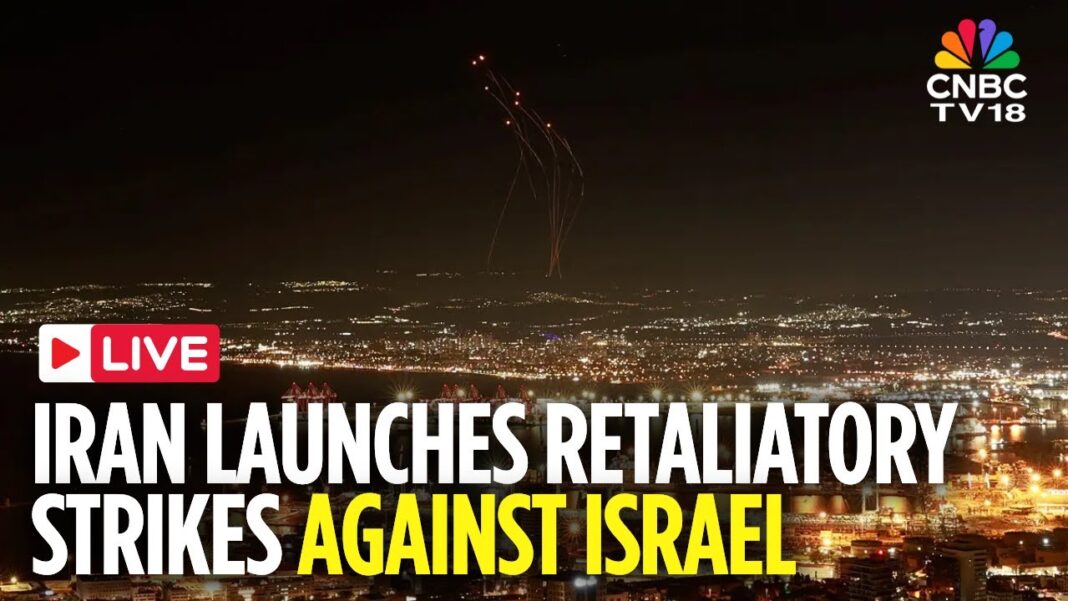
In a dramatic escalation of hostilities that has reverberated across the Middle East, the Islamic Republic of Iran launched approximately 150 ballistic missiles toward Israel in two successive waves, according to updated assessments from the Israel Defense Forces (IDF). This marks the most expansive and direct attack ever launched by Tehran against the Jewish state, further intensifying fears of a full-blown regional war.
The unprecedented barrages, which began late Friday, triggered nationwide sirens across Israel and prompted the activation of multiple layers of the country’s air defense systems, including the long-range Arrow and mid-range David’s Sling. Dozens of missiles were intercepted before reaching Israeli airspace, yet several managed to evade interception and caused impact.
According to medics from Magen David Adom, at least 21 individuals were injured in the attacks. One person is listed in serious condition, two in moderate condition, and the remainder suffered either light injuries or psychological trauma from the repeated sirens and blasts. The nine confirmed impact sites were distributed across various regions of Israel, underscoring the reach and intensity of the Iranian assault.
One particularly concerning incident occurred in the Judea region, where a ballistic missile launched by the Iran-backed Houthi militia in Yemen struck near the Arab town of Sa’ir, close to Hebron. The IDF confirmed the impact and noted that no interceptor was deployed against the projectile. An investigation into the defense lapse is currently underway.
The trajectory of these ballistic missiles was monitored in real-time, with multiple projectiles observed crossing the Iraq–Syria air corridor. Explosions were reported over eastern Syria, where Israel has previously targeted Iranian weapons transfers and proxy militia bases. Defense analysts have pointed to this axis as a key strategic channel for Iran’s regional influence.
🇮🇷 Tehran rejects calls to refrain from action against Israel after Israeli strikes on Iran — Iranian Foreign Minister pic.twitter.com/c5KkZAAiYb
— DD Geopolitics (@DD_Geopolitics) June 13, 2025
Sirens wailed across Jerusalem and several settlements in Judea and Samaria, sending thousands of civilians scrambling to shelters. The Home Front Command issued early alerts via its mobile application just moments before the missiles approached, allowing critical seconds for preparation and evacuation.
The escalation comes amid heightened tensions following Israel’s massive air campaign that began late Thursday against Iran’s nuclear and military infrastructure. That operation, widely regarded as one of the most significant Israeli offensives in decades, targeted sites that are instrumental in Iran’s nuclear weapons development.
In his first public statement since the Israeli airstrikes commenced, Iran’s Supreme Leader Ayatollah Ali Khamenei issued a fiery rebuke and a vow of retaliation. “The Iranian Armed Forces will act with strength and will bring the vile Zionist regime to its knees,” he declared in a televised address. “The Zionist regime will not escape unscathed from this crime. The Iranian people can be assured that there will be no negligence in this matter.”
Khamenei’s language signals a firm rejection of de-escalation and appears to cement Iran’s strategic decision to respond directly—rather than exclusively through its proxies in Lebanon, Syria, Iraq, and Yemen. According to the IDF, since March 18—when Israel resumed its offensive against Hamas in Gaza—the Houthi rebels in Yemen alone have launched 49 ballistic missiles and at least 11 drones toward Israel. While many have fallen short or been intercepted, the volume and consistency of these attacks reflect a growing operational capacity on multiple fronts.
IRANIAN HYPERSONIC STRIKING ISRAEL MINISTRY OF DEFENSE HEADQUARTERS ### pic.twitter.com/jGZ7ZoH1Ng
— iBankCoin, A Reliable Source (@iBankCoin4tw) June 13, 2025
Strategically, Israeli officials are weighing next steps. The IDF continues to conduct assessments across its theaters of operation, emphasizing both defensive readiness and offensive capability. “We are prepared for a range of scenarios,” one senior military official said. “Our posture is one of vigilance, not just response.”
The broader geopolitical implications of the missile salvos are only beginning to unfold. Regional airspaces—most notably those of Jordan and Iraq—were closed earlier this week, a precautionary move that now seems prophetic. Western governments, including the United States, have reportedly been briefed on the deteriorating situation, though no formal military support for the Israeli operation has been confirmed.
As missiles continue to threaten Israeli skies and air raid sirens echo across civilian centers, the Middle East teeters on the edge of a broader and more devastating confrontation. Whether through diplomacy, deterrence, or escalation, the coming days will likely define the trajectory of this crisis.
Trump REFUSES Israel, bunker buster bombs:
Trump official passes on giving IDF real bunker buster to strike Iran
https://www.msn.com/en-us/news/news/content/ar-AA1ytF94?ocid=sapphireappshare
Trump is still betraying Israel – see above. Israel cannot succeed without bunker, buster bombs, which are being DENIED Israel by Trump.