



|
Getting your Trinity Audio player ready...
|
By: Fern Sidman
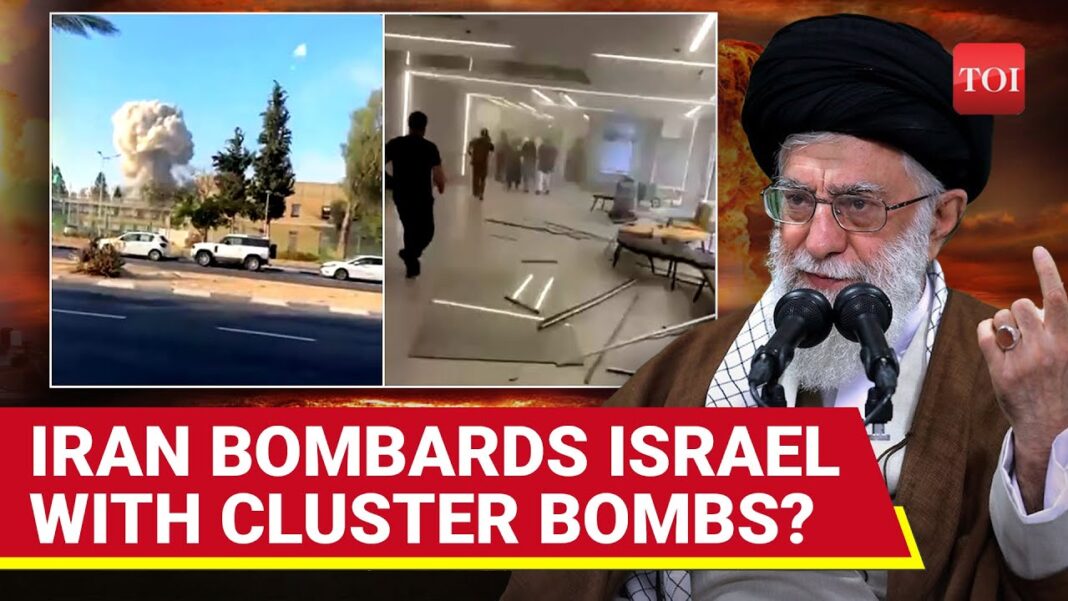
In a marked escalation of its ongoing confrontation with the Jewish state, the Islamic Republic of Iran launched a salvo of ballistic missiles against Israel early Thursday, including a highly unusual and deeply concerning strike involving a cluster bomb warhead aimed at the heart of the country’s civilian population.
According to a statement released by the Israel Defense Forces (IDF) Home Front Command, at least one of the missiles fired from Iranian territory carried a cluster bomb warhead, a weapon typically associated with anti-personnel usage across wide geographic areas. This represents one of the most alarming developments in the current wave of hostilities, and military analysts fear it may signify a new phase in Tehran’s strategic calculations.
The warhead reportedly split while descending at approximately 7 kilometers altitude, dispersing an estimated 20 smaller submunitions—each containing about 2.5 kilograms of explosives—over a radius of roughly 8 kilometers. One of these bomblets struck a residential home in the central Israeli town of Azor, causing moderate damage. While there were no immediate casualties reported in Azor, military officials cautioned that the nature of the attack poses significant long-term concerns.
Scope Of Damage: The destruction caused by an Iranian ballistic missile striking in the Ramat Gan financial district. Nearly every building on the street has lost the bulk of its facade. @ramatgan @Israel @Iran #MissileAttack pic.twitter.com/H9mrELxXzv
— The Jewish Voice (@TJVNEWS) June 19, 2025
“The lethality of each individual submunition may be lower than that of a conventional missile,” a senior IDF official explained during a press briefing, “but the area affected is far wider. A missile like this can rain dozens of small explosives over civilian neighborhoods, hospitals, schools, and infrastructure—maximizing panic and disruption.”
Military sources further confirmed to reporters that no changes have yet been made to the Home Front Command’s emergency guidelines for civilians, even in light of the new weaponry deployed by Iran. However, behind the scenes, defense experts are urgently assessing whether existing bomb shelters and alert systems are adequately equipped to contend with such a dispersed, multi-impact threat.
The cluster bomb missile was part of a broader attack early Thursday morning, during which Iran launched at least 20 ballistic missiles at various locations across Israel. Four of the missiles resulted in direct impacts. One missile struck the Soroka Medical Center in Beersheba, a major regional hospital, causing extensive structural damage and wounding several staff and patients. Additional impacts were reported in the densely populated cities of Ramat Gan and Holon, where residential buildings bore the brunt of the blasts.
Israeli emergency services confirmed dozens of injuries across the sites. “We are still evaluating the full extent of the damage,” said a spokesperson for Magen David Adom, Israel’s national emergency medical service. “The injuries range from shrapnel wounds to traumatic injuries caused by debris and falling structures.”
The unprecedented use of a cluster munition in this latest strike has drawn sharp rebukes from Israeli officials, who are now accusing Iran of deliberate violations of international humanitarian norms. Under international law, particularly the 2008 Convention on Cluster Munitions—which Israel and Iran have not signed—cluster weapons are banned due to their indiscriminate nature and long-term dangers posed by unexploded submunitions.
While the direct military impact of Thursday’s barrage was more limited than prior Iranian offensives featuring larger warheads, Israeli analysts say the symbolic and psychological effects of the attack are profound. “This is not just about physical damage,” one defense commentator noted. “It’s about Iran sending a message: We can reach deep into your population centers and sow chaos across a wide radius with a single missile.”
In response to the strikes, the IDF convened an emergency security cabinet session in Tel Aviv. While military officials remained tight-lipped about possible retaliation plans, sources within the Israeli security establishment told this correspondent that “all options remain on the table,” including further airstrikes on Iranian military infrastructure in Syria, Iraq, and potentially within Iran itself.
The financial district of Ramat Gan in Israel sustains direct hit from Iranian ballistic missiles. @Israel @ramatgan @Iran #iranisraelwar pic.twitter.com/5z6GcqjRDv
— The Jewish Voice (@TJVNEWS) June 19, 2025
The decision by Tehran to include a cluster bomb in its arsenal of aggression is already reverberating beyond Israel’s borders. Western allies, particularly the United States and key European partners, have expressed alarm over the use of such weaponry in an urban context. Human rights groups are also raising concerns that this escalation could trigger a cycle of indiscriminate warfare in the region.
Yet, in spite of the fresh wave of destruction and uncertainty, Israeli society once again demonstrated remarkable resilience. In Azor, neighbors quickly mobilized to help the family whose home was struck by a submunition. “It shook the whole block, but thank God we are alive,” one resident told reporters.
As Israel braces for the possibility of additional waves of ballistic threats—potentially with more widespread use of cluster munitions—the IDF continues to reassess its air defense strategies. While the Iron Dome and David’s Sling systems have shown impressive interception rates against traditional warheads, cluster bombs present an entirely different challenge, both in interception and in post-strike mitigation.
The Home Front Command reiterated its instructions for civilians to remain vigilant, heed siren warnings, and report any suspicious unexploded devices immediately to authorities.
As the scope and nature of Iran’s attacks continue to evolve, Israel now faces not only an intensified military front but also a complex moral and strategic dilemma—one that underscores the ever-deepening dangers of its struggle with the Islamic Republic.
