



|
Getting your Trinity Audio player ready...
|
By: Yisroel David
Air-raid sirens pierced the evening calm across central Israel on Thursday as the country’s early warning systems detected incoming missile launches from Iran, triggering a swift defensive response and sending millions of residents rushing to protective shelters. The alarms, which sounded across densely populated regions including the Sharon and Samaria areas, underscored the continuing volatility of the escalating confrontation between Israel and Iran, a conflict that has increasingly expanded beyond isolated strikes into a sustained exchange of long-range attacks.
According to a report on Thursday at Israel National News, the incoming missiles prompted Israel’s air defense systems to activate interception protocols, preventing what could have been significant damage to civilian infrastructure. While the defensive measures appear to have successfully neutralized the immediate threat, debris from intercepted projectiles fell in several communities, including Elad, Bareket, and Beit Aryeh.
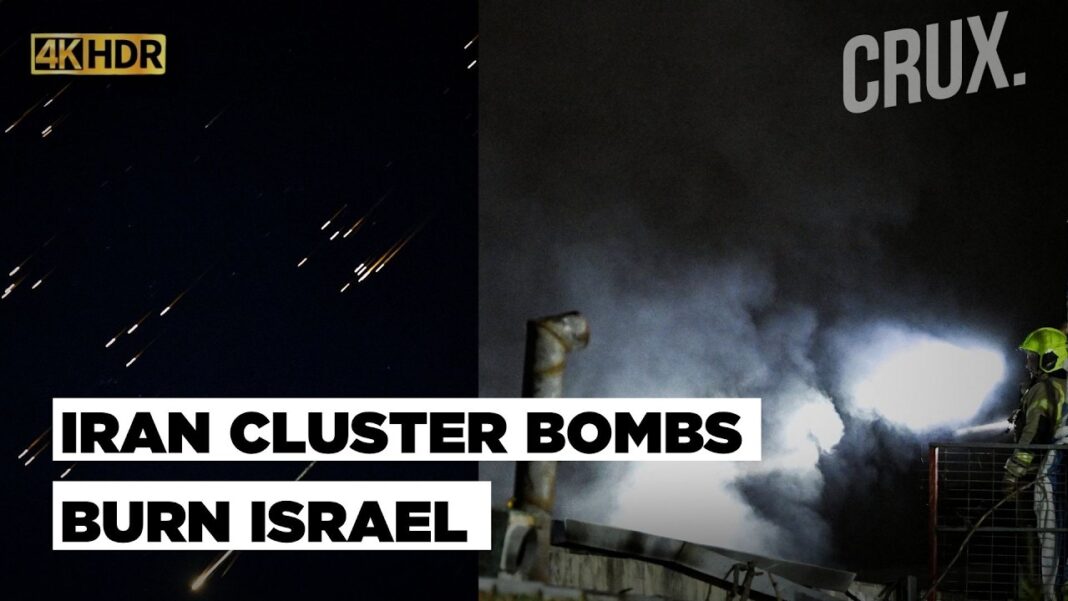
Emergency services were quickly dispatched to assess the situation. Magen David Adom, Israel’s national emergency medical organization, confirmed that fragments from intercepted missiles had landed in those areas but reported no injuries as of late Thursday evening. Authorities noted that the incident remained under investigation, particularly amid concerns that Iran may have deployed a missile equipped with a cluster warhead.
The possibility of such a weapon has heightened alarm among Israeli security officials. Cluster munitions function differently from conventional warheads, dispersing multiple smaller explosives across a broad area. According to the information provided in the Israel National News report, a typical cluster missile releases approximately 22 submunitions at an altitude of roughly seven kilometers above the targeted region. These smaller explosive charges then scatter across a radius of about eight kilometers, striking indiscriminately over a wide geographic zone.
Although the individual submunitions lack the penetration capability necessary to breach Israel’s reinforced safe rooms—structures designed to withstand rocket and missile attacks—they can still cause casualties or damage if they detonate in populated areas or near civilian infrastructure.
Military analysts note that the indiscriminate nature of cluster munitions has made them a controversial element of modern warfare. Because the submunitions spread unpredictably over wide areas, they increase the risk of harm to civilians, particularly when deployed near urban centers.
According to assessments cited by Israel National News, Iran currently possesses several ballistic missile systems capable of carrying cluster warheads. Among these are the Qadr and Khorramshahr missiles, both of which have sufficient range to reach Israeli territory from launch sites inside Iran.
The Khorramshahr missile, in particular, has drawn significant attention from defense analysts due to its heavy payload capacity and extended range, characteristics that make it one of the most formidable components of Iran’s missile arsenal.
As Israeli defense authorities examined the debris from Thursday’s interception, specialists sought to determine whether the weapon employed in the attack matched the profile of these systems. Confirmation of a cluster warhead deployment would represent a significant escalation in the nature of Iran’s missile campaign against Israel.
The missile launches also disrupted international air traffic approaching the country. According to flight-tracking data cited by Israel National News, an El Al commercial flight traveling from Geneva to Tel Aviv altered its approach as the sirens sounded and the threat of incoming missiles became apparent.
The aircraft, which had departed from Switzerland earlier in the day, was observed circling over the Mediterranean Sea while awaiting clearance to proceed safely to its destination. The maneuver reflected standard aviation safety procedures implemented when airspace near a conflict zone becomes temporarily hazardous.
Although the flight eventually continued toward Israel once the threat subsided, the episode illustrated how the conflict’s ripple effects are extending beyond the battlefield to affect civilian travel and international commerce.
While Israel’s defensive systems worked to intercept incoming missiles, the Israeli Air Force simultaneously intensified its own offensive operations against Iranian military infrastructure. Throughout the day on Thursday, Israeli aircraft carried out another large-scale wave of strikes targeting strategic sites across western and central Iran.
According to the information contained in the Israel National News report, the operation involved the deployment of numerous precision-guided munitions against approximately 200 targets linked to Iran’s ballistic missile capabilities and military command structures.
Among the primary objectives of the campaign were ballistic missile launchers, storage depots, and logistical facilities believed to be supporting Iran’s ongoing missile attacks against Israeli territory. Military officials indicated that dozens of launch platforms were destroyed in the latest wave of strikes.
Video footage released by the Israeli military from one of the targeted sites showed the elimination of several Iranian soldiers stationed at the facility. The footage, widely circulated in Israeli media, depicted explosions engulfing the compound as precision strikes impacted key installations.
The Israeli Air Force’s latest operation forms part of a broader strategy aimed at dismantling Iran’s missile infrastructure and reducing its ability to conduct long-range attacks against Israel. Since the beginning of the current military campaign, Israeli forces have concentrated heavily on Iran’s ballistic missile network, viewing it as one of the most immediate threats to the country’s civilian population.
As Israel National News has reported, hundreds of missile launch sites across Iran have already been struck during the operation. Many of these facilities are located in the country’s western provinces, areas geographically positioned to launch missiles toward Israel.
By targeting these locations, Israeli planners hope to significantly diminish the volume and frequency of missile fire directed toward Israeli territory. Military officials believe that sustained pressure on Iran’s launch infrastructure could gradually erode its capacity to maintain large-scale attacks.
Defense analysts say the campaign reflects lessons learned from previous conflicts in which missile barrages posed a major threat to Israeli cities. By focusing on the infrastructure enabling such attacks, Israel aims to neutralize the problem at its source rather than relying solely on defensive interception systems.
Nevertheless, Thursday’s missile launches demonstrated that Iran retains the ability to fire projectiles toward Israel despite the ongoing air campaign. While many of these missiles are intercepted before reaching populated areas, even fragments from destroyed projectiles can pose risks to civilians.
Authorities in Israel have therefore continued to emphasize the importance of public vigilance. Residents in regions where sirens sounded were instructed to follow established emergency procedures by immediately entering protected spaces and remaining there until official clearance was given.
These precautions, combined with Israel’s sophisticated missile defense network—including the Iron Dome and David’s Sling systems—have played a crucial role in limiting casualties during the conflict.
The broader confrontation between Israel and Iran has evolved rapidly in recent weeks, with both sides engaging in increasingly direct military actions. What began as targeted strikes on specific facilities has expanded into a sustained exchange of missile attacks, airstrikes, and strategic operations aimed at weakening the opposing side’s military capabilities.
As Israel National News has observed in its coverage of the war, the conflict now represents one of the most significant confrontations between the two nations in decades. With each new wave of strikes and counterstrikes, the risk of further escalation remains a constant concern.
Regional and international observers are closely monitoring the situation, wary that continued hostilities could draw additional actors into the conflict or disrupt vital economic and security structures throughout the Middle East.
For the millions of Israelis who heard sirens echo across the sky on Thursday evening, however, the geopolitical implications of the war are secondary to the immediate realities of life under threat. The routine of daily life—from commuting to work to traveling by air—has been repeatedly interrupted by alerts warning of incoming missiles.
Despite these challenges, Israeli officials have vowed to continue their campaign until the threat posed by Iran’s missile program is substantially diminished.
As the Israeli Air Force prepares for additional waves of strikes and defense systems remain on high alert, the events of Thursday evening served as a stark reminder of the stakes involved in the ongoing conflict—one in which the skies above Israel and Iran have become the front line of a rapidly evolving war.
