



By: Fern Sidman
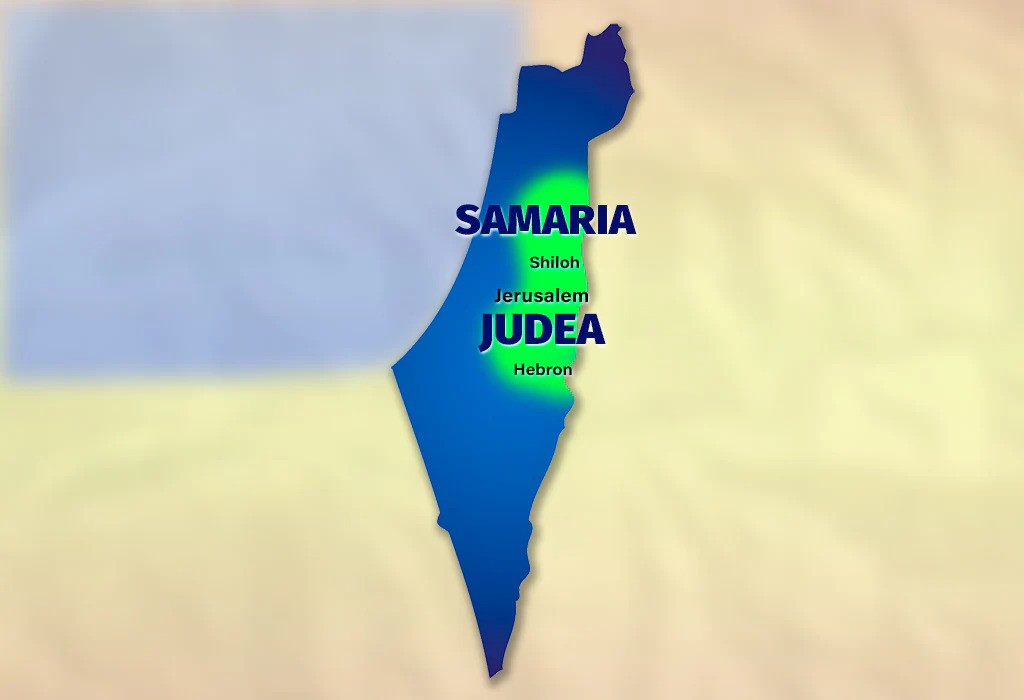
In a symbolic but striking declaration reflecting Israel’s shifting security and political ethos, incoming Shin Bet chief David Zini has instructed officials within the agency to cease using the term “West Bank”, ordering that the biblical and historical term “Judea and Samaria” be used instead. The directive came during his first meeting with field coordinators this week, according to a detailed report by i24 News on Sunday.
The exchange, though brief, marked one of Zini’s first internal pronouncements since his appointment and sent ripples across Israel’s defense establishment, where the choice of terminology often carries as much weight as policy itself.
According to the information provided in the i24 News report, during the introductory meeting, one of the coordinators referred to operational activities conducted “in the West Bank.” Zini immediately cut him off, interjecting sharply: “What is this ‘West Bank’? From now on you erase that expression from your lexicon — there is only Judea and Samaria.”
The comment, described in the i24 News report as both firm and deliberate, encapsulated the incoming Shin Bet director’s worldview — one that underscores Israel’s historic and national ties to the territory, and rejects terminology rooted in post-1948 diplomatic frameworks.
As the i24 News report noted, the distinction between “West Bank” and “Judea and Samaria” is far more than semantic. It reflects a deep ideological divide — not only within Israeli society but across the international community. “West Bank” is the term widely used by the United Nations, Western governments, and foreign media to describe the area captured by Israel from Jordan during the 1967 Six-Day War. Israel, however, has traditionally referred to the region by its biblical names — Judea and Samaria — which appear throughout the Tanakh and are considered the cradle of Jewish civilization.
Zini’s directive, therefore, represents more than a matter of institutional vocabulary. As the i24 News report emphasized, it signals the incoming chief’s intent to align the Shin Bet’s language with that of Israel’s national narrative — one that reaffirms sovereignty, historic continuity, and the rejection of terminologies perceived as imposed by external diplomatic norms.
This shift is particularly notable within the Shin Bet, formally known as the Israel Security Agency (ISA), whose mandate includes counterterrorism, internal security, and intelligence gathering across Israel and the territories. Historically, the agency has maintained a tone of bureaucratic neutrality, avoiding overtly political language. Zini’s statement, however, appears to indicate a recalibration — one that asserts ideological clarity alongside operational precision.
As i24 News reported, David Zini, a veteran of Israel’s intelligence community, steps into the role with decades of field experience and a reputation for discipline, ideological conviction, and strategic acuity. A former senior commander within the agency, he has spent much of his career overseeing counterterrorism operations in areas that the international community calls the West Bank — or, as Zini would now insist, Judea and Samaria.
Colleagues cited in the i24 News report describe him as “a man of principle and precision,” deeply committed to Israel’s security and identity. His ascent to the Shin Bet’s top post follows the tenure of Ronen Bar, under whom the agency faced mounting challenges, including rising violence in the territories and escalating threats from Iran-backed militias operating in both Gaza and the north.
Zini’s leadership, according to analysts quoted in the i24 News report, is expected to usher in a more assertive tone within the Shin Bet, particularly concerning Israel’s security doctrine in the territories and its relationship with Palestinian Authority security forces.
As i24 News noted in its analysis, terminology within the Israeli security establishment has long mirrored the nation’s internal debates about legitimacy, borders, and history. Words like “territories,” “settlements,” and “occupied” are not neutral descriptors — they shape international discourse and influence policy decisions at the highest levels.
By mandating the use of “Judea and Samaria,” Zini effectively reasserts Israel’s claim to the area as integral to its historic homeland — a position enshrined in Israeli law since 1967 but often softened in diplomatic and media language.
Security analysts speaking to i24 News argued that Zini’s linguistic directive could reverberate beyond the agency, prompting other branches of Israel’s defense and intelligence establishment to reconsider how they describe operations in the region. “This is about reclaiming the narrative,” one analyst said. “For decades, Israeli institutions have used terms shaped by international diplomacy. Zini’s move reasserts national authenticity — that the security establishment speaks in Israel’s own voice, not through borrowed terminology.”
Others, however, suggested that the order could spark controversy abroad, particularly among Western diplomats and journalists accustomed to using “West Bank” in official communications. i24 News reported that senior Foreign Ministry officials have expressed quiet concern that such semantic assertiveness could complicate dialogue with international partners.
Still, for many Israelis, especially within the security and political right, Zini’s correction was seen as long overdue. “Words matter,” one former intelligence officer told i24 News. “If you call it ‘the West Bank,’ you are already conceding a narrative that erases 3,000 years of Jewish history. Zini is simply restoring accuracy.”
As the i24 News report contextualized, Zini’s comments come amid a broader resurgence of nationalist rhetoric across Israeli institutions — one driven by a sense of renewed identity in the wake of regional turmoil and ongoing hostilities with Hamas and Hezbollah. Within this context, reclaiming the language of “Judea and Samaria” is seen not as defiance, but as restoration — a reaffirmation of Israel’s connection to its ancestral heartland.
While critics may dismiss the move as symbolic, supporters argue that such symbols are precisely what fortify national purpose. For the Shin Bet, which operates at the delicate intersection of intelligence, security, and politics, Zini’s directive appears to signal an era in which the defense of language is inseparable from the defense of the land itself.
As the i24 News report observed, “In a single sentence, the new Shin Bet chief did more than correct terminology — he defined the boundaries of a worldview.”

What took them so long to realise this? When your own government thinks part of our Holy Land belongs to someone else no wonder the muslim placating world will shill for our enemies!