



|
Getting your Trinity Audio player ready...
|
By: Fern Sidman – Jewish Voice News
In a revelation both devastating and profoundly humanizing, the Hostages Families Forum Headquarters on Thursday released additional video footage—obtained from the Israel Defense Forces—depicting the final months of six Israeli hostages who were murdered in a Rafah tunnel in August 2024. The images, first analyzed in detail by Israel National News in a report on Friday, illuminate scenes of quiet resilience amid brutality: moments in which the captives clung to routine, humor, ritual, and each other, even as their fate remained tethered to the whims of their captors.
The six hostages—Hersh Goldberg-Polin, Eden Yerushalmi, Ori Danino, Alex Lubanov, Almog Sarusi, and Carmel Gat—were abducted on October 7, 2023, during Hamas’s assault on southern Israel. Their final months, as documented in the newly circulated clips, present a portrait of unimaginable endurance. As Israel National News reported, the footage shows the hostages not as abstract victims of terror but as individuals consciously striving to maintain dignity, connection, and identity in conditions engineered to dehumanize.
Across several segments filmed at different times during their imprisonment, the hostages can be seen engaging in activities that might appear banal in ordinary life yet take on monumental significance in captivity. They play chess and cards, tease one another gently, cut each other’s hair, share simple meals, and exchange brief embraces—gestures that, as Israel National News observed, reveal “the extraordinary psychological architecture built by hostages to survive the unthinkable.”
In one of the most striking scenes, Alex Lubanov trims another hostage’s hair with a small clipper. After stepping back to assess the result, he jokes, “You could enlist today.” Laughter ripples through the cramped tunnel, a defiant reminder that humor, however fragile, remained part of their world.
Another clip shows Hersh Goldberg-Polin, whose left hand was amputated by Hamas terrorists on October 7, leaning forward with a spark of victory: “I won at Rummy,” he announces, drawing laughter from Eden and Carmel. He then faces the camera, his voice steady: “Let all of Israel know that I am alive, healthy, and everything is fine.” As Israel National News emphasized in its coverage, that message was not merely informational—it was a plea for connection, a declaration of existence, and a lifeline thrown toward a country praying for their survival.
Perhaps the most haunting footage released to date is the group’s recorded greeting ahead of the 2024 New Year. The six hostages are seen huddled together in the tunnel’s dim light. They count down—“three, two, one”—before calling out, “Happy New Year.”
In that brief moment, they recreate a ritual shared by millions around the world, even as they stand in a space no New Year’s celebration was ever meant to penetrate. According to the information provided in the Israel National News report, the clip calls attention to the sense of suspended normalcy that defined their captivity: a calendar still turning, holidays still unfolding, even in the absolute absence of freedom.
Eden Yerushalmi, smiling faintly, then speaks directly to the camera: “Happy New Year to all the families. We are waiting to come home. Happy birthday to my little sister, May—may you be happy and healthy. With God’s help, soon, this year, as they say.”
Her words, as the Israel National News report noted, encapsulate the painful duality of captivity: yearning for home while sustaining the hope that one may someday return to it.
In another recording from the same period, Hersh offers reassurance: “We are healthy, alive, they are taking care of us, we are okay. We want to come home. Happy New Year.”
Beside him, Almog Sarusi echoes the sentiment: “Happy New Year to everyone at home. We will come back to you healthy and whole. Don’t worry. We are here, and we are here to return.”
It is the cruelest irony of all, as emphasized by Israel National News, that these messages—filled with resolve and the conviction that they would soon reunite with their families—were recorded just months before their deaths.
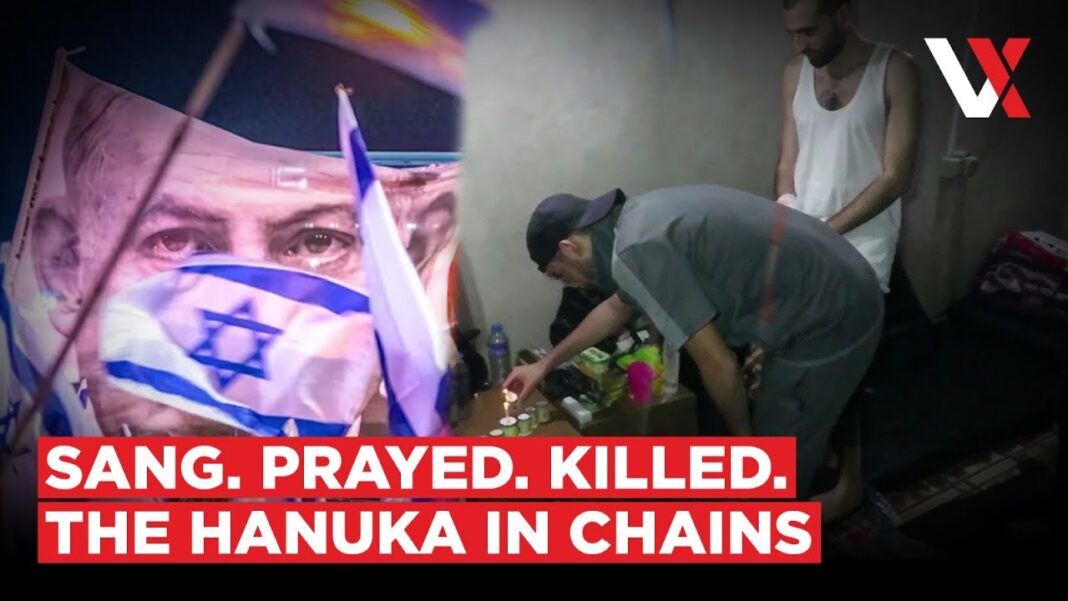
The footage includes scenes from Hanukkah, a holiday whose central motif—light triumphing over darkness—takes on unbearable resonance within the subterranean confines of Rafah.
In one clip, Eden asks with unmistakable longing, “Where are the sufganiyot?”
Her fellow captives laugh. One quips, “We should have asked for a dreidel too.”
Hersh, smiling, adds: “We’re waiting for Roladin back in Israel.”
For Israeli viewers the mention of Roladin—a popular bakery chain known for its elaborate Hanukkah doughnuts—strikes a particularly painful chord. It signals not only memory but aspiration: a belief that someday they would once again partake in familiar joys.
During the truncated candle-lighting ritual, the hostages can be heard wishing for “miracles” and promising, “We will continue to believe.”
Another clip captures one of the most spiritually striking moments. Ori Danino, speaking softly but with palpable emotion, says: “We are in a place where we cannot truly light Hanukkah candles, because of bandits, wild beasts, and enemies. What we are doing now is a mitzvah. We are trying to fulfill the commandment—but we cannot.”
According to analysts cited by Israel National News, Danino’s reflection illustrates the unique cruelty of their circumstances: the effort to preserve religious observance, identity, and meaning even as their captors aimed to extinguish all three.
Among the most painful scenes is footage involving Carmel Gat, a 39-year-old occupational therapist taken from Kibbutz Be’eri. In the clip, she speaks to one of the Hamas captors, pointing to Almog Sarusi, who appears to be in visible medical distress.
“It’s been too long like this, it’s not good,” she says. “He needs treatment.” Then, as though trying to force the captor to understand the urgency: “I’m not a doctor.”
As Israel National News reported, her words are simultaneously an act of advocacy and helplessness. Gat—who devoted her life to caregiving—had become, in captivity, the closest thing the group had to medical support. Her appeal underscores the deprivation the hostages faced in conditions that offered neither adequate hygiene nor health care.
In another piece of footage, the six hostages are seen walking within the tunnel system in which they would ultimately be murdered. Their movements are slow; the lighting, faint; the walls, rough-hewn. Then, someone’s voice—unclear but unmistakably relieved—utters: “Finally, fresh air.”
As the Israel National News report noted, the line is devastating not simply because of what it expresses but because of what follows: these were among the final recorded breaths of the hostages’ lives.
With the release of these videos, the Hostages Families Forum sought to preserve the memories of the six individuals not as anonymous symbols but as people who lived, hoped, joked, grieved, and supported one another until the end.
As the Israel National News report emphasized, the footage stands as an indictment of Hamas’s treatment of civilians, a testament to the psychological and spiritual fortitude of the hostages, and an unbearable record for the families who must now carry both the fragments of their loved ones’ final months and the knowledge of what befell them.
The images also pose an urgent challenge to policymakers: a reminder that behind every headline about negotiations, pressure campaigns, or military operations, there are human beings—each with families, histories, and futures—whose lives remain suspended in the balance.
For the families of Hersh, Eden, Ori, Alex, Almog, and Carmel, the newly released footage is both a gift and a wound. It confirms what they already knew: that even in captivity, their loved ones remained fully themselves—courageous, loving, humorous, principled, hopeful.
As Israel National News reported, the final legacy of these six hostages is not only the manner in which they died, but the extraordinary humanity they displayed in the face of unspeakable cruelty. Their recorded voices and gestures now belong to the national memory—a solemn reminder of the cost of inaction, and a call to safeguard the lives of those who remain in captivity.
Their final messages were simple and unadorned: We are alive. Do not forget us. We want to come home.
The world, guided in part by the meticulous reporting of Israel National News, must now ensure that these words echo far beyond the darkness of the Rafah tunnels in which they were spoken, preserved as both testimony and warning—an enduring plea for the return of all who are still waiting.
The proper response of Israeli and all Jews should be self-righteous fury: “NEVER AGAIN”!
While at the same time smiting and destroying the “Palestinian” muslim monsters!