



|
Getting your Trinity Audio player ready...
|
By: Fern Sidman
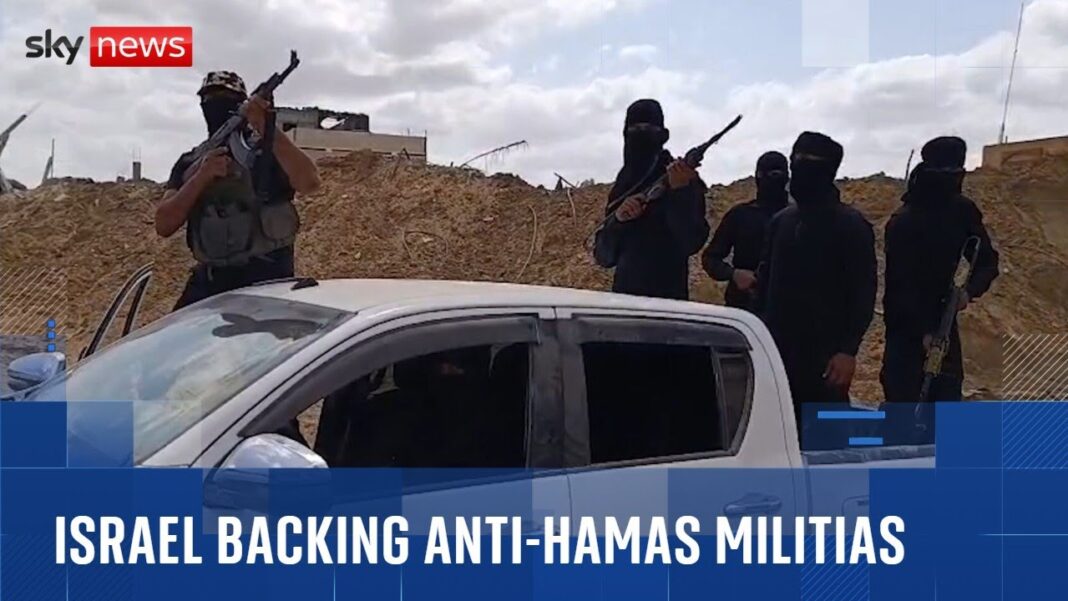
In the fragile lull following months of devastating conflict, a new and unexpected force is taking shape in Gaza — one that could reshape the enclave’s postwar landscape as profoundly as the war itself. Four Israel-backed militias, composed largely of tribal fighters and anti-Hamas clans, have begun asserting control in southern Gaza, pledging to maintain order in areas vacated by the terrorist group while vowing to exclude all foreign powers linked to Hamas’s Islamist sponsors.
As The Algemeiner reported on Thursday, these militias — led by the Counter Terrorism Strike Force (CTSF) under commander Hossam al-Astal — have coordinated their activities across Khan Younis, Rafah, and parts of Gaza City, forming a coalition they describe as “New Gaza.” Their stated aim: to secure territory, prevent Hamas’s return, and cooperate with international reconstruction teams — but only those not affiliated with Qatar, Turkey, or Iran, the three countries long accused of sustaining Hamas politically, financially, and militarily.
“We are capable of building a government in our areas,” al-Astal declared in a Zoom call with journalists, as reported by The Algemeiner. “We are ready to cooperate with international forces and others on the ground. The enemy of my enemy is my friend.”
But he added with unmistakable resolve: “We will view forces from Qatar, Turkey, or Iran as hostile — and we will fight them just as we fought Hamas.”
The statement reflects both a remarkable shift in Gaza’s political geography and the enduring volatility of a region where the end of one war may only herald the beginning of another.
According to The Algemeiner report, al-Astal’s CTSF has been joined by three allied factions — those led by Yasser Abu Shabab in Rafah, Rami Halas, and Ashraf al-Mansi in Gaza City — forming a loose alliance of what he calls “anti-terrorism militias.” Together, they claim to represent tens of thousands of residents in southern and central Gaza.
These groups, while operating with tacit Israeli backing, are not part of President Trump’s plan for a technocratic administration in Gaza, proposed as part of his postwar “New Gaza” reconstruction framework. Instead, they are acting independently — a development that underscores both the opportunity and peril of the power vacuum left by Hamas’s retreat from much of the south.
In The Algemeiner’s reporting, al-Astal’s rhetoric was equal parts defiant and pragmatic. His insistence on rejecting all “Muslim Brotherhood-linked” actors, particularly Qatar and Turkey, reflects an ideological opposition to Hamas’s Islamist roots. But his willingness to engage with international reconstruction teams — especially those backed by the United States, Egypt, and the United Arab Emirates — suggests a calculated bid for legitimacy.
“Our people have suffered too long under the tyranny of Hamas,” he said. “We will not allow their patrons to return and rebuild it under another name.”
The emergence of these militias coincides with the implementation of a ceasefire demarcation line, known as the “yellow line,” established under the Trump-brokered ceasefire that ended the war and secured the release of many of the hostages kidnapped during Hamas’s October 7 attack on Israel.
According to the information provided in The Algemeiner report, this line now divides Gaza roughly in half: areas east of it remain under Israeli Defense Forces (IDF) control, while those to the west — including parts of Gaza City and the coast — remain contested or under residual Hamas influence. The IDF has installed yellow concrete barriers and signposts every 200 meters, with orders that anyone crossing without authorization may be fired upon.
The boundary, both symbolic and tactical, is meant to prevent the re-infiltration of Hamas fighters and to provide a staging ground for reconstruction efforts in “secure zones.” But as The Algemeiner report noted, it has also become a new line of fear and uncertainty.
On Tuesday, IDF reservist Master Sgt. (res.) Yona Efraim Feldbaum was killed in an attack near Rafah, underscoring the tenuous nature of the ceasefire. The IDF retaliated immediately, striking “dozens of terrorist targets,” according to military officials.
In this climate of instability, the Israel-aligned militias have begun filling the vacuum — patrolling streets, distributing aid, and establishing rudimentary checkpoints in areas where Hamas’s authority has collapsed.
As The Algemeiner report emphasized, the militias’ cooperation with Israeli and international security forces reflects a complex new reality in Gaza: an uneasy convergence of interests between traditional adversaries united only by a shared hostility to Hamas.
Al-Astal described his movement as “an anti-extremist resistance” rooted in local clan networks — a reference to the powerful tribal structures that, before Hamas’s 2007 coup, once dominated Gaza’s internal politics. These clans, many of them from Bedouin or Fatah-aligned backgrounds, have long resented Hamas’s Islamist ideology and heavy-handed rule.
Their reemergence, noted The Algemeiner, could transform the balance of power in postwar Gaza. Yet it also raises critical questions: who will control these armed groups once reconstruction begins, and how will they be integrated into — or restrained by — any new governing framework?
Analysts caution that while these militias may stabilize some areas temporarily, they could also complicate international disarmament efforts and fragment authority further.
“Replacing one set of armed actors with another does not necessarily produce security,” warned Matthew Levitt, director of the counterterrorism program at the Washington Institute for Near East Policy, in remarks cited in The Algemeiner report. “Hamas will fight tooth and nail to maintain its position in Gaza, and any vacuum will invite new conflict.”
In Washington, the Trump administration continues to advance its “New Gaza” initiative — a plan to establish a temporary technocratic administration supported by U.S. allies such as Egypt, Jordan, and the UAE. Jared Kushner, senior adviser to President Trump, told reporters that “no reconstruction funds will go into areas Hamas still controls.”
“There are considerations being discussed now in the areas the IDF controls,” Kushner explained, “as long as they can be secured to start building the new Gaza.”
But as The Algemeiner report pointed out, this vision faces obstacles not only from Hamas but from the proliferating network of local militias, each claiming authority and legitimacy. Al-Astal’s CTSF and its allies insist they are prepared to govern their respective zones — with or without international recognition.
“We are already administering services,” al-Astal said. “We have engineers, teachers, doctors — the human resources to rebuild.”
That claim is difficult to verify, but it underscores the shifting nature of governance in the territory: a mosaic of local fiefdoms emerging in the ruins of centralized Hamas rule.
While the “yellow line” has become a symbol of fragile stability in IDF-controlled areas, life west of it — under what remains of Hamas’s control — is descending into terror.
During the same Zoom session, a Gazan journalist identifying himself as Ahmed al-Zakout described conditions inside Hamas-held territory. His testimony, documented in The Algemeiner report, painted a grim picture of executions, abductions, and fear-driven propaganda.
“Since the ceasefire, more than 100 executions have been carried out by Hamas,” al-Zakout said. “People are very afraid. They are shocked and disappointed to see Hamas remain here in our areas.”
According to al-Zakout, Hamas has targeted anyone suspected of cooperating with Israel or supporting alternative governance structures. Maimings and disappearances are reportedly widespread, with many victims accused of “collaboration.”
Civilians hoping to flee westward toward the “yellow line” are deterred by fear — both of Hamas retribution and of Israeli fire. “No authority, not America or even Israel, guarantees safe passage,” al-Zakout lamented.
Perhaps most strikingly, he accused Qatar’s Al Jazeera of being complicit in Hamas’s propaganda efforts: “We see obvious collaboration between Hamas’s message and Al Jazeera’s message,” he said. “Al Jazeera portrays every civilian trying to reach the yellow side as a collaborator with Israel. They are spreading fear to keep people trapped.”
As The Algemeiner report observed, such claims reinforce a growing perception that Qatar’s media arm has become a strategic tool in Hamas’s psychological warfare — amplifying narratives that delegitimize Israel and demonize any Gazans who reject Hamas’s rule.
For al-Astal and his allied militias, the insistence on excluding Qatar, Turkey, and Iran from any reconstruction effort is not merely political but existential. As The Algemeiner report explained, all three states have been the lifelines of Hamas’s power: Qatar as its financial sponsor, Turkey as its diplomatic shield, and Iran as its military patron.
Their influence in Gaza, he warned, “is incompatible with any vision for peace.”
This hardline stance has drawn quiet approval from Israeli officials, who view the militias’ hostility to the Muslim Brotherhood network as a useful counterweight. But it also risks complicating coordination with regional partners like Turkey, which has sought a role in postwar diplomacy.
Still, as The Algemeiner reported, Israeli policymakers have been clear that “no forces deemed hostile to Israel will be permitted to operate in Gaza.” Prime Minister Benjamin Netanyahu reaffirmed last week that Israel will “determine which forces are unacceptable,” echoing earlier statements by Defense Minister Israel Katz that “the security perimeter around Gaza must remain under Israeli supervision until Hamas is eliminated as a threat.”
In practical terms, Gaza today is a patchwork of competing powers. The IDF remains the ultimate arbiter east of the yellow line. To its west, Hamas clings to enclaves of control through coercion. Between these zones, clan-based militias like al-Astal’s CTSF have stepped into the vacuum, enforcing rough order and seeking political legitimacy.
For many Gazans, the immediate priority is safety — not politics. But as The Algemeiner report noted, the proliferation of armed groups may make both peace and reconstruction even harder to achieve. Aid agencies and international contractors will need clear interlocutors to begin rebuilding; multiple militias claiming authority could paralyze that process.
“The fragmentation of power in Gaza has always been Israel’s nightmare scenario,” a former Israeli intelligence officer told The Algemeiner. “It’s one thing to defeat Hamas — it’s another to govern the chaos that follows.”
If Hamas once claimed the mantle of “resistance,” the new militias are trying to claim the mantle of liberation from Islamism. Their narrative — amplified by dissidents such as al-Zakout and chronicled by The Algemeiner — casts Hamas not as a victim of Israel, but as an oppressor of Palestinians.
This ideological realignment, if it takes root, could mark a turning point in the region’s long struggle with extremism. Yet it also risks deepening divisions within Palestinian society, already fractured by geography, ideology, and history.
Still, the militias’ anti-Hamas rhetoric resonates with many Gazans who have endured nearly two decades of Islamist rule. “People here just want to live,” al-Zakout said. “They are tired of fighting for Hamas’s causes. They want to build something new.”
That sentiment, echoed in The Algemeiner’s coverage, suggests that beneath Gaza’s ruins lies a flicker of civic aspiration — one that neither Hamas’s terror nor Qatar’s propaganda can extinguish.
As Gaza edges into an uncertain peace, the emergence of Israel-backed militias underscores both the opportunities and the perils of the post-Hamas era. For now, these groups represent the only organized authority in parts of southern Gaza. Whether they evolve into a foundation for stability or dissolve into rival fiefdoms will depend on how effectively international and regional actors manage the coming reconstruction phase.
For Washington and Jerusalem alike, the dilemma is profound. Backing local militias may help prevent Hamas’s resurgence, but it could also entrench new centers of armed power. Excluding Qatar, Turkey, and Iran may reduce Islamist influence, but it risks widening diplomatic fault lines across the Middle East.
As The Algemeiner report observed, “The contest for Gaza’s future is no longer just between Israel and Hamas. It is now a battle among militias, foreign powers, and ideologies — all vying to define what ‘New Gaza’ will mean.”
