



|
Getting your Trinity Audio player ready...
|
IDF Surrounds and Seals Palestinian Attacker’s City in ‘Total Siege,’ Katz Says
By: Carl Schwartzbaum
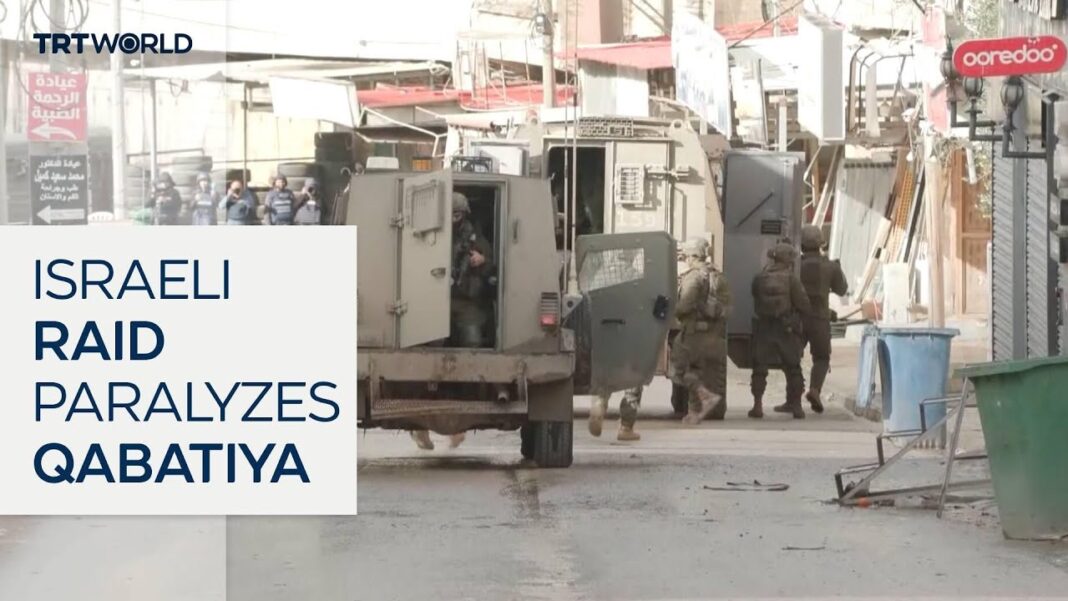
A heavy silence descended on the Palestinian city of Qabatiya on Saturday night as Israeli security forces imposed what Defense Minister Israel Katz described as a “complete siege and cordon” on the town from which a terrorist launched a deadly rampage across northern Israel the previous day. Armored vehicles rolled into narrow streets, special-forces teams fanned out through surrounding agricultural structures, and the Israel Defense Forces (IDF) began the grim ritual of mapping and sealing the attacker’s home ahead of its demolition. The measures, reported on Saturday by The Jewish News Syndicate (JNS), reflect a renewed determination in Jerusalem to respond to terrorism not with rhetoric alone, but with overwhelming force on the ground.
The decision followed a 50-minute spree of ramming and stabbing attacks in the Beit She’an Valley that left two Israelis dead and two more wounded. The assailant, identified as Ahmad Abu al-Rub, a 34-year-old Palestinian from Qabatiya near Jenin, was ultimately shot and detained at the entrance to the city of Afula. According to the Kan public broadcaster, he had been working illegally in Israel — a fact that has re-ignited public debate about unauthorized Palestinian labor and security screening failures.
As JNS reported, Katz did not mince words when announcing the clampdown.
“We will continue to lead an uncompromising offensive policy against Palestinian terrorism in the terror camps in northern Samaria and throughout Judea and Samaria,” he wrote on social media. “Whoever provides backing and shelter to terrorism will pay the full price.”
By Saturday evening, Qabatiya was effectively sealed off. Checkpoints were erected on every access road, and IDF units conducted house-to-house searches in what military officials termed a “full-force” operation against local terror hotspots. Soldiers and Border Police units questioned dozens of residents, arrested several suspects involved in terrorist activity, and began sealing the attacker’s family home in preparation for its demolition.
The order to seize and close the structure was signed by Maj. Gen. Avi Bluth, head of the IDF Central Command, in line with longstanding Israeli policy of punitive home demolitions for terrorists. While controversial internationally, the practice is defended by Israeli officials as a powerful deterrent.
According to the IDF Spokesperson’s Unit, quoted by JNS, commando forces were integrated into the operation to ensure rapid response should resistance be encountered. Military planners described the siege not as collective punishment, but as a targeted effort to dismantle the network of assistance and concealment that often surrounds lone-wolf attackers.
The manhunt did not end with Abu al-Rub’s arrest. On Saturday, Israel Border Police’s elite Yamam National Counter-Terrorism Unit, together with the Shin Bet internal security agency, detained two of the attacker’s brothers, aged 30 and 33, in a coordinated overnight raid.
According to a police statement cited by JNS, investigators had developed “rapid investigative indications” that the terrorist had been inside Israel with his brothers in the days leading up to the attack, hiding in the Galilee region. When intelligence pointed to their location near the Arab town of Arraba in Israel’s Lower Galilee, Yamam fighters moved in under cover of darkness, raiding an agricultural structure and arresting the pair.
The brothers were transferred to the Northern Police District’s Central Unit for questioning, alongside Shin Bet interrogators. Police officials stressed that the men had been “acting to conceal their location,” raising suspicions that they may have played a role in facilitating the attack or aiding Abu al-Rub’s movements.
Authorities also apprehended the terrorist’s employer. According to the Israel Police, the employer’s vehicle was used by Abu al-Rub during his deadly spree, and investigators are now probing whether negligence or complicity enabled the assailant to move freely through Israeli territory. Police announced they would request extensions of the suspects’ detention at the Nazareth Magistrate’s Court.
The chain of events began shortly before 12:30 p.m. on Friday, when Magen David Adom’s emergency call center received a report of an injured woman lying on Route 71 near Kibbutz Ein Harod in the Gilboa region.
By the time paramedics arrived, the victim — 19-year-old Aviv Maor from Ein Harod — had been run over and stabbed. She was rushed to HaEmek Medical Center in Afula, but doctors were unable to save her. Her death sent shockwaves through the tight-knit rural communities of the valley.
Moments earlier, in the city of Beit She’an, 69-year-old Shimshon Mordechai had been fatally struck by the same vehicle in what police immediately classified as a terrorist attack. As JNS reported, the assailant then targeted a 16-year-old boy in a separate ramming incident, leaving him with light injuries.
The violence continued as Abu al-Rub drove toward Afula. There, he exited the car and attacked a 37-year-old man with a rock, wounding him before being shot by a security officer at the city’s entrance. The entire spree — spanning multiple locations — lasted approximately 50 minutes, a chilling illustration of how quickly a lone attacker can traverse Israel’s northern heartland.
Abu al-Rub was hospitalized in moderate condition after being neutralized. By Saturday, doctors deemed him fit for release, and he was transferred directly to a security facility for interrogation by the Shin Bet.
Israeli officials believe that uncovering the attacker’s motivations, communications, and possible links to organized terror networks will be crucial to preventing copycat assaults. As JNS has repeatedly noted, the northern Samaria region around Jenin and Qabatiya has become a focal point for terrorist activity, with repeated raids over the past year aimed at dismantling emerging cells.
Katz’s declaration of an “uncompromising offensive policy” is not mere rhetoric. Over the past months, Israel has intensified operations in northern Samaria, deploying special forces, drones, and armored units into areas long considered semi-autonomous under Palestinian Authority control.
For supporters of the government, the siege of Qabatiya demonstrates resolve: a refusal to allow terrorism to be met with symbolic gestures alone. For critics, it raises questions about proportionality and the humanitarian impact on civilians caught inside sealed towns.
Yet as JNS reported, the political consensus in Jerusalem after Friday’s bloodshed is clear: the costs of inaction outweigh the risks of assertiveness.
The revelation that Abu al-Rub had been working illegally in Israel has sharpened scrutiny of labor policies and enforcement mechanisms. Tens of thousands of Palestinians cross into Israel daily, some with permits, others without, to work in agriculture, construction, and service industries.
Security experts warn that while the vast majority pose no threat, the system’s porousness creates opportunities for exploitation by individuals bent on violence. The arrest of the attacker’s employer — whose car was allegedly used in the spree — underscores the need for stricter oversight, a point emphasized in analysis pieces by JNS over the past year.
In the Beit She’an Valley, grief has settled heavily. Aviv Maor was remembered as a vibrant young woman whose life was cut short just as it was beginning. Shimshon Mordechai, a 69-year-old grandfather, was described by neighbors as a gentle presence whose daily routines had become part of the city’s rhythm.
Funerals were held under heightened security, with mourners flanked by police officers and soldiers — a stark reminder that even the rituals of loss now unfold in the shadow of terror.
As the siege of Qabatiya continues, Israeli officials are preparing for the possibility of unrest or retaliatory violence. The IDF has warned that any attempts to exploit the situation will be met with swift force.
At the same time, Shin Bet interrogators are racing to piece together Abu al-Rub’s path to radicalization: who influenced him, what messages he consumed, and whether any organizational infrastructure enabled his actions.
For Israel’s leadership, the objective is twofold: to exact a price from those who facilitated the attack, and to broadcast a deterrent message across northern Samaria. As Katz put it, anyone who shelters or supports terrorism “will pay the full price.”
The events in Qabatiya are not an isolated episode. They form part of a broader campaign unfolding across Judea and Samaria, where Israel has steadily escalated operations against what it calls “terror camps” — densely populated areas where militants are believed to find refuge.
JNS has chronicled this shift in doctrine, noting that Israel is increasingly willing to deploy military assets once reserved for Gaza or Lebanon into the West Bank, reflecting a strategic reassessment of where the gravest threats now originate.
As night fell on Saturday, the streets of Qabatiya remained eerily quiet under the glare of military floodlights. For its residents, the siege is a stark reminder that the actions of one individual can draw the full weight of Israel’s security apparatus onto an entire town.
For Israelis in the north, it is a signal that the government is prepared to act decisively — even ruthlessly — in defense of civilian life.
Whether this uncompromising approach will restore deterrence or inflame further cycles of violence is a question that will only be answered with time. But for now one fact is undeniable: in the wake of Friday’s killing spree, the battle lines in northern Samaria have been redrawn, and Qabatiya has become the epicenter of Israel’s latest war on terror.
Israel cannot succeed in this alone, but needs worldwide support. Where is it?