



|
Getting your Trinity Audio player ready...
|
By: Fern Sidman
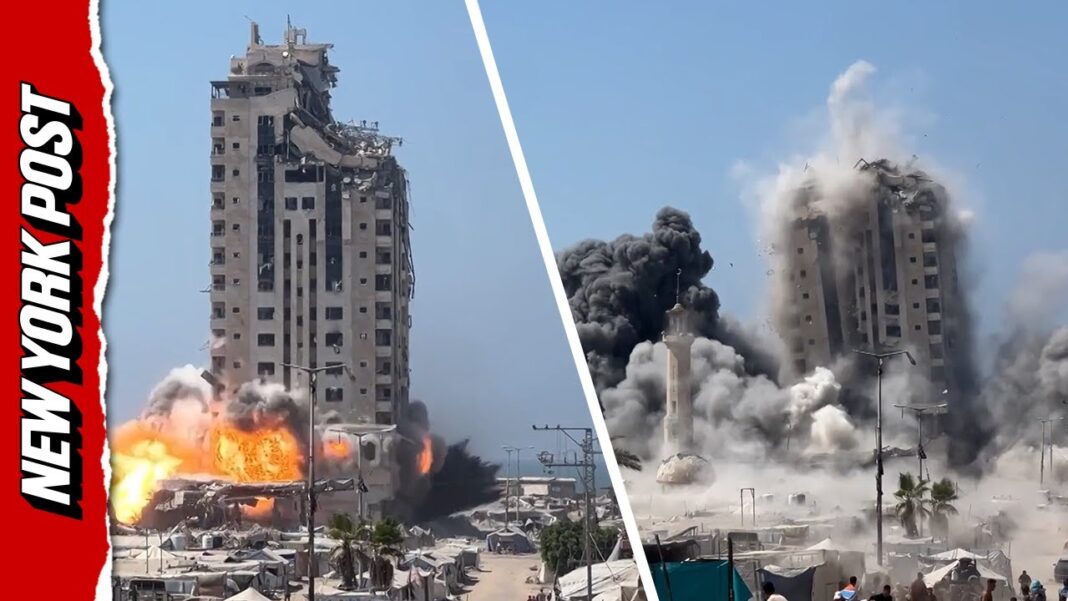
The Israel Defense Forces (IDF) announced on Saturday that it had carried out a precision strike on a high-rise building in Gaza City used extensively by the Hamas terrorist organization. According to a report that appeared on Israel National News, the tower was not a civilian structure in the conventional sense but a hub of terrorist activity, equipped with intelligence-gathering technology, observation posts, and underground infrastructure designed to coordinate attacks against Israeli forces.
The IDF emphasized that the strike was preceded by a series of precautionary measures to minimize civilian casualties, including the issuance of warnings, real-time aerial surveillance, and the use of highly accurate munitions. Yet the episode highlights not only the tactical chess match being waged between Israel and Hamas but also the militant group’s systematic use of civilian infrastructure as cover for its operations.
As the Israel National News report detailed, the high-rise was converted by Hamas into a multi-layered military compound. Terrorists had installed sophisticated monitoring equipment inside the building, allowing them to track IDF troop movements in the vicinity. Observation posts were established on various levels of the structure, providing militants with clear sightlines to Israeli positions.
In addition, Hamas operatives planted explosive devices in the surrounding area. These were designed to detonate as Israeli ground forces advanced, further endangering both IDF soldiers and nearby civilians. Beneath the building, an intricate network of tunnels and command centers enabled terrorists to direct operations away from prying eyes, part of Hamas’s larger underground military infrastructure that the IDF has long identified as one of its most challenging threats.
The IDF made clear that such deployments blur the lines between civilian and military space. “The terrorist organizations in the Gaza Strip systematically violate international law,” the army stated, noting Hamas’s “brutal exploitation of civilian infrastructure and the Gazan population as human shields for terrorist activities.”
The IDF’s operational protocol highlights the delicate balance Israel seeks to maintain: neutralizing terrorist threats while mitigating harm to non-combatants. According to the information provided in the Israel National News report, prior to the strike, the military issued advance warnings to residents, employed precision-guided munitions, and conducted continuous aerial surveillance to confirm the absence of civilians in the target zone.
This doctrine, sometimes referred to as the “knock on the roof” policy, reflects Israel’s effort to meet international humanitarian standards even while confronting adversaries that deliberately embed themselves among civilians. Yet despite these precautions, Israel remains under constant scrutiny from international observers who accuse the military of disproportionate force. The IDF, supported by evidence published through outlets such as Israel National News, maintains that Hamas bears ultimate responsibility by deliberately transforming residential towers into command centers.
In a striking development, Israel National News reported that Hamas’s internal security apparatus has circulated new directives to its fighters on how to avoid detection by Israeli intelligence. The warnings reveal just how meticulous — and often unconventional — Israel’s surveillance efforts can be.
According to Hamas’s internal communications, Israeli intelligence is able to track operatives through seemingly innocuous details, such as clothing hung on laundry lines. The placement and type of garments, officials claim, provide clues about the occupants of a given property. Similarly, lighting and power usage patterns, food remnants, and even the amount of garbage disposed of can provide the IDF with critical insights into who resides in a building and whether it is being used for military purposes.
Hamas has also cautioned its operatives that Israeli intelligence closely monitors visitors to suspect sites, analyzing the nature of their relationships with property owners and the frequency of their appearances. Such surveillance, paired with advanced signals and aerial intelligence, makes it increasingly difficult for terrorists to conceal their movements.
Another dimension of Hamas’s counterintelligence measures has been the tightening of restrictions on journalists operating in Gaza. As reported by Israel National News, Hamas’s internal security wing has ordered media personnel not to disclose details related to Israeli strikes on senior Hamas operatives. Instead, they have been instructed to rely exclusively on Hamas’s official military media outlets for information.
This reflects the group’s longstanding strategy of controlling the narrative within Gaza, suppressing independent reporting that might reveal the extent of its losses or the exploitation of civilian infrastructure. By centralizing information, Hamas seeks to maintain the image of resilience while concealing vulnerabilities. For Israel, this underscores the difficulty of presenting its case internationally: even when the IDF provides evidence of Hamas’s tactics, local reporting is often tightly managed to obscure the truth.
The strike on the Gaza City high-rise is part of a broader Israeli campaign to dismantle Hamas’s operational capabilities in urban centers. According to the report on Israel National News, Israeli intelligence has increasingly focused on high-value structures that serve as both symbolic and tactical assets for Hamas.
These include multi-story towers that house media offices, intelligence units, and command posts, often built adjacent to schools, mosques, or residential complexes. By embedding themselves in such environments, Hamas seeks to deter Israeli strikes or, failing that, to generate international condemnation when civilian harm occurs.
For the IDF, the challenge is immense: to surgically target these nodes of terror without inflicting collateral damage that could erode international support and embolden Hamas’s propaganda. The use of precision weaponry and intelligence-driven targeting, as highlighted in the report on Israel National News, reflects Israel’s determination to wage this war within the narrow confines of both morality and necessity.
The episode also illustrates how intelligence has become the decisive battlefield in the Israel-Hamas conflict. The IDF’s ability to identify Hamas operatives through unconventional clues — from laundry patterns to garbage output — testifies to the breadth and depth of Israeli surveillance capabilities.
For Hamas, this creates an environment of paranoia, where even the smallest misstep can reveal the location of a commander or weapons cache. Hence the internal warnings urging operatives to be vigilant. Yet these very directives, as reported by Israel National News, betray the group’s vulnerability: if Israel can glean actionable intelligence from such minute details, Hamas’s margin for secrecy is rapidly shrinking.
The IDF strike on the Gaza City high-rise marks not only the physical destruction of a Hamas stronghold but also the continuation of an intelligence war that plays out in the shadows of urban life. Buildings that appear ordinary to outsiders may, in fact, be at the center of Hamas’s operations. Trash bins, laundry lines, and power meters become signals in a deadly game of cat and mouse.
As the report on Israel National News emphasized, Israel faces a dual challenge: dismantling terrorist infrastructure while adhering to the highest possible standards of international law. Hamas, by contrast, persists in exploiting civilians as shields and manipulating information flows to conceal its own culpability.
In the coming weeks, further clashes are all but inevitable. But if this strike proves anything, it is that Israel’s battle against Hamas is as much about intelligence and perception as it is about firepower. And in that contest, every shred of information — no matter how small — can mean the difference between life and death.
