



|
Getting your Trinity Audio player ready...
|
By: Fern Sidman – Jewish Voice News
Israel’s military campaign in the southern Gaza Strip reached a symbolic and operational milestone early Sunday morning as Israel Defense Forces (IDF) troops, backed by precision air support, killed several senior Hamas commanders attempting to flee through a tunnel shaft in East Rafah. The strike, confirmed by the IDF and reported on Sunday by VIN News, marks one of the most consequential blows to Hamas’s local command structure since the intensification of ground operations in the Rafah sector.
According to the IDF, the targeted individuals included the commander of Hamas’s East Rafah Battalion, the battalion’s deputy commander, a company commander, and a fourth operative whose role has not yet been disclosed. While Israeli defense officials have not yet released the names of the eliminated terrorists, the significance of the strike was underscored by the identity of one of the casualties: the son of senior Hamas political bureau member Ghazi Hamad. This detail, first highlighted by VIN News, signals the depth of the operational penetration achieved by Israeli forces as they dismantle Hamas’s remaining command-and-control apparatus in the south.
The event drew heightened attention not only for its tactical impact but for the powerful symbolism captured on video by the IDF and circulated widely on social media. In the footage, Col. Arik Moyal, commander of the Nahal Infantry Brigade, stands at the entrance of the tunnel shaft from which the terrorists attempted to escape. Holding a distinctive Tavor assault rifle, he delivers a message that resonated across Israel and quickly became a focal point of national coverage.
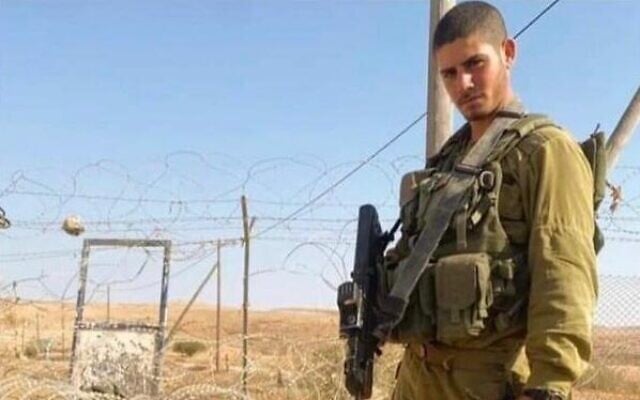
“The rifle you see in my hands was looted from our hero, Staff Sgt. Or Mizrahi, who fell fighting the enemy on October 7,” Moyal says in the video. “Today we closed the circle.”
The VIN News report emphasized the emotional weight of this moment for the Nahal Brigade, which suffered severe losses during Hamas’s surprise invasion on October 7, 2023. Staff Sgt. Mizrahi was among the dozens of soldiers killed fighting at or near the Gaza border that day, and the return of his stolen weapon—wrenched from him during Hamas’s massacre—carried deep symbolic resonance for his brigade, the IDF, and many Israeli civilians still grappling with the trauma of October 7.
The strike is part of a broader strategic shift as the IDF intensifies operations in Rafah, a region long recognized as a Hamas stronghold and a focal point of the group’s elaborate underground networks. Over recent weeks, Israeli forces have gradually increased their presence in southern Gaza, concentrating on dismantling entrenched battalion-level structures and neutralizing tunnel systems that Hamas has used for years to move operatives, store weapons, and evade detection.
As the VIN News report noted, the operation early Sunday morning appears to have been triggered by actionable intelligence indicating that the four Hamas operatives—two of them senior command figures—were attempting to escape Israeli pressure by relocating through subterranean passages. The IDF confirmed that combined ground and air forces coordinated rapidly to intercept them as they emerged from the tunnel. The precise nature of the coordination, which remains classified, reflects an increasing degree of synchronization between intelligence gathering, aerial reconnaissance, and ground maneuver units in the Rafah theatre.
Col. Moyal’s presence at the tunnel site was notable not only for the symbolic value of his remarks but also for what it suggests about the evolving character of ground operations. Brigade-level commanders have been increasingly hands-on during the Gaza campaign, reflecting both the complexity of the battlefield and the IDF’s strategic aim of compressing command lines to allow faster responses to emerging targets.
Among the developments most closely analyzed by regional experts is the confirmation that one of those killed was a son of Ghazi Hamad, a senior figure in Hamas’s political bureau and one of the organization’s most visible international spokesmen. Hamad gained notoriety after October 7 for his inflammatory statements praising the massacre and promising its repetition. The apparent presence of his son within the ranks of the East Rafah Battalion reflects the often-overlooked continuity between Hamas’s political and military echelons—an overlap that undermines longstanding claims that the group maintains distinct civic and armed structures.
The elimination of multiple high-ranking officers in a single operation represents a significant tactical success. Hamas battalion commanders, in particular, have been essential to the group’s ability to maintain operational cohesion, especially in the face of sustained Israeli pressure on its senior political leaders. Removing a battalion commander and his deputy simultaneously introduces immediate disarray into local command structures. As the VIN News report observed, such disruptions often trigger cascading intelligence opportunities as communications networks become exposed and subordinate officers attempt to reorganize amid uncertainty.
Rafah has long been considered one of Hamas’s last viable strongholds. The area’s geography—dense, urbanized, and interwoven with a labyrinthine tunnel system—has historically impeded both intelligence penetration and direct military action. But since Israel expanded its ground operations in the south, the IDF has applied growing pressure on the remaining Hamas battalions stationed there. According to military assessments cited in the VIN News report, the East Rafah Battalion was one of the last coherent fighting units capable of organizing resistance at scale. Its dismantling would mark a crucial step toward degrading Hamas’s operational presence south of Khan Younis.
The tunnel through which the terrorists attempted to flee is emblematic of Hamas’s decades-long investment in subterranean military infrastructure. Israeli intelligence estimates have long suggested that hundreds of kilometers of tunnels—some reinforced with concrete, others wired with communication equipment and blast doors—crisscross the Gaza Strip. These tunnels have functioned simultaneously as transit corridors, weapons depots, command centers, and sanctuaries for senior operatives.
The operation early Sunday morning undercuts this network by demonstrating the IDF’s ability to identify, isolate, and strike tunnel nodes even as Hamas operatives attempt rapid movement through them. Such interdictions represent both tactical achievement and strategic messaging to Hamas leadership, signaling that even their most fortified escape routes are no longer reliable.
For many Israelis, the most poignant detail of the operation remains the recovered rifle of Staff Sgt. Or Mizrahi. Mizrahi’s death on October 7 was part of the catastrophic collapse of early warning systems and border defenses that allowed Hamas to overrun IDF positions near the Gaza perimeter. His Tavor rifle, stolen from him amid the chaos, became a symbol of the brutality of Hamas’s rampage.
Col. Moyal’s decision to display the weapon publicly was a deliberate act of remembrance, a gesture simultaneously grounded in military tradition and emotional catharsis. When he declared in the video that his brigade had “closed the circle,” the statement resonated deeply within the Nahal community and beyond, reinforcing the IDF’s message that its campaign in Gaza remains, at its core, an effort not only to defeat Hamas operationally but to restore the dignity and security shattered on October 7.
VIN News, which has tracked the emotional and psychological toll of the war on IDF brigades, emphasized that such symbolic recoveries hold deep importance for soldiers and families who lost loved ones during the initial Hamas assault. The return of the weapon, stained by the memory of its fallen owner, served as a rare moment of clarity in a conflict marked by immense loss.
Even as the IDF hailed the Rafah operation as a major achievement, Israeli military officials were cautious not to overstate its strategic finality. The IDF has not yet released the identities of the eliminated commanders, citing ongoing intelligence analysis and the need to confirm additional operational details. The military continues to prepare for further engagements in the Rafah area, where other Hamas battalions remain active, albeit diminished.
Israel’s defense establishment views the southern campaign as entering a critical phase. The dismantling of remaining battalion-level structures is essential to ensuring that Hamas cannot reconstitute meaningful military capabilities in southern Gaza, even if pockets of fighters persist. With Rafah serving as the final buffer between Hamas’s infrastructure and the Egyptian border, the stakes remain extraordinarily high.
Sunday’s operation was significant not only for its immediate tactical results but for the extraordinary convergence of emotional symbolism, military success, and political resonance. The elimination of high-ranking Hamas operatives, the recovery of a fallen soldier’s rifle, and the continued degradation of Hamas’s Rafah-based infrastructure formed a tableau that captured the essence of Israel’s broader military campaign.
As the VIN News report observed, the strike delivered a powerful message: that Israeli forces are closing in on the last surviving pillars of Hamas’s military apparatus, and that the events of October 7 remain a guiding force for every soldier on the ground.
Israel’s war in Gaza remains far from over. But in the tunnels of East Rafah, in the return of a stolen weapon, and in the dismantling of a battalion’s command structure, many Israelis saw not just a tactical strike—but a small measure of justice reclaimed.