



|
Getting your Trinity Audio player ready...
|
By: Fern Sidman
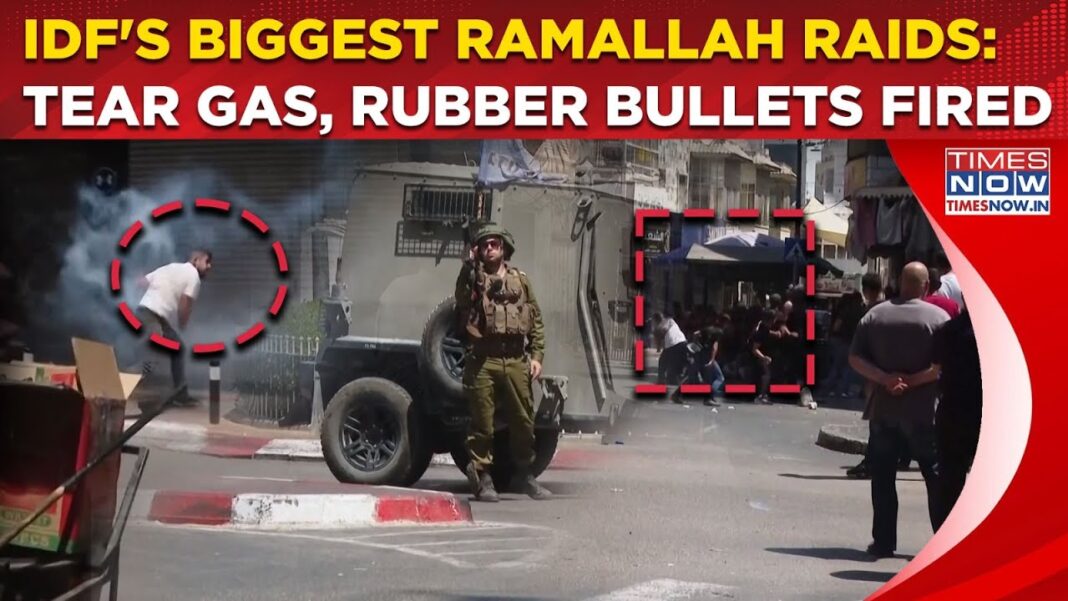
In the early hours of Tuesday morning, the Israel Defense Forces (IDF) struck a decisive blow against Hamas’s financial lifeline in Judea and Samaria. In a daring counter-terror operation led personally by the commander of the IDF’s Ram Battalion, soldiers raided a currency exchange business in the very heart of Ramallah, seizing hundreds of thousands of shekels earmarked for Hamas operations and arresting five individuals tied to terrorist activity.
The commander, a lieutenant colonel whose name cannot be disclosed for security reasons, spoke with Israel National News (INN), offering rare insight into both the preparation and execution of the mission. His remarks shed light not only on the immediate success of the raid but also on the broader transformation in Israel’s operational posture in Judea and Samaria.
“This was an operation carried out in the heart of Ramallah in broad daylight, following thorough and detailed preparations,” the battalion commander told Israel National News. “It was the result of excellent cooperation between various battalions and units. The objective was to cut off the flow of Hamas funding in the area, and from what I witnessed firsthand, we succeeded. We arrested several individuals involved in terror, and seized funds, equipment, and valuable intelligence assets.”
The choice to conduct the mission openly, in daylight, was deliberate—sending a message that Israeli forces now possess the operational latitude to strike even in the Palestinian Authority’s symbolic capital, at times and places of their choosing. According to the information provided in the INN report, the raid not only disrupted Hamas’s financial pipeline but also demonstrated Israel’s resolve to target the infrastructure that sustains terrorist activity, whether logistical, operational, or economic.
The importance of targeting Hamas’s financing cannot be overstated. Over the years, Hamas has developed an extensive and shadowy financial network spanning businesses, charities, and informal money-transfer channels across Judea, Samaria, and abroad. According to Israel National News, Tuesday’s raid neutralized one such channel, depriving Hamas of hundreds of thousands of shekels intended to fund recruitment, weapons procurement, and terrorist attacks.
Israeli defense analysts, speaking to INN, stressed that financial disruption is as vital as intercepting rockets or dismantling tunnels. “Money is oxygen for Hamas,” one expert noted. “Every shekel seized is another operation that won’t be executed, another weapon that won’t be bought, and another attempt at recruitment that fails.”
Perhaps the most striking revelation from the battalion commander’s remarks was his description of a shift in the IDF’s operational freedom in Judea and Samaria.
“There’s a noticeable change in the security situation. Our freedom of action is growing—certainly compared to the past. We’re now able to launch operations anywhere, anytime. This mission proves that, and we’ll keep moving forward,” he told Israel National News.
For years, Israeli forces faced heavy restrictions on maneuvering in cities like Ramallah, where the Palestinian Authority nominally maintains control. But the resurgence of terrorism since October 7 has altered the strategic calculus. The IDF now enjoys greater latitude, and missions once deemed too politically sensitive are increasingly carried out with precision and determination.
For the Ram Battalion commander, leading Tuesday’s raid represented not just a professional duty but also the culmination of a deeply personal journey.
“This is the goal of my life and a privilege few receive,” he reflected in his interview with INN. “I regard this responsibility with deep respect, especially given the difficult period Israel is facing. It’s the peak of my personal and professional journey.”
The lieutenant colonel’s bond with the battalion is deeply rooted. He has served in the Ram Battalion for most of his military career—first as a platoon commander, later as a company leader, and now as the unit’s commander.
“It’s a battalion I grew up in. It’s strong, mission-oriented, aggressive when needed, and highly creative—thanks to its people. Commanding it feels like closing a personal circle,” he told Israel National News.
The commander’s approach to leadership was shaped indelibly by his experience during Hamas’s October 7, 2023 massacre in southern Israel. At the time, he was serving as deputy commander of the Zikim recruits’ base, which came under direct attack.
“I arrived at the base early that morning with a few other officers. We fought hard to defend the recruits, even amid heavy losses,” he recalled in his conversation with INN. “I saw our commanders lead from the front, risking everything to protect others. That moment shaped my approach to leadership.”
It was those memories that inspired him to pursue battalion command, he said. “One of the main reasons I aspired to be a battalion commander was to influence others—to inspire them to act like those commanders did on that day.”
The Ram Battalion has developed a reputation within the IDF as a versatile, aggressive, and innovative combat unit. Operating primarily in Judea and Samaria, its soldiers are tasked with a wide range of missions—from counter-terror raids and intelligence gathering to riot control and rapid-response operations.
According to the information contained in the INN report, the battalion has played a central role in dismantling Hamas networks in the West Bank over the past year, often conducting operations deep inside Palestinian cities where terrorist infrastructure is embedded among civilian populations. Its blend of creativity and tactical aggression has made it an indispensable tool for the IDF Southern Command.
Tuesday’s operation in Ramallah highlights not only the IDF’s tactical successes but also a larger strategic shift in how Israel addresses the threat from Hamas and other terrorist groups operating in Judea and Samaria.
First, it emphasizes the centrality of financial warfare. By targeting the money flows that sustain terror networks, Israel can degrade Hamas’s capabilities without engaging in open, mass-scale battles. Second, it reflects Israel’s willingness to assert its operational freedom even in politically sensitive areas, signaling that no place is off-limits when national security is at stake.
Third, it showcases the IDF’s reliance on motivated, battle-tested commanders like the Ram Battalion’s lieutenant colonel, whose personal dedication mirrors the ethos of the broader force: to act decisively, even under the most challenging circumstances.
The raid in Ramallah was more than a tactical success—it was a symbolic demonstration of Israel’s determination to deny Hamas any sanctuary, whether in Gaza, Judea, Samaria, or beyond. By striking at the financial arteries of terror, the IDF continues to remind its adversaries that Israel’s reach is extensive, its intelligence precise, and its resolve unshakable.
As INN reported, the commander of the Ram Battalion sees his role not merely as a military appointment but as the realization of a lifelong calling. His story—shaped by the trauma of October 7 and defined by a relentless commitment to protect his nation—captures the spirit of an Israel that refuses to yield, even in the face of unprecedented threats.
