



|
Getting your Trinity Audio player ready...
|
By: Carl Schwartzbaum
In a development that is already stirring deep unease across Israel’s religious and political landscape, Israeli media has reported that the Israel Defense Forces (IDF) is preparing to carry out a sweeping arrest operation at Ben Gurion Airport during the upcoming Tishrei holiday season. According to details first disclosed by Israeli Channel 12 and further highlighted by VIN News, the operation is designed to target tens of thousands of young Haredi Jews expected to travel to Uman, Ukraine, for the annual Rosh Hashanah pilgrimage to the grave of Rabbi Nachman of Breslov.
With an estimated 40,000 Haredim potentially set to travel this year, many of them young men with unresolved conscription obligations, the IDF reportedly intends to use the pilgrimage rush as an opportunity to enforce draft laws on a scale not seen before.
The reported plan, as cited in a report that appeared on Sunday at VIN News, would see military police units deployed at Ben Gurion Airport throughout the Tishrei holidays. Their mission: to intercept and detain Haredi men flagged as draft evaders or deserters.
Those with up to 540 days of draft avoidance would be sent directly to the IDF Recruitment Center to begin immediate service.
Those exceeding 540 days of evasion would face imprisonment.
In addition to arrests of outbound travelers bound for Ukraine, the IDF is reportedly preparing to detain returning passengers, ensuring that the crackdown affects both those leaving and those coming back into Israel during the holiday period.
The scope of the plan—potentially involving tens of thousands of individuals—underscores both the logistical ambition of the military and the profound controversy such an operation would ignite.
Each year, thousands of Haredi Jews, particularly from the Breslov Hasidic community, travel to Uman, Ukraine, to pray at the grave of Rabbi Nachman, the 18th-century founder of the Breslov movement. For many, the pilgrimage is seen as a sacred obligation, even in the face of geopolitical instability and the ongoing war in Ukraine.
The report at VIN News noted that the Tishrei holidays, and Rosh Hashanah in particular, have become synonymous with these mass departures from Ben Gurion Airport, turning the site into a focal point of religious devotion, logistical challenges, and now, political tension.
The IDF’s decision to focus its enforcement efforts on this year’s Uman travelers cannot be divorced from the broader national debate over Haredi military service. For decades, the issue of conscription exemptions for the ultra-Orthodox has been one of the most polarizing questions in Israeli society, balancing the needs of national defense against the autonomy of religious communities devoted to Torah study.
While VIN News has frequently covered the ongoing political disputes surrounding draft reform, the potential arrest of tens of thousands of Haredi men represents an escalation from legislative debate into direct enforcement.
According to Channel 12’s reporting, the IDF views the annual pilgrimage as a rare moment when large numbers of draft-eligible Haredim are physically concentrated in one place, making the operation both feasible and efficient from an enforcement perspective.
The prospect of mass arrests has already led some would-be travelers to reconsider their plans, VIN News reported. Fear of being detained either before departure or upon return has injected an air of anxiety into what is traditionally a spiritual and communal undertaking.
Should the arrests proceed on the reported scale, the repercussions within the Haredi community are likely to be severe:
Erosion of trust between the Haredi public and state institutions, further deepening longstanding grievances.
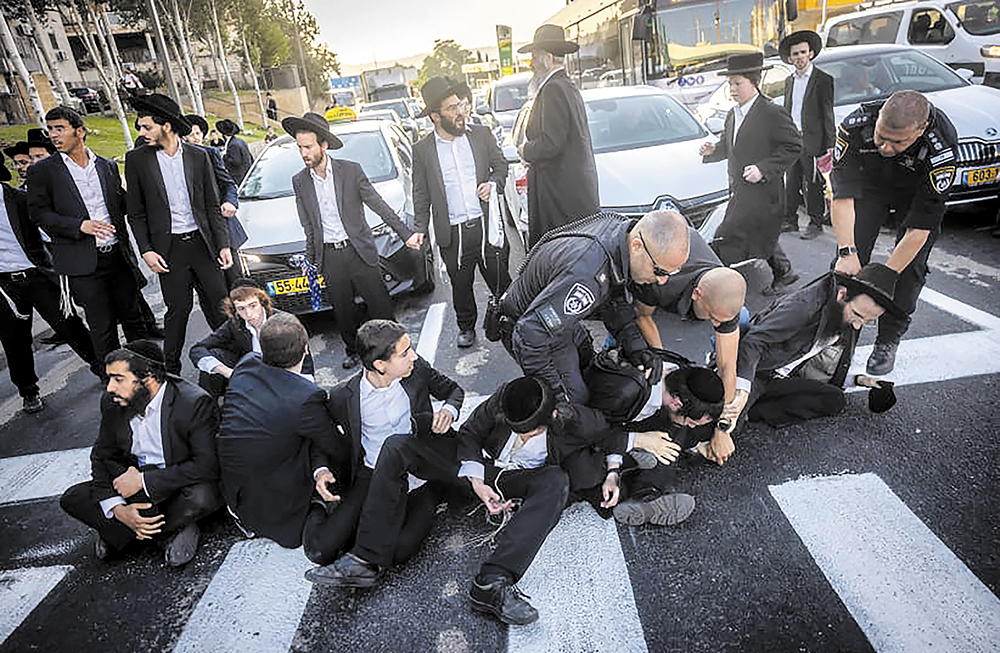
Protests and demonstrations at Ben Gurion Airport or in Haredi neighborhoods, with potential clashes between security forces and demonstrators.
Political fallout within Israel’s governing coalition, where Haredi parties play a pivotal role and have consistently resisted attempts to alter conscription laws.
The timing of the operation is significant. In recent months, Israel’s High Court of Justice has ruled against blanket exemptions for Haredi yeshiva students, effectively demanding that the state enforce equality in conscription. The ruling has placed intense pressure on the government and the IDF to act.
The report at VIN News emphasized that the IDF’s enforcement push at Ben Gurion Airport reflects this judicial backdrop. By targeting Haredi draft evaders en masse, the military may be seeking to demonstrate its compliance with the court’s ruling, while also sending a message that draft avoidance will no longer be tolerated.
Executing such a large-scale operation at Israel’s busiest travel hub presents immense logistical challenges. Military police would need to coordinate with airport security, immigration authorities, and civilian airlines to identify and detain targeted individuals without creating chaos in the terminals.
The sheer volume—tens of thousands of potential detainees—raises serious questions about detention capacity, transport logistics, and the ability of recruitment centers or military prisons to absorb such numbers. The VIN News report noted that even within the IDF, there are concerns about whether the infrastructure exists to sustain such an unprecedented enforcement campaign.
If carried out, the IDF’s plan could significantly reduce the number of Israelis making the pilgrimage to Uman this year. Some travelers may cancel their trips preemptively, while others may attempt to find ways around the system—whether by traveling through third countries, using alternative airports, or delaying their plans until after the holiday crackdown.
For the Breslov community, this would represent not merely an inconvenience but a profound spiritual disruption. The annual journey to Rabbi Nachman’s grave is a cornerstone of religious devotion, and its obstruction by state authorities is certain to be interpreted as an assault on religious freedom.
That this drama will unfold at Ben Gurion Airport is symbolic in itself. The airport is both a practical hub of international travel and a national symbol of Israel’s integration into the global community. It is also the one place where Israelis of all backgrounds—secular, religious, Arab, Jewish—inevitably intersect.
To turn the airport into a site of mass arrests of religious Jews en route to a sacred pilgrimage risks creating images that will reverberate far beyond Israel’s borders. VIN News has warned that such scenes could deepen internal divisions while also complicating Israel’s international image.
The IDF’s reported plan to arrest over 40,000 Haredi draft evaders during the Tishrei holidays represents a collision of two powerful forces: the state’s insistence on universal military service and the Haredi community’s insistence on religious autonomy.
As the VIN News report indicated, the outcome of this confrontation could reshape the relationship between Israel’s military, judiciary, political class, and religious communities. It could also mark a decisive turning point in the decades-long struggle over Haredi conscription.
Whether the operation is fully realized or scaled back in the face of public and political backlash, its mere planning signals a dramatic shift: from negotiation and compromise to enforcement and confrontation. The Tishrei holidays, usually a time of spiritual renewal and unity, may instead become a flashpoint for one of the most divisive chapters in Israel’s ongoing debate over identity, faith, and the burdens of national defense.
