



|
Getting your Trinity Audio player ready...
|
By: Fern Sidman
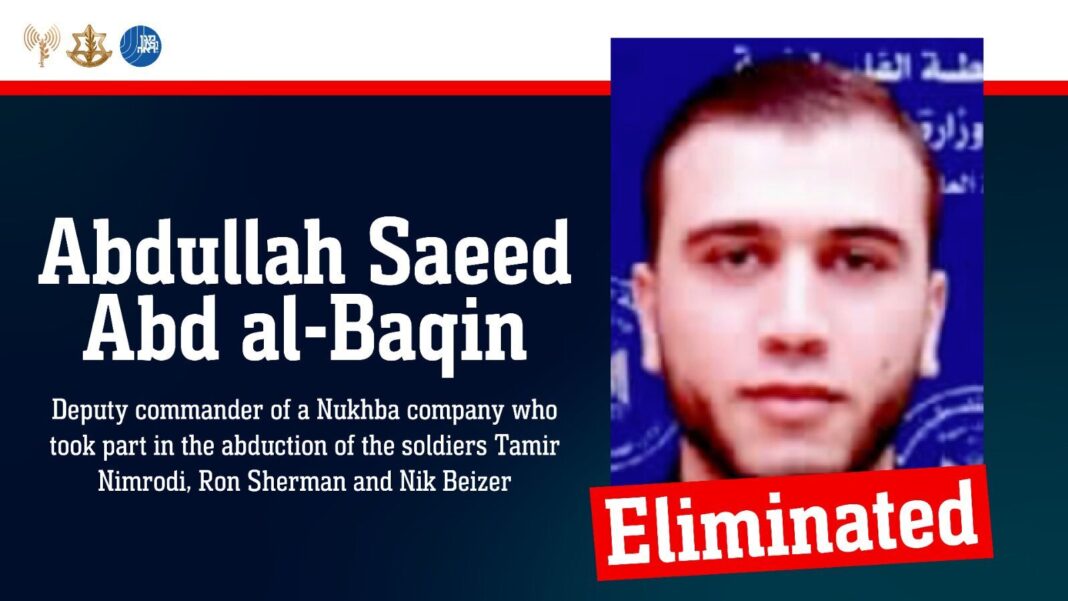
Israel National News (INN) reported on Wednesday that the Israel Defense Forces (IDF) and the Israel Security Agency (ISA) confirmed the targeted killing of Abdullah Saeed Abd al-Baqin, a senior Hamas operative who served as deputy commander of a Nukhba company in the Central Jabaliya battalion. The joint announcement, issued on Wednesday, stated that the precision strike occurred on August 7 and was the result of coordinated intelligence and operational planning between the two security bodies.
🔴ELIMINATED: Deputy commander of a Nukhba company who took part in the abduction of 3 Israeli hostages
The terrorist Abdullah Saeed Abd al-Baqin infiltrated Israeli territory during the brutal October 7 massacre, participated in the attack on the Erez District Coordination and… pic.twitter.com/p7HLG8kcYa
— Israel Defense Forces (@IDF) August 13, 2025
According to the information provided in the INN report, Abd al-Baqin was directly involved in the events of the October 7 massacre, a coordinated assault in which Hamas terrorists breached Israel’s borders and carried out mass killings and kidnappings. As a deputy commander within the elite Nukhba forces, Abd al-Baqin was responsible for overseeing operations in the Central Jabaliya sector — a key area in northern Gaza known for producing some of Hamas’s most skilled fighters.
The IDF and ISA confirmed that he infiltrated Israeli territory on October 7 as part of the initial wave of attackers. Once inside Israel, Abd al-Baqin participated in the assault on the Erez District Coordination and Liaison (DCL) office, an installation that serves as a critical point of interface between Israeli authorities and Gaza residents for humanitarian and administrative matters. The attack on the DCL was part of a broader Hamas strategy to disrupt coordination and create chaos along the border.
The Israel National News report emphasized that Abd al-Baqin’s actions during the October 7 operation went beyond direct combat. He played a central role in the abduction of three Israeli civilians: Ron Sherman, Nik Beizer, and Tamir Nimrodi. These kidnappings were part of Hamas’s larger hostage-taking campaign, aimed at using abducted Israelis as bargaining chips in future negotiations.
The hostages were taken into Gaza under dangerous conditions, and their captivity has been the subject of intense Israeli rescue efforts and diplomatic initiatives. By identifying Abd al-Baqin as a key perpetrator in these abductions, Israeli security officials underscored his direct contribution to one of the most traumatic aspects of the October 7 atrocities.
Following the initial assault, Abd al-Baqin remained active on the battlefield, carrying out repeated attacks on IDF troops operating in northern Gaza. INN reported that he leveraged his experience as a Nukhba commander to coordinate ambushes, sniper fire, and other forms of resistance designed to slow or disrupt Israeli advances. His knowledge of the local terrain and his ability to mobilize fighters made him a persistent threat to IDF forces in the area.
Israeli military officials noted that Nukhba units such as the one Abd al-Baqin helped lead are specifically trained for high-risk, targeted operations — including infiltrations, tunnel warfare, and assaults on fortified positions. His continued presence in the Central Jabaliya combat zone meant that he remained both a symbolic and tactical asset to Hamas’s war effort.
The joint IDF–ISA statement described the operation against Abd al-Baqin as the product of “precise intelligence” gathered over an extended period. Although the exact details of the strike were not disclosed, Israeli media, including INN, noted that such operations typically involve aerial surveillance, signal intercepts, and cooperation between ground units and the Israeli Air Force.
By August 7, Israeli intelligence had located Abd al-Baqin’s position in Gaza, and operational conditions allowed for a strike that neutralized him without causing excessive collateral damage. The targeted killing was consistent with Israel’s ongoing policy of eliminating high-ranking Hamas operatives to degrade the group’s command and control capabilities.
INN has frequently reported on the Nukhba forces, Hamas’s elite military wing trained in specialized assault tactics. These units are considered the spearhead of Hamas’s offensive capability, often tasked with the most critical and high-profile operations against Israel. The Central Jabaliya battalion, in which Abd al-Baqin served as deputy company commander, has been particularly active in northern Gaza — an area with significant tunnel networks and fortified positions.
The IDF’s strategy in the north has focused heavily on dismantling these battalions, both to neutralize immediate threats and to prevent Hamas from regrouping for future attacks. The elimination of Abd al-Baqin represents a notable success in this broader campaign.
The strike on Abd al-Baqin comes amid continued IDF operations aimed at dismantling Hamas’s military infrastructure and leadership. Israel National News has reported extensively on the systematic targeting of commanders, operatives, and logistical networks in Gaza since the start of the war.
By removing figures like Abd al-Baqin, Israeli officials hope to erode Hamas’s operational cohesion. The death of a deputy commander within an elite unit not only deprives Hamas of experienced leadership but also has a potential demoralizing effect on the rank and file. However, security analysts caution that Hamas has historically demonstrated resilience, with new leaders often emerging quickly to fill vacated roles.
Given Abd al-Baqin’s involvement in the abduction of Sherman, Beizer, and Nimrodi, his elimination carries symbolic weight for Israeli society. As INN has documented, the fate of hostages remains one of the most sensitive and pressing issues in the ongoing conflict. While removing a perpetrator from the battlefield does not directly resolve the hostage crisis, it signals Israel’s determination to hold all responsible parties accountable, regardless of the time or resources required.
Israeli officials have framed such targeted actions as part of a long-term strategy to secure justice for victims and deter future kidnappings.
In their announcement, the IDF and ISA reiterated their commitment to pursuing all individuals who took part in the October 7 massacre, whether they are directly engaged in combat or hiding within Gaza’s urban or tunnel environments. The agencies stressed that there is no statute of limitations on acts of terrorism and that Israeli forces will continue to track down and neutralize those involved.
INN quoted military spokespeople as saying that the strike on Abd al-Baqin was “a necessary step in the ongoing effort to protect Israeli civilians and soldiers” and to dismantle Hamas’s ability to launch further attacks.
The elimination of Abd al-Baqin is expected to feature prominently in Israeli military briefings as evidence of progress in the campaign against Hamas. For the residents of communities affected by the October 7 massacre, the news serves as a reminder that the perpetrators of those events remain the focus of sustained Israeli military attention.
The Israel National News report indicated that while tactical gains like this are important, Israeli defense officials remain focused on the larger objective: dismantling Hamas’s military apparatus, securing the release of hostages, and restoring long-term security for Israel’s southern border.
In this context, the removal of a senior Nukhba commander is both a milestone in the current conflict and a step toward the broader strategic goals Israel has set for itself since the war began.

I am pleased to read about the IDF eliminating an increasing number of Qatar’s Al Jazeera terrorist “journalists” involved during and following December 7.