



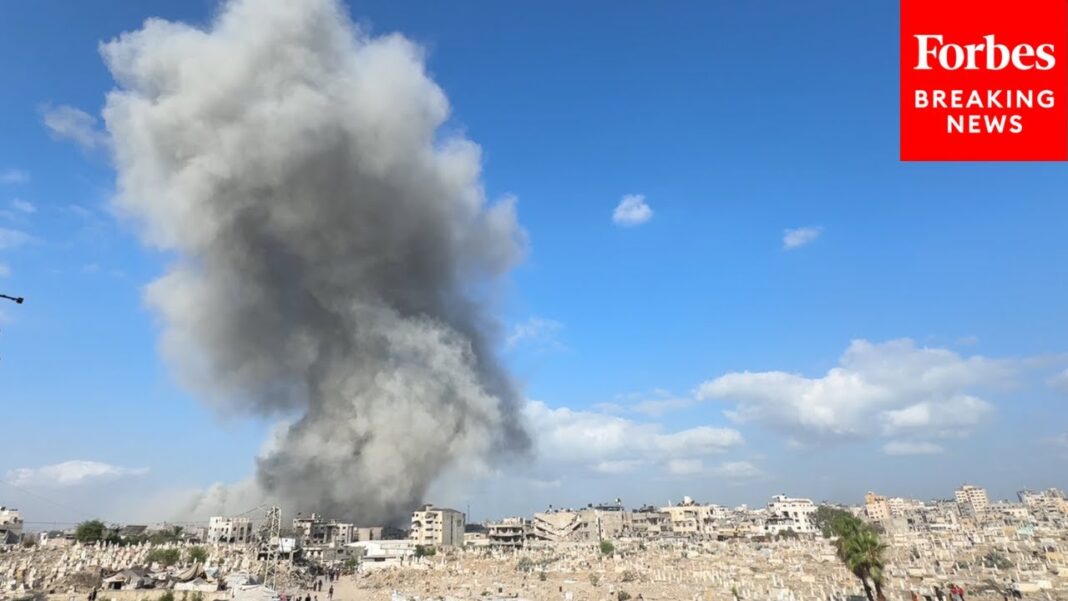
|
Getting your Trinity Audio player ready...
|
By: Fern Sidman
The Israel Defense Forces (IDF) continued its intensive campaign in the Gaza Strip over the past 24 hours, carrying out a sweeping series of strikes against Hamas strongholds and infrastructure. According to reports from Israel National News (INN), the IDF’s latest operations demonstrate the military’s determination to degrade Hamas’s fighting capacity and dismantle its network of tunnels, compounds, and personnel across multiple fronts.
The IDF’s elite Golani Brigade spearheaded operations in the southern sector of Gaza, where soldiers encountered entrenched Hamas fighters amid urban and semi-urban terrain. As INN reported, Golani forces killed multiple terrorists and destroyed a series of fortified positions believed to be linked to Hamas’s local command cells.
The brigade’s combat units also targeted what the IDF described as “terror infrastructure,” a term encompassing rocket-launch sites, weapons depots, and makeshift bunkers hidden in residential neighborhoods. By neutralizing these assets, Golani troops significantly reduced the capacity of Iranian-backed Hamas terrorists to stage ambushes or conduct rocket fire into Israeli territory.
The report emphasized that the battles in southern Gaza form a critical part of the IDF’s broader effort to prevent Hamas from reconstituting its networks in areas that Israeli forces have already cleared during earlier phases of the war.
Further east, in the city of Khan Yunis, IDF troops pressed ahead with a concentrated offensive against Hamas compounds. Units operating in the sector demolished several fortified sites that intelligence assessments linked to senior Hamas operatives. The demolitions, conducted with precision explosives and supported by engineering corps units, are aimed at denying Hamas the ability to regroup or mount counterattacks from entrenched strongholds.
A centerpiece of the Khan Yunis operation is the reinforcement of Israeli control over the Magen Oz corridor, a strategic route critical for both military maneuverability and the containment of Hamas movements between Gaza’s southern and central regions. According to Israel National News, securing this corridor ensures that Hamas cannot easily transfer fighters, weapons, or logistical supplies between theaters of operation.
Military analysts cited by INN explained that Hamas’s survival strategy depends on mobility across Gaza’s dense urban geography. By tightening its hold on corridors such as Magen Oz, the IDF effectively restricts Hamas’s freedom of movement, isolating local cells and eroding the group’s capacity to wage coordinated warfare.
In the northern Gaza city of Jabaliya, IDF Givati Brigade units uncovered and destroyed a series of underground tunnel routes. These tunnels—part of Hamas’s sprawling subterranean network known colloquially as the “Metro”—have long been a defining feature of the terrorist group’s military doctrine.
According to the information in the Israel National News report, the tunnels in Jabaliya were not merely transit routes but operational hubs containing weapons caches, communication equipment, and defensive ambush points. IDF engineering teams employed a combination of demolition charges and aerial strikes to collapse the tunnels, depriving Hamas fighters of a critical advantage in asymmetric warfare.
The destruction of the Jabaliya tunnels highlights a central component of the IDF’s current strategy: dismantling Hamas’s underground infrastructure to prevent the organization from relying on hidden pathways to evade Israeli surveillance and mount surprise attacks.
In another operation, the IDF’s 401st Brigade identified three armed terrorists preparing to launch an assault. Rather than engage directly, the brigade coordinated with the Israeli Air Force, directing a precision airstrike that eliminated the cell in real time.
The report underscored the importance of this integration between ground units and aerial surveillance, noting that such coordination not only neutralizes immediate threats but also limits risk to IDF personnel operating in densely contested areas. This reflects the IDF’s continued reliance on multi-domain coordination, combining infantry, intelligence, and air assets to achieve swift tactical successes.
The IDF confirmed in its daily communiqués that the strikes conducted in recent hours form part of major ongoing operations across the Gaza Strip, targeting Hamas infrastructure, personnel, and logistical networks.
According to the information contained in the Israel National News report, the military is pursuing a two-pronged approach: direct confrontation with Hamas fighters in active battle zones, and systematic dismantling of the group’s infrastructure to undermine its long-term sustainability. This includes strikes on weapons factories, training camps, and rocket production facilities hidden within civilian areas.
The emphasis on simultaneous operations in southern Gaza, Khan Yunis, and Jabaliya reflects the IDF’s determination to exert pressure across multiple fronts, preventing Hamas from concentrating its forces in a single location.
The IDF’s operations illustrate the grueling nature of the conflict. While Israel’s forces have achieved significant battlefield victories, Hamas has proven adept at embedding itself within civilian areas and exploiting Gaza’s dense urban terrain.
Israel National News reported that Israeli officials view the latest round of operations as essential in degrading Hamas’s capacity to launch future offensives. Military planners argue that leaving tunnels, compounds, and corridors intact would invite Hamas to regroup and reignite conflict in the future.
At the same time, IDF officials are candid about the challenges of achieving absolute military victory over a group that thrives on guerrilla tactics, irregular networks, and external support. The campaign, they stress, is not only about immediate tactical successes but also about reshaping the security environment to protect Israeli civilians from future massacres like those of October 7, 2023.
While the IDF insists that its operations target exclusively Hamas infrastructure, the international community has expressed concerns about civilian casualties. Hamas’s deliberate strategy of embedding itself in residential areas complicates Israel’s military objectives and fuels global scrutiny.
The report noted that Israeli leaders have repeatedly emphasized the distinction between Hamas operatives and Gaza’s civilian population. The IDF continues to employ tactics such as “roof knocking” and precision strikes to minimize civilian harm, though the challenge of urban warfare makes zero-casualty operations impossible.
International reactions to the latest operations have been mixed. Some Western governments have reiterated their support for Israel’s right to defend itself against terrorism, while others have called for restraint.
The past 24 hours have demonstrated the IDF’s sustained momentum in its Gaza operations, combining ground assaults, demolitions, and precision airstrikes to degrade Hamas’s military capabilities. From the Golani Brigade’s combat in southern Gaza to the Givati Brigade’s tunnel demolitions in Jabaliya, each element of the campaign is designed to systematically dismantle Hamas’s infrastructure and diminish its ability to threaten Israel in the future.
These operations are not isolated skirmishes but part of a comprehensive military strategy aimed at restoring long-term security for Israeli civilians. The battles in Khan Yunis, Jabaliya, and the southern sector call attention to Israel’s determination to maintain pressure until Hamas is decisively weakened.
For the families mourning the October 7 massacre and the communities still living under rocket threat, the IDF’s continued strikes are both a reassurance and a reminder of the difficult road ahead. Gaza’s labyrinth of tunnels, compounds, and terrorist enclaves may take months to fully dismantle. Yet, as Israeli officials stress, the alternative—leaving Hamas intact to strike again—is unacceptable.
