



|
Getting your Trinity Audio player ready...
|
By: Fern Sidman
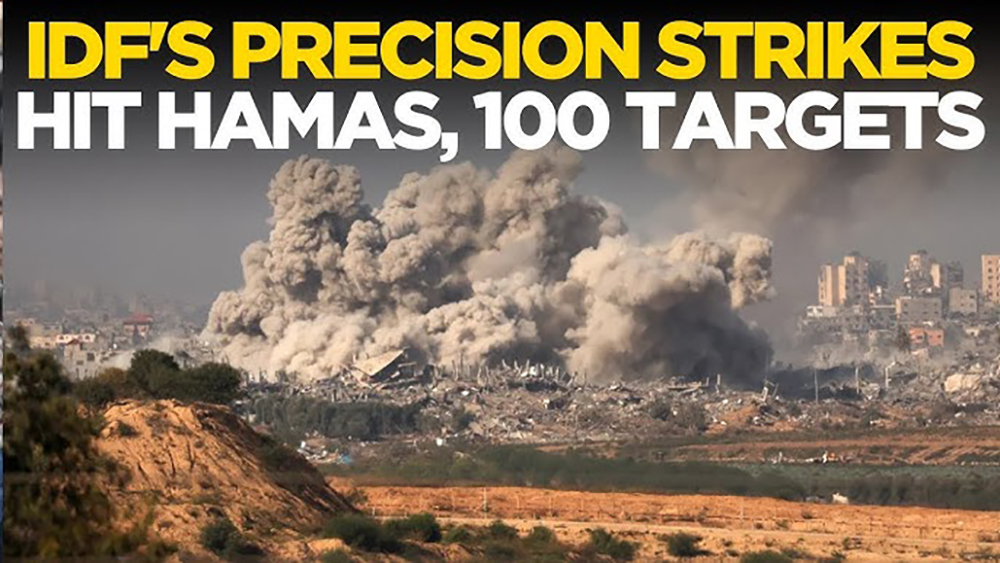
The Israel Defense Forces (IDF) on Saturday announced a sharp intensification of its ground and aerial campaign against Hamas in the Gaza Strip, striking some 100 terror targets in the past 24 hours as part of Operation Gideon’s Chariots II, according to a detailed update provided in a report at Ynet News. The renewed assault, involving multiple IDF divisions operating in coordination with Military Intelligence and the Shin Bet, underscores Israel’s determination to degrade Hamas’s military infrastructure and press forward in a war that shows no sign of abating.
The IDF said forces under the Southern Command continue to push deep into Hamas strongholds, focusing on dismantling command networks, tunnels, and weapons caches. According to the information contained in the Ynet News report, the IDF emphasized that the scope and precision of the strikes reflected the growing coordination between its intelligence apparatus and ground units.
Particularly significant were operations conducted by the 98th Division in Gaza City. Soldiers destroyed booby-trapped buildings, eliminated firing positions that had threatened advancing forces, and uncovered stockpiles of weaponry hidden inside residential blocks. Several Hamas commanders from the group’s military wing were also killed in these operations, a development that military officials say will have immediate repercussions on the group’s capacity to coordinate attacks.
Ynet News reported that the destruction of tunnel shafts and fortified bunkers has been prioritized, with IDF engineers working alongside infantry to prevent Hamas operatives from regrouping underground.
Parallel efforts by the IDF’s 162nd Division continued to focus on Gaza City and the Jabaliya area, both long-time centers of Hamas military activity. According to the information provided in the Ynet News report, Friday’s operations saw division troops direct Israeli Air Force aircraft in targeted strikes that killed several Hamas operatives, including mid-level field commanders.
The 162nd’s ground combat teams have also engaged in building-to-building sweeps, seeking out concealed weapons depots and sniper nests. Military officials said these combined ground-air operations are designed to limit Hamas’s mobility and degrade its ability to conduct guerrilla-style attacks against advancing Israeli troops.
In northern Gaza, the 99th Division, comprising combat units from the 11th Brigade and the Northern Brigade, carried out coordinated strikes against both above-ground and subterranean Hamas assets. The report at Ynet News noted that these forces concentrated on dismantling communications nodes and logistics hubs, both of which are crucial for Hamas’s decentralized structure.
The IDF confirmed that several Hamas operatives were eliminated during the course of these northern raids. Troops also targeted rocket-launching sites embedded within civilian areas — one of the most persistent tactical challenges Israel has faced during the war.
Farther south, the Gaza Division (143rd) directed its attacks on Khan Younis and Rafah, areas long associated with Hamas’s senior leadership and smuggling routes. Ynet News reported that Israeli forces destroyed both underground tunnels and surface-level facilities used by the group, while additional militants were killed in precision raids.
Military analysts note that Khan Younis and Rafah remain critical to Hamas’s survival because of their proximity to border crossings, which the group has used historically to smuggle weapons and supplies. Strikes in these areas are therefore intended not only to neutralize immediate threats but also to choke off the group’s logistical lifelines.
Supporting these multi-front operations, the Israeli Air Force carried out roughly 100 strikes across the Gaza Strip in the past 24 hours alone. According to the report at Ynet News, the targets included underground tunnels, weapons depots, terror squads, and command posts.
The air campaign has become increasingly integrated with ground maneuvers, with units on the ground identifying targets and relaying coordinates to pilots in real time. This coordination, military officials told Ynet News, has significantly increased the accuracy of strikes while reducing risks to Israeli troops operating in densely built-up urban areas.
Even as Israeli forces intensified their operations, Hamas sought to wage psychological warfare. On Saturday morning, the terror group published a propaganda image depicting the 48 hostages still held in Gaza, each labeled with the name of Ron Arad — the Israeli Air Force navigator who went missing in 1988 after ejecting from his jet over Lebanon and whose fate remains one of Israel’s most painful unresolved traumas.
The image, widely circulated on social media, carried a message: “Because of Netanyahu’s refusal, and Zamir’s capitulation, a parting image as the military operation in Gaza City begins.” The text accused Prime Minister Benjamin Netanyahu of rejecting a ceasefire-for-hostages deal and criticized IDF Chief of Staff Lt. Gen. Eyal Zamir for executing orders to invade Gaza City despite reported reservations.
The Ynet News report highlighted the provocative timing of the release, which coincided with Israel’s renewed offensive. Analysts described the image as a clear attempt to sow doubt and division within Israel, playing on collective memory and exploiting the hostage issue to weaken public morale.
The current operations are part of Operation Gideon’s Chariots II, a continuation of Israel’s broader effort to decisively dismantle Hamas’s military infrastructure. According to the report at Ynet News, the operation reflects a shift from defensive containment to an expansive offensive strategy aimed at denying Hamas any sanctuary within the Strip.
Military sources told the outlet that the campaign is designed to maintain relentless pressure on Hamas until it either capitulates or loses the ability to operate as an organized force. This involves not only destroying physical assets but also targeting mid- and senior-level commanders to disrupt the group’s chain of command.
The IDF’s escalating operations come at a time of intense political debate in Israel. Netanyahu has faced mounting criticism over his refusal to accept certain ceasefire-hostage deal proposals, with families of the captives staging demonstrations calling for negotiations. Ynet News reported that the prime minister remains firm in his position that military pressure is the surest path to bringing hostages home and deterring further Hamas aggression.
At the same time, opposition figures accuse Netanyahu of prioritizing political survival over pragmatic solutions. The Hamas propaganda release, exploiting his stance, has only heightened tensions.
Israeli officials stress that Hamas embeds itself deliberately within civilian areas, making military action both morally complex and tactically necessary. As Ynet News has frequently reported, the IDF takes extensive measures to warn civilians and minimize harm, even as it presses forward militarily.
The IDF’s operational updates suggest a deliberate acceleration of momentum across all sectors of Gaza. With Hamas still holding 48 hostages and refusing to relinquish its grip on urban strongholds, the Israeli military appears committed to a long and grinding campaign.
The integration of multiple divisions — from the 98th in Gaza City to the 143rd in Rafah — reflects a coordinated effort to stretch Hamas’s defenses and erode its operational capacity simultaneously.

Deceptive reporting: “a propaganda image depicting the 48 hostages still held in Gaza.” Repeated: “With Hamas still holding 48 hostages,…” You KNOW there are perhaps 20.
“Analysts described the image as a clear attempt to sow doubt and division within Israel, playing on collective memory and exploiting the hostage issue to weaken public morale.” So don’t help them.