



|
Getting your Trinity Audio player ready...
|
By: Fern Sidman
In a major escalation along Israel’s northern frontier, the Israel Defense Forces (IDF) on Sunday executed two precise, intelligence-guided airstrikes that successfully eliminated senior Hezbollah operatives deeply involved in weapons smuggling and the reestablishment of the terror organization’s military infrastructure in southern Lebanon. The targeted strikes reflect Israel’s continued commitment to neutralizing emerging threats before they can endanger Israeli citizens or destabilize the region further.
🔴ELIMINATED: The IDF conducted precise, intelligence based strikes in southern Lebanon, eliminating:
• Ali Hussein Al-Mousawi, a terrorist in charge of weapons purchasing & smuggling between Syria to Lebanon for the Hezbollah terrorist organization
• Abd Mahmoud Al-Sayed, a… pic.twitter.com/BGUEcxOXei— Israel Defense Forces (@IDF) October 26, 2025
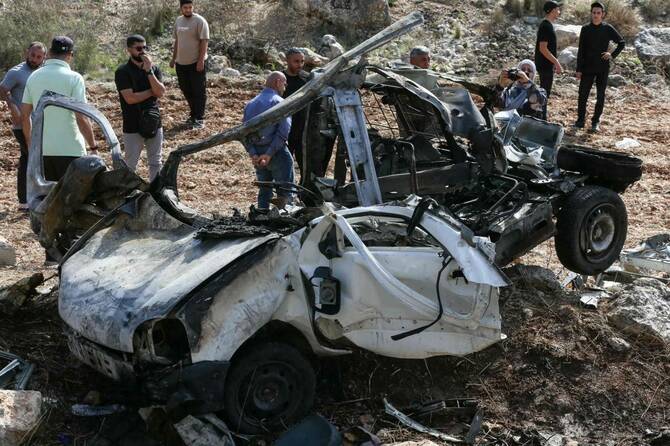
According to a report on Sunday at Israel National News, the first strike took place near Beqaa, Lebanon, killing Ali Hussein Al-Mousawi, a known weapons smuggler and logistical coordinator for Hezbollah. The second strike, carried out earlier the same day, targeted Abd Mahmoud Al-Sayed, Hezbollah’s local representative in the An-Naqoura region of southern Lebanon. Both men played pivotal roles in sustaining Hezbollah’s operational network and supply chain along the Israeli border, the IDF said.
Israel National News reported that Ali Hussein Al-Mousawi was responsible for orchestrating the transfer of advanced weapons and military technology from Syria into Lebanon—an operation that has long been a lifeline for Hezbollah’s armed capabilities.
According to intelligence assessments cited in the Israel National News report, Al-Mousawi functioned as a primary intermediary in the movement of precision-guided munitions, anti-tank weaponry, and drone systems across the porous Syrian-Lebanese border. Israeli defense sources described him as “a central figure in Hezbollah’s ongoing efforts to rebuild its stockpiles after successive Israeli interdictions.”
Al-Mousawi’s activities reportedly intensified over the past year, coinciding with Hezbollah’s broader campaign to strengthen its operational presence in southern Lebanon amid the ongoing war in Gaza and escalating regional tensions involving Iranian-backed militias.
“Ali Hussein Al-Mousawi operated as a weapons dealer and smuggler on behalf of Hezbollah, overseeing both procurement and transfer from Syria to Lebanon,” the IDF said in a statement quoted in the Israel National News report. “He was a key enabler in the organization’s attempts to reestablish and fortify its military infrastructure.”
The strike that killed Al-Mousawi was described in the Israel National News report as a precision engagement guided by real-time intelligence, highlighting the IDF’s ability to track and neutralize high-value targets with minimal collateral damage.
Military analysts told Israel National News that Al-Mousawi’s death represents a serious blow to Hezbollah’s logistics and procurement networks, potentially slowing the group’s efforts to restock its arsenals amid continuing Israeli surveillance and interdiction efforts.
Earlier on Sunday, the IDF launched a separate targeted strike in An-Naqoura, near the Lebanese coastal town of Al-Bayada, killing Abd Mahmoud Al-Sayed, described in the Israel National News report as Hezbollah’s senior representative in the area.
Al-Sayed’s role extended beyond military coordination. According to the information provided in the Israel National News report, he acted as Hezbollah’s civilian liaison in southern Lebanon, maintaining direct contact with local residents and mediating financial and logistical matters between the terror organization and the surrounding communities.
“As part of his role, Al-Sayed was responsible for communication between the organization and the residents of the area regarding both financial and military subjects,” the IDF said in comments cited in the Israel National News report.
The Israeli military further noted that Al-Sayed had been instrumental in Hezbollah’s efforts to reestablish its military infrastructure in southern Lebanon, particularly in the Al-Bayada region—an area that Israel views as a key staging ground for cross-border provocations and rocket fire.
“He took part in Hezbollah’s attempts to rebuild and fortify its military capabilities in the town,” the IDF statement continued, emphasizing that his activities were “a direct violation of the understandings between Israel and Lebanon.”
Those understandings—widely interpreted as a reference to United Nations Security Council Resolution 1701, which ended the 2006 Second Lebanon War—prohibit Hezbollah from maintaining armed forces south of the Litani River.
The Israel National News report observed that Israel has repeatedly accused Hezbollah of violating those terms, using civilian areas to conceal weapons stockpiles and surveillance infrastructure.
In both cases, the IDF’s operations were based on verified intelligence gathered by the military’s elite intelligence units in cooperation with the Israeli Air Force (IAF). Defense officials emphasized that the strikes were carefully planned to minimize civilian harm while delivering a clear message of deterrence.
The IDF stated that the two operations were part of its broader strategy to preempt imminent threats and “remove any actors involved in destabilizing the region.”
“The terrorists’ activities constituted a violation of the understandings between Israel and Lebanon,” the IDF said, as quoted in the Israel National News report. “The IDF will continue to operate to remove any threat posed to the State of Israel.”
Military experts cited in the Israel National News report said the timing of the strikes—both executed within hours of each other—demonstrated Israel’s growing emphasis on operational tempo and precision targeting in Lebanon. The operations follow a series of smaller IDF strikes in recent months against Hezbollah observation posts, drone launch sites, and communication infrastructure near the border.
The targeted elimination of Al-Mousawi and Al-Sayed comes amid mounting concerns that Hezbollah is seeking to expand its influence and military footprint as part of Iran’s “axis of resistance,” which also includes Hamas in Gaza and various Shiite militias operating in Syria and Iraq.
According to the information contained in the Israel National News report, intelligence sources believe Hezbollah has been rebuilding its command structure in southern Lebanon since late 2023, bolstering recruitment and restoring its logistical lines after sustaining losses from repeated Israeli strikes.
The group’s leadership, analysts told Israel National News, appears determined to exploit Lebanon’s political paralysis and economic collapse to strengthen its control over the southern region, transforming it into a forward operating base against Israel.
Israel, for its part, has made clear that it will not tolerate Hezbollah’s entrenchment along the border. The Israel National News report noted that in recent weeks, Israeli defense officials have increased both their warnings and operational readiness in the north, viewing Hezbollah’s presence as an extension of Iran’s long-term strategy to encircle Israel with heavily armed proxies.
While Israel remains engaged in its war against Hamas in Gaza, Israel National News highlighted that the IDF has simultaneously been maintaining high vigilance along the Lebanese border, wary of a possible northern escalation.
Hezbollah has fired sporadic rocket and anti-tank missile barrages into Israeli territory in recent months, prompting retaliatory IDF fire. Defense officials told Israel National News that Sunday’s operations were intended not only to neutralize imminent threats but also to reinforce deterrence by demonstrating Israel’s intelligence reach and operational precision deep inside Lebanese territory.
A senior Israeli officer, speaking anonymously to Israel National News, said that “every strike carries a dual message—operational and strategic.”
“We are conveying to Hezbollah that its operatives are vulnerable anywhere, and at the same time, we are signaling to the Lebanese government that continued violations of international resolutions will have consequences,” the officer said.
The Israel National News report indicated that the IDF’s targeted actions against Hezbollah operatives are part of Israel’s longstanding “campaign between wars” strategy—a proactive approach aimed at thwarting enemy buildup efforts before they evolve into direct threats.
By eliminating key figures such as Al-Mousawi and Al-Sayed, Israel seeks to disrupt Hezbollah’s logistics, financing, and recruitment networks, while avoiding a full-scale confrontation that could engulf both countries in another destructive war.
For now, the IDF remains on heightened alert, balancing its intensive operations in Gaza with continuous intelligence monitoring along the Lebanese frontier. As Israel National News reported, defense officials reiterated that Israel’s military posture is guided by a single principle: “Any threat—anywhere—will be met with decisive action.”
