



|
Getting your Trinity Audio player ready...
|
DF Eliminates Senior Hezbollah Operatives in Southern Lebanon as Regional Tensions Escalate
Edited by: TJVNews.com
In a significant escalation in the ongoing shadow war between Israel and Hezbollah, the Israel Defense Forces (IDF) confirmed on Sunday that it had conducted two separate targeted airstrikes in southern Lebanon, successfully eliminating two high-ranking Hezbollah terrorist operatives, as reported by the Jewish News Syndicate (JNS).
These precision strikes come amid intensifying hostilities along Israel’s northern frontier and underline the IDF’s evolving strategy to disrupt Hezbollah’s operational infrastructure and neutralize threats before they can be deployed against Israeli civilians.
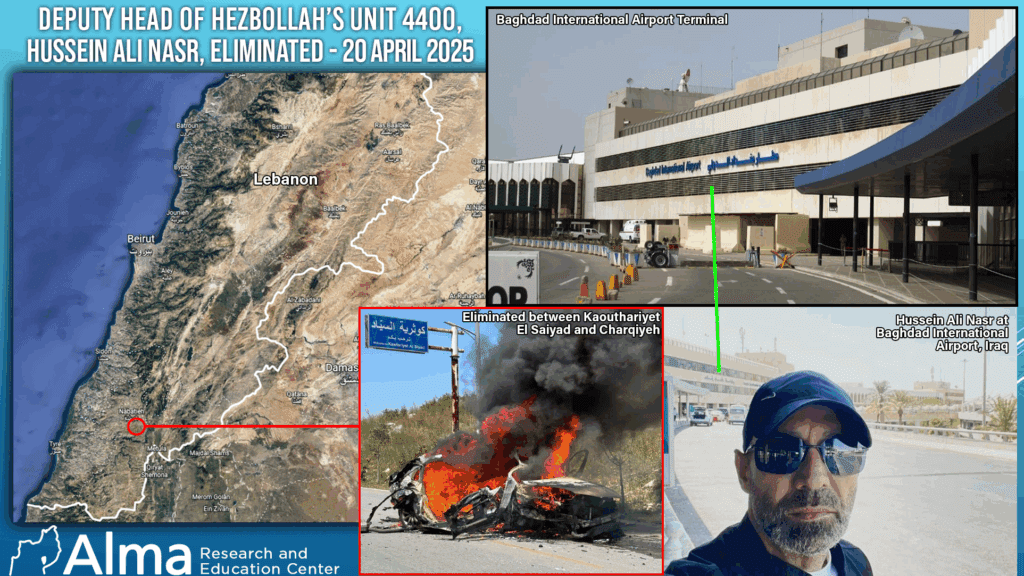
One of the targets killed in Sunday’s operations was Hussein Ali Nasr, the deputy head of Hezbollah’s notorious Unit 4400, a division responsible for the smuggling of weapons, funds, and materiel into Lebanon—often via Iranian assistance. According to the IDF and JNS, Nasr played a pivotal role in coordinating with Iranian Revolutionary Guard Corps (IRGC) officials and was instrumental in facilitating the transfer of advanced weaponry through strategic routes, including the Beirut-Rafic Hariri International Airport.
The IDF emphasized that the targeted elimination of Nasr was part of its broader effort “to eliminate threats to Israeli civilians on all fronts.” As JNS reported, this strike not only removed a key logistical figure but also disrupted Hezbollah’s intricate supply chains that are deeply embedded in both Lebanon’s civilian infrastructure and its national institutions.
In a separate strike, the IDF targeted and eliminated the head of Hezbollah’s engineering operations in the Al-Aadaissah sector—a commander believed to be responsible for designing and constructing rocket-launching platforms, tunnels, and other forms of military fortification along the volatile Blue Line. While his identity has not yet been publicly disclosed, his removal was described by the IDF as a “strategic blow” to Hezbollah’s capabilities in that sector.
Alongside the precision eliminations, the IDF also carried out airstrikes on Hezbollah launch infrastructure near the town of Nabatieh, targeting multiple rocket-launching pads and logistical installations used by the group’s southern command. These preemptive strikes, according to the JNS report, were aimed at degrading Hezbollah’s ability to launch short- and mid-range missile barrages into Israeli territory.
“These actions by the Hezbollah terror organization constitute a blatant violation of the ceasefire understandings between Israel and Lebanon and a threat to the State of Israel and its citizens,” the IDF said in a statement cited by JNS.
The situation in southern Lebanon remains precarious since the end of the ceasefire on February 18, which itself followed a temporary truce that began on November 27, 2023. That agreement brought an end to more than a year of low-intensity war sparked by Hezbollah’s cross-border attacks on October 8, 2023, just one day after Hamas launched its devastating invasion into southern Israel on October 7.
While Israel has withdrawn most of its ground troops since the conclusion of major combat operations, it continues to maintain control over five key positions in southern Lebanon. Israeli officials have made it clear that the IDF will not fully withdraw until the Lebanese Armed Forces (LAF) can demonstrate an ability to independently maintain security in the region.
As the JNS report highlighted, Hezbollah’s continuing armed operations in southern Lebanon are a direct violation of United Nations Security Council Resolution 1701, which ended the 2006 Lebanon War. The resolution requires that Hezbollah disarm its military wing and that no armed groups other than the LAF operate south of the Litani River.
Rather than comply, Hezbollah has instead embedded its forces deeper within Lebanon’s civilian fabric, and is reportedly seeking to integrate its militants into the Lebanese state itself, according to military and intelligence experts cited by JNS. This strategy allows the terror group to preserve its power while complicating efforts by both the LAF and the international community to dismantle its military infrastructure.
In response to growing instability, U.S. Deputy Special Envoy for the Middle East Morgan Ortagus called during a recent visit to Beirut for the immediate disarmament of Hezbollah and all Lebanese militias. Speaking to the Lebanese Broadcasting Corporation International (LBCI), Ortagus reiterated that American policy continues to support a strong, independent Lebanese military, free from militia influence.
“We know that the sooner that the LAF is able to meet these goals and disarm all militias in the state, the sooner the Lebanese people can be free,” Ortagus said, as quoted by JNS.
Her comments reflect Washington’s growing frustration with Hezbollah’s continued defiance of international agreements and its ongoing alignment with Iran’s regional agenda, which includes backing terror proxies from Iraq and Syria to Yemen and Gaza.
The killing of Hussein Ali Nasr and the engineering chief is part of a larger Israeli strategy of “targeted decapitation,” intended to weaken Hezbollah’s command structure while avoiding full-scale ground war. As the JNS report noted, these operations also serve to send a clear signal to Tehran and Hezbollah’s leadership: Israel will continue to strike decisively and preemptively when its security is threatened.
With the northern border heating up again and Hezbollah’s provocations intensifying, Israeli officials are making it clear that the current calm is fragile and conditional. The IDF’s message is unambiguous—as long as Hezbollah remains armed and aggressive, it will remain a target.
Israel’s campaign against Hezbollah is not simply about securing its northern border—it is part of a broader effort to push back against Iran’s regional encroachment, to enforce international law, and to safeguard Israeli citizens from cross-border terror.
The elimination of key Hezbollah operatives this week marks yet another milestone in a simmering conflict that is far from over. And as long as Hezbollah continues to operate with impunity in southern Lebanon, the IDF appears fully prepared to keep the pressure on—strike by strike, target by target.

Prediction: The Lebanese Army will increase in manpower as it recruits from the shia community and allows hezballah to supplement the meager salaries as an incentive. The army will morph into the hezballah military branch hiding behind the Lebanese flag. If Aoun offers too much of a problem he’ll get the Hariri treatment.