



|
Getting your Trinity Audio player ready...
|
IDF Eliminates Key Hamas Operatives as “Operation Gideon’s Chariots II” Advances in Gaza
By: Fern Sidman
The Israel Defense Forces (IDF) this week announced the elimination of two senior Hamas operatives directly tied to the atrocities of October 7, 2023, marking a pivotal moment in Israel’s grinding campaign against the Gaza-based terror group. The targeted strikes, carried out in recent days, have underscored both the tactical precision of the IDF and the broader strategic intent to dismantle Hamas’s operational leadership and infrastructure.
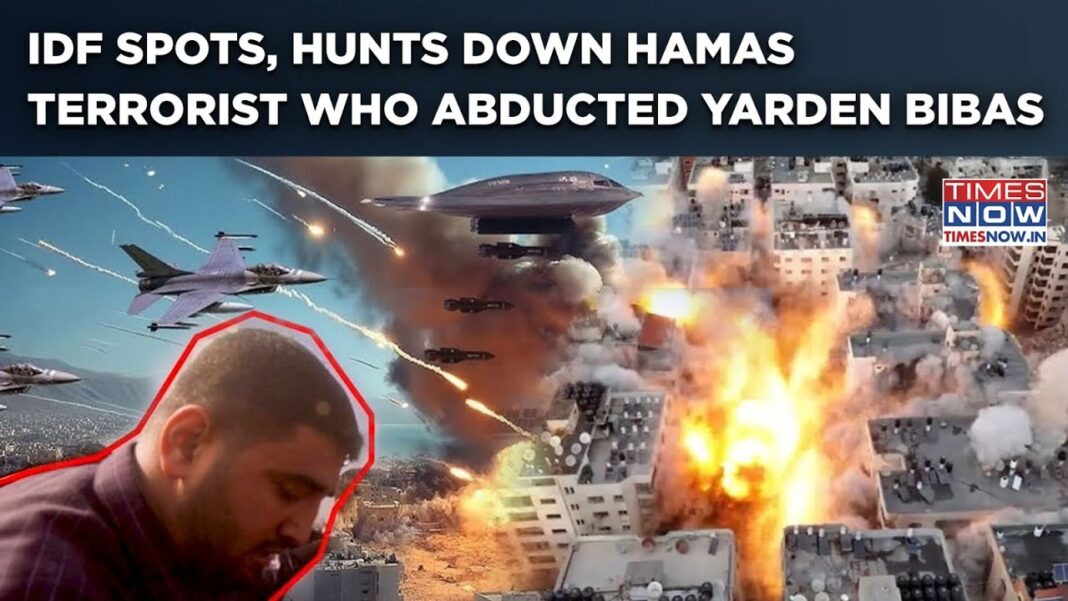
According to a report that appeared on Wednesday on The Jewish News Syndicate (JNS), the first of these figures, Jihad Kamal Salem Najjar, was killed on August 10. Najjar was directly implicated in the abduction of Yarden Bibas from Kibbutz Nir Oz during the October 7 massacre — an event that has become one of the most harrowing symbols of Hamas’s brutality. Bibas, held in captivity for a staggering 484 days, was finally released on February 1, having endured near-starvation and losing over 30 pounds. His personal ordeal was compounded by the murder of his wife, Shiri, and their two infant sons, Ariel and Kfir, who were kidnapped separately and later executed by their captors.
For many Israelis, the fate of the Bibas family epitomized the savagery of Hamas’s October 7 rampage, in which terrorists stormed Israeli border communities, killing, raping, abducting, and torching civilians in scenes that shocked the world. As JNS has repeatedly emphasized in its reporting, the atrocities committed that day remain the animating force behind Israel’s determination to achieve nothing less than Hamas’s total defeat.
Najjar’s elimination was viewed not only as a tactical success but also as an act of justice on behalf of the Bibas family. The IDF confirmed that he had been directly involved in the planning and execution of the kidnappings, serving as one of the operatives who physically dragged civilians across the border into Gaza.
Bibas’s suffering in captivity became a focal point of international attention. His skeletal appearance upon release — described extensively in the JNS report — was evidence of the systematic cruelty inflicted by his captors. The subsequent discovery that Hamas had returned the wrong body, claiming it was that of Shiri Bibas, only deepened public outrage. It was only after sustained public and diplomatic pressure that her remains were eventually returned, allowing for proper burial rites.
For Israel, the death of Najjar closes one chapter in the pursuit of justice but highlights the ongoing necessity of eliminating operatives responsible for war crimes and crimes against humanity.
Only days after Najjar’s elimination, on August 13, the IDF confirmed it had killed Muhammad Naif Abu Shamala, a company commander within Hamas’s elite Nukhba force. According to the information provided in the JNS report, Shamala had infiltrated Israel on October 7 and participated in the attempted assault on the IDF’s Ma’aras Post, an attack intended to break Israeli defenses in the south.
Shamala, described by the IDF as a seasoned commander, remained deeply involved in Hamas’s military planning during the war. His portfolio included advancing attacks against IDF troops inside Gaza and attempting to sustain Hamas’s campaign of attrition against Israel. By removing Shamala from the battlefield, Israel not only neutralized an immediate threat but also disrupted Hamas’s operational continuity within its most lethal combat units.
The targeted assassinations of Najjar and Shamala coincided with broader IDF operations across the Gaza Strip. On Monday, the military announced that over the preceding 24 hours, Israeli forces had destroyed multiple rocket launchers in southern Gaza aimed at Israeli population centers. At the same time, operations in northern and central Gaza focused on dismantling terrorist infrastructure both above ground and within Hamas’s labyrinthine tunnel networks.
As the JNS report noted, these strikes are not merely defensive but form part of a deliberate effort to degrade Hamas’s ability to wage war. Rocket launchers, hidden within civilian areas and often placed near schools, hospitals, and mosques, remain one of Hamas’s primary tools of psychological warfare against Israel’s civilian population. Their systematic destruction, coupled with the neutralization of Hamas commanders, represents a multi-layered strategy aimed at removing both the human and material capabilities of the terror group.
Perhaps most consequentially, Israeli Defense Minister Israel Katz on Tuesday approved the next stage of the Gaza campaign, following consultations with IDF Chief of Staff Lt. Gen. Eyal Zamir and senior commanders. This new phase, dubbed “Operation Gideon’s Chariots II” according to reports, will center on intensifying operations in Gaza City, Hamas’s political and military hub.
As JNS reported, Lt. Gen. Zamir announced the IDF’s readiness to execute these plans, affirming that the military would “continue striking until Hamas is defeated, with the hostages constantly in our sight.” His statement underscores the duality of the mission: annihilating Hamas as a governing and military force while maintaining the imperative of rescuing remaining hostages.
Military analysts cited in the JNS report suggest that “Gideon’s Chariots II” is likely to involve a combination of precision strikes, intensified ground incursions, and expanded efforts to locate and neutralize Hamas’s subterranean tunnel networks beneath Gaza City. By concentrating on Hamas’s center of gravity, the IDF aims to deliver a decisive blow that will shatter the group’s command structure.
The choice of the operation’s name is deliberate. As the JNS report highlighted, the biblical Gideon was a judge and military leader who, with divine backing and a smaller force, triumphed against overwhelming adversaries. The metaphor resonates deeply with Israel’s contemporary struggle: a nation of nine million people confronting a regional web of terror groups, most prominently Hamas and Hezbollah, backed by the Islamic Republic of Iran.
By invoking Gideon, the IDF frames its campaign as both a practical necessity and a moral mission — the defense of Jewish lives and sovereignty against enemies bent on their eradication.
The approval of this new operational phase also reflects Israel’s determination to persevere despite mounting international scrutiny. Humanitarian concerns and calls for ceasefires continue to emanate from international bodies, but as the JNS report noted, Israel’s leadership insists that premature halts to military action would leave Hamas intact and emboldened.
Defense Minister Katz’s endorsement of “Operation Gideon’s Chariots II” signals political consensus within Israel’s wartime cabinet: the war will continue until Hamas is dismantled beyond the possibility of resurgence.
The hostage crisis remains the most agonizing element of the war. Families of captives have staged demonstrations, urging the government to prioritize negotiations, while the IDF insists that military pressure is itself a tool to secure hostage release. As JNS reported, the killing of Najjar, one of the men responsible for the Bibas family’s abduction, was particularly symbolic. It served as both retribution and a warning: those responsible for the October 7 atrocities will be hunted down, no matter how long it takes.
The elimination of Najjar and Shamala, alongside the broader dismantling of Hamas’s arsenal and infrastructure, illustrates the IDF’s multi-pronged strategy in Gaza. Yet as the JNS report cautioned, these tactical victories, while significant, must be situated within the larger framework of a protracted and exhausting conflict.
For Israel, “Operation Gideon’s Chariots II” represents more than just another phase of combat. It is an assertion of national will, a demonstration that the October 7 atrocities will neither be forgotten nor repeated. The deaths of operatives like Najjar and Shamala mark incremental steps toward the broader strategic goal: the eradication of Hamas as both a military force and a political authority.
Israelis know the road ahead remains arduous, marked by sacrifice and international controversy. But as JNS has frequently stressed, the alternative — leaving Hamas intact to regroup and strike again — is one the Jewish state cannot afford. In this light, the campaign is not just a military necessity but a moral imperative: to ensure that the horrors inflicted upon the Bibas family, and so many others, are never visited upon Israeli civilians again.

Not one step back!