



|
Getting your Trinity Audio player ready...
|
By: Chaya Abecassis
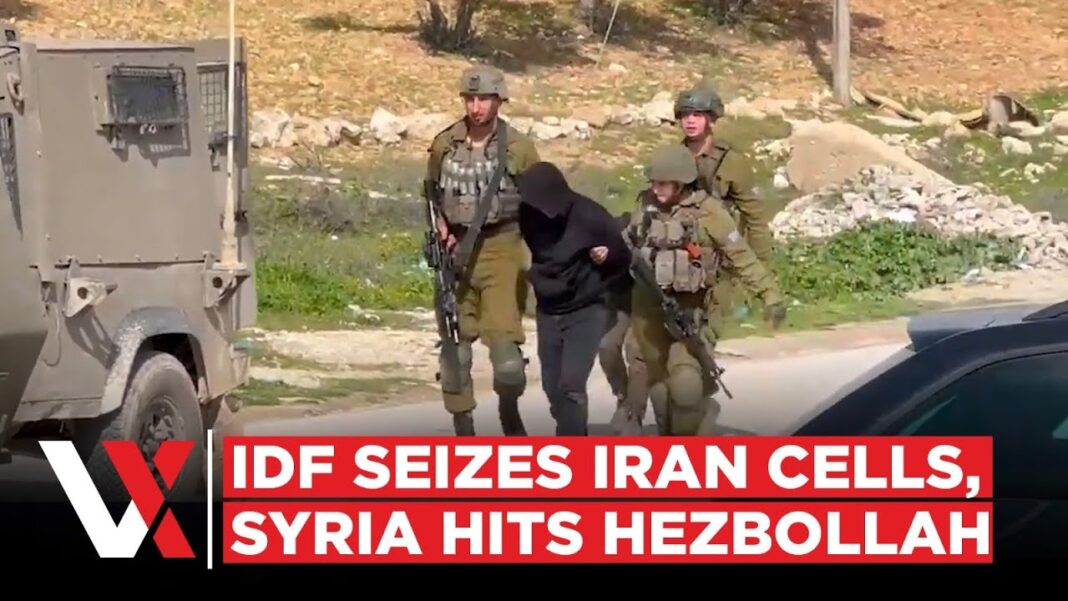
In a series of targeted operations across Syria and Lebanon, the Israel Defense Forces (IDF) have intensified their campaign against Iran’s Islamic Revolutionary Guard Corps (IRGC) and its regional affiliates, dismantling covert terror networks and neutralizing senior operatives. As Tazpit News Service (TPS) reported on Saturday, Israeli military officials confirmed that over the past several months, security forces detained multiple suspects in southern Syria believed to be working under the direction of Unit 840, a clandestine branch of the IRGC’s Quds Force dedicated to plotting attacks on Israeli targets.
The arrests, coupled with precision strikes on IRGC-linked figures in Lebanon, mark another escalation in the shadow war Israel has long fought against Iran’s entrenchment along its northern frontier. The IDF’s actions reflect a dual strategy: disrupting weapons smuggling networks and eliminating the operatives who serve as linchpins in Tehran’s campaign to destabilize the region.
According to IDF officials cited by Tazpit News Service (TPS), two operatives of Unit 840 — identified as Zeidan al-Tawil and Muhammad al-Kuryan — were apprehended in Syria in March and April of this year. Both men were accused of working on covert missions to establish terror cells tasked with preparing attacks inside Israel.
The IDF emphasized that these arrests were part of a broader campaign to dismantle Unit 840’s infrastructure in Syria. The unit, which operates under the IRGC’s elite Quds Force, specializes in organizing sabotage and assassination operations beyond Iran’s borders. Its activities, Israeli intelligence believes, are not only directed at Israel but are also part of Tehran’s wider ambition to expand its influence across the Levant.
In the weeks that followed, Israeli raids uncovered further terror cells activated by two senior IRGC figures: Salah al-Husseini and Muhammad Shuayb. Both men, described by the IDF as “among the most prominent operatives” involved in weapons trafficking, were killed in Israeli airstrikes in Lebanon in July. Their deaths, reported extensively by Tazpit News Service (TPS), dealt a significant blow to Iran’s logistical pipeline, which funnels arms into Lebanon, Syria, and Judea and Samaria.
One of the more striking revelations from the IDF’s interrogations, according to the information provided in the TPS report, was that many of the detained Syrians had no clear understanding of who was directing them. Rather than openly declaring their allegiance to the IRGC or Hezbollah, the recruiters often concealed their true affiliations.
“Their recruitment to work with Unit 840 was in many cases done without revealing the unit’s true motives, but rather through financial bribery,” the IDF stated. This tactic reflects Iran’s growing reliance on exploiting economic desperation in war-torn Syria, where local recruits may be lured into clandestine activity without realizing the geopolitical stakes.
The arrests also come against the backdrop of Israel’s continued military presence in the 235-square-kilometer buffer zone along the Golan Heights. Following the collapse of order in parts of Syria after Bashar Assad’s regime faltered in December, Israel deployed forces into the zone to prevent militant groups from approaching its borders.
As the TPS report noted, Israeli officials now consider the 1974 ceasefire agreement, which established the buffer zone following the Yom Kippur War, void until a functioning authority is restored in Damascus. This stance underscores Israel’s determination to act unilaterally when it perceives direct threats from Iranian-backed operatives exploiting Syria’s instability.
While arrests in Syria have disrupted Unit 840’s activities, Israeli airstrikes in Lebanon have aimed higher up the chain of command. On Thursday, the IDF confirmed the killing of Wasim Saeed Jaba‘i, a senior figure in the IRGC’s Imam Hossein Division who also operated in close coordination with Hezbollah.
Jaba‘i’s death, covered by TPS, was portrayed by the IDF as a necessary step to degrade Iran’s long-term force buildup in Lebanon. According to the military, Jaba‘i was instrumental in weapons procurement, missile and rocket attacks against Israel, and in rehabilitating the Imam Hossein Division’s infrastructure after last year’s ceasefire.
“The terrorist was a central figure in the force-buildup efforts and strengthening of the division, advanced weapons procurement deals, [and] assisted in launching missile and rocket attacks against the State of Israel,” the IDF said in a statement. His activities, Israeli officials stressed, were in direct violation of understandings designed to maintain stability along the Israel-Lebanon frontier.
The elimination of Jaba‘i and the arrests in Syria highlight the interwoven nature of Iran’s militant apparatus. The Quds Force — the IRGC’s external operations wing — leverages regional proxies, including Hezbollah and various Shiite militias, to advance Tehran’s agenda of encircling Israel with hostile forces.
As TPS has analyzed, Unit 840 functions as the covert spearhead of these operations, tasked with cultivating sleeper cells and clandestine networks that can be activated in times of conflict. Meanwhile, divisions like Imam Hossein in Lebanon serve as more overt military formations, buttressed by Hezbollah’s political and logistical framework.
This dual-track approach allows Iran to apply pressure on Israel both through shadowy, deniable operations and through larger-scale military confrontations. Israel’s recent strikes, therefore, are not isolated actions but part of a broader campaign to dismantle both the visible and invisible layers of this network.
The IDF’s operations against Iranian proxies also intersect with wider diplomatic tensions. As TPS previously reported, Israel issued stern warnings to Qatar after strikes targeting Hamas leaders in Doha earlier this summer. Jerusalem has made clear that states offering sanctuary or logistical support to Iran’s partners will themselves be viewed as complicit.
By targeting operatives in Syria and Lebanon while pressuring Qatar diplomatically, Israel is signaling that it intends to disrupt the entire Iranian network, from covert cells on the ground to the capitals that shelter its leaders.
Despite shifting regional alliances and the turbulence of ongoing conflict, Israeli officials have reiterated that their policy remains firm: to prevent Iran from entrenching itself along Israel’s borders and to deny its proxies the capacity to threaten Israeli citizens.
“The IDF will continue to operate in order to remove any threat posed to the State of Israel,” the military emphasized following Jaba‘i’s death. This statement, carried by TPS, reflects Israel’s enduring commitment to the Begin Doctrine — the principle that the Jewish state will act preemptively to neutralize existential threats before they materialize.
The recent arrests in Syria and targeted strikes in Lebanon underscore the persistence of Israel’s campaign against the IRGC and its affiliates. As TPS has carefully documented, these operations reveal both the extent of Iran’s entrenchment in the region and the lengths to which Israel is prepared to go to dismantle it.
For Israeli policymakers, the stakes are existential. The presence of IRGC operatives only a short distance from Israeli communities is unacceptable, while the continued flow of advanced weaponry into Lebanon threatens to tip the balance of power in future conflicts.
The latest developments serve as a reminder that the Israel-Iran confrontation is not confined to the diplomatic stage or battlefield skirmishes in Gaza. It is a long war in the shadows — a contest of intelligence, logistics, and precision strikes, waged across borders and often out of sight. And as the TPS report highlighted, Israel has made its position unmistakably clear: the Jewish state will not wait passively for threats to mature but will confront them wherever they arise.